Insights
ADA Requirements for Office Space in Texas: What Every Business Must Know Before Build-Out
May 29, 2026
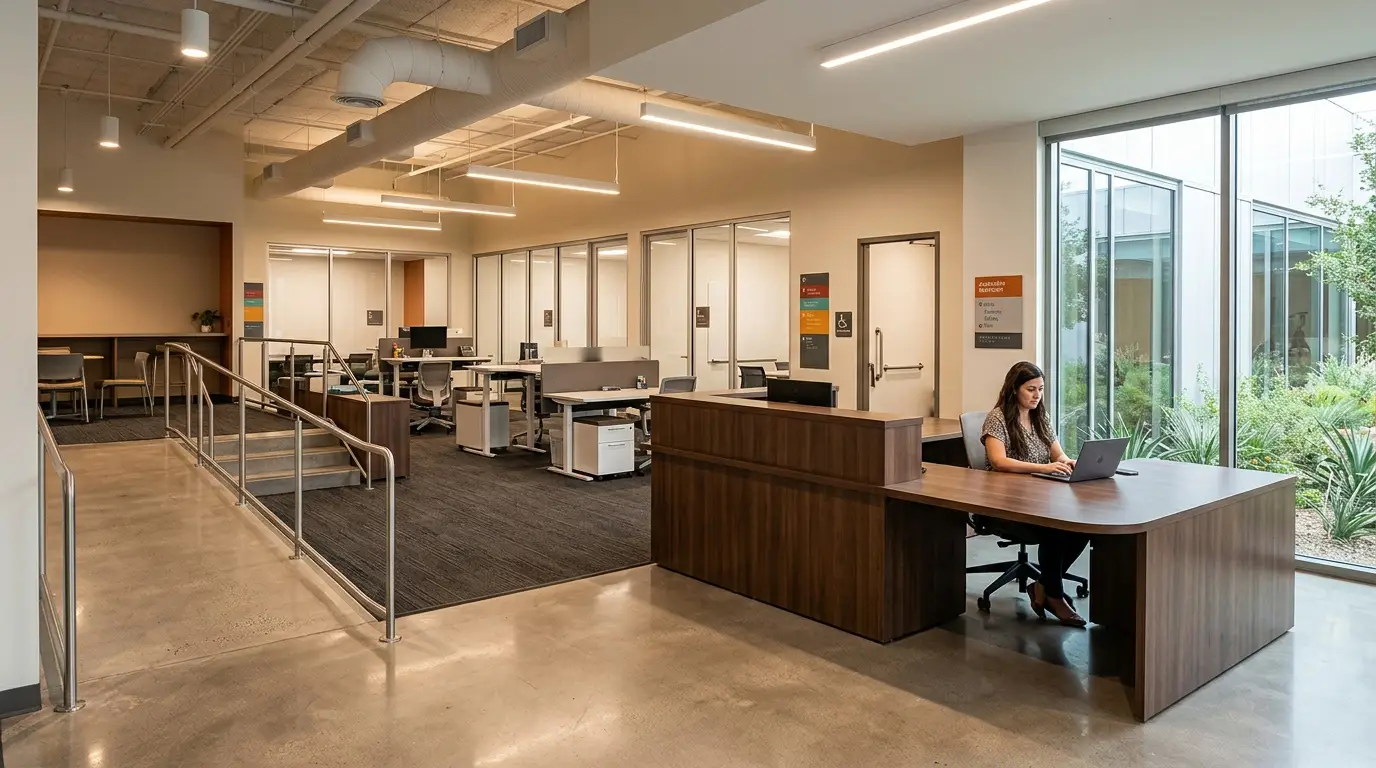
ADA compliance in a Texas office space is not a single standard. It is two overlapping standards (the federal 2010 ADA Standards and the Texas Accessibility Standards) plus a state-mandated review process for projects over 50,000 dollars. Get any part of it wrong and you face the choice between expensive corrections after construction, a failed certificate of occupancy inspection, or a private lawsuit under the ADA. This guide gives you the actual dimensions, fixture counts, route requirements, and process steps you need to plan an ADA-compliant office buildout in Texas in 2026.
Quick Answer: Texas office buildouts with construction costs above 50,000 dollars must comply with the Texas Accessibility Standards (TAS) and undergo a Registered Accessibility Specialist (RAS) review. Key requirements include 32 inch minimum clear door openings, 60 inch turning radius in accessible spaces, an accessible parking ratio of 1 space per 25 standard spaces, at least one accessible restroom per floor with grab bars and 60 inch turning radius, accessible reception counters with a lowered section 28 to 34 inches high, and tactile/braille signage at all permanent room entries. RAS plan review fees average 175 dollars per project plus per-square-foot inspection fees.
ADA 2010 vs. Texas Accessibility Standards
The federal ADA 2010 Standards and the Texas Accessibility Standards (TAS) cover the same subject matter but are not identical documents. TAS is the state-adopted accessibility standard administered by the Texas Department of Licensing and Regulation (TDLR). For Texas commercial projects, TAS compliance is the operational requirement: federal ADA enforcement applies separately as a civil rights statute, but TDLR is the agency that reviews and inspects Texas projects.
| Issue | 2010 ADA Standards | Texas TAS |
|---|---|---|
| Enforcement agency | US Department of Justice (civil rights complaints) | Texas Department of Licensing and Regulation (state law) |
| Plan review trigger | None (federal standard applies regardless) | Construction cost above 50,000 dollars |
| Required reviewer | No state-licensed reviewer | Registered Accessibility Specialist (RAS) |
| Inspection | None pre-occupancy | Required RAS inspection before CO |
| Penalty for non-compliance | Civil suit, settlement, mandatory remediation | TDLR administrative penalty plus required remediation |
The two standards align on the substantive technical requirements (door widths, turning radii, fixture clearances, signage). The differences are primarily procedural: TAS adds the RAS plan review and inspection process that federal ADA does not require. For practical purposes, a Texas office project that passes TAS review is also ADA-compliant on the technical specifications.
The 50,000 dollar threshold for RAS review is calculated on the total construction cost, including labor, materials, and fixed equipment. Soft costs like design fees, permits, and FF&E are not included. Most office buildouts above 500 to 800 square feet cross the 50,000 dollar threshold and trigger RAS review.
RAS Review Process and Cost
The Registered Accessibility Specialist (RAS) review is a two-phase process: a plan review during design and an inspection after construction. The RAS is a private professional registered with TDLR, not a state employee. The project owner selects and pays the RAS directly. Plan review fees are set by TDLR and inspection fees vary by project size.
| RAS Process Step | Timing | Typical Cost |
|---|---|---|
| RAS plan review (submission) | During permit application | 175 dollars per project (TDLR fee) |
| RAS plan review (professional fee) | 1 to 3 weeks for review | 500 to 1,500 dollars depending on project size |
| Construction | Per project schedule | N/A |
| RAS inspection (pre-CO) | After substantial completion | 500 to 1,500 dollars depending on project size |
| RAS inspection (TDLR fee) | Filed with inspection | Sliding scale based on square footage |
The total cost of TAS compliance review for a typical 3,000 to 10,000 square foot office buildout in Texas is 1,500 to 3,500 dollars. This is not optional for projects above the 50,000 dollar threshold. Failing to submit for RAS review when required results in TDLR administrative penalties plus the cost of the review and any remediation work.
Submit the RAS plan review at the same time as the city building permit. The RAS review runs in parallel with the city plan review and typically takes 1 to 3 weeks. If the RAS identifies non-compliance during plan review, correct the drawings before construction begins. Identifying non-compliance during the final inspection is dramatically more expensive than catching it on the drawings.
For Texas office buildouts, the 1,500 to 3,500 dollar cost of RAS compliance is the cheapest insurance on the project. The cost of remediation work after the CO inspection fails is typically 10 to 50 times higher, plus the delay cost of holding the space without occupancy.
Doors, Routes, and Clearances
Door widths and route clearances are where most office buildout corrections happen. The numbers are specific and consistent across the standard, but field measurements often miss the difference between nominal door size and clear opening dimension.
| Element | Minimum Requirement | Common Mistake |
|---|---|---|
| Door clear opening | 32 inches at 90 degrees open | Using a 32 inch door frame; clear opening becomes 30 to 31 inches |
| Door hardware | Lever or push handle, 34 to 48 inches above finished floor | Round knobs at any height (non-compliant) |
| Accessible route width | 36 inches minimum (preferred 44 inches) | Furniture or storage encroaching on route |
| Turning radius | 60 inch diameter clear circle in accessible spaces | Furniture preventing the turn |
| Maneuvering clearance at door | 18 to 24 inches on push side, 12 to 24 on pull side | Walls or counters within the maneuvering area |
| Door threshold height | 1/2 inch maximum | Existing thresholds at 3/4 inch or higher |
The 32 inch clear opening requirement is measured with the door at 90 degrees open, between the door face and the door stop. A 32 inch nominal door frame typically yields a 30 to 31 inch clear opening once the door slab thickness and hardware are accounted for. For new construction, specify a 34 or 36 inch door slab to achieve the 32 inch clear opening reliably.
Routes through office space must remain 36 inches wide and clear of obstructions. The most common compliance failure is a workstation, copier, or storage cabinet placed during furniture installation that reduces the route width below 36 inches. This is corrected after CO and remains the responsibility of the tenant throughout occupancy.
For professional office layout planning, route width and furniture placement should be coordinated during design rather than left to the furniture installer or office manager.
Restroom Requirements
Office restroom requirements are the most detailed area of accessibility compliance. The standard governs fixture count, clearances, grab bar placement, mirror height, and lavatory clearances. Every dimension is specific and verifiable during inspection.
| Restroom Element | Requirement |
|---|---|
| At least one accessible restroom per sex | Per floor in multi-floor occupancy |
| Single-occupancy accessible restroom (alternative) | 60 inch turning radius, accessible fixtures, lockable door |
| Accessible stall clear floor space | 60 inches wide by 56 inches deep minimum |
| Toilet centerline from wall | 16 to 18 inches |
| Toilet seat height | 17 to 19 inches above finished floor |
| Side grab bar | 42 inches long, 33 to 36 inches above finished floor |
| Rear grab bar | 36 inches long, 33 to 36 inches above finished floor |
| Lavatory clear floor space | 30 by 48 inches |
| Lavatory knee clearance | 27 inches high, 30 inches wide, 11 inches deep minimum |
| Mirror bottom edge | 40 inches maximum above finished floor |
| Soap and towel dispenser reach | 48 inches maximum to operable parts |
Multi-stall restrooms must include at least one accessible stall, and many newer Texas projects also include an ambulatory accessible stall (a smaller stall with grab bars on both sides, designed for users who can walk but need stability support). The ambulatory stall is required in restrooms with six or more fixtures.
The most common restroom non-compliance items in Texas office projects are mirror height (often installed at 42 to 44 inches instead of 40 inches maximum), grab bar height (often installed at 32 inches instead of the required 33 to 36 inch range), and soap dispenser placement (often above the 48 inch reach limit when mounted on the wall above the lavatory).
Parking and Building Entry
Accessible parking is calculated based on the total parking ratio in the lot, not just the office tenant’s allocation. The ratio is 1 accessible space per 25 standard spaces, with at least one of the accessible spaces being van-accessible (8 foot loading aisle on the passenger side).
| Total Parking Spaces | Minimum Accessible Spaces | Van-Accessible Required |
|---|---|---|
| 1 to 25 | 1 | 1 (the required accessible space must be van-accessible) |
| 26 to 50 | 2 | 1 |
| 51 to 75 | 3 | 1 |
| 76 to 100 | 4 | 1 |
| 101 to 150 | 5 | 1 |
| 151 to 200 | 6 | 1 |
Accessible parking spaces must be located on the shortest accessible route to the building entrance. Accessible route from the parking space to the building entry must have a maximum slope of 1:20 (5%) without handrails, or 1:12 (8.33%) with handrails if a ramp is required. Cross-slope of the accessible route must not exceed 1:48 (2%).
The path from accessible parking to the building entry is the responsibility of the building owner, not the office tenant. However, if the tenant identifies non-compliance during the buildout review, the tenant should document it and request landlord remediation under the lease before opening. Operating in a space with non-compliant parking exposes the tenant to liability that the lease may or may not allocate to the landlord.
Signage and Wayfinding
Signage requirements for accessible offices cover three categories: directional signage (visual contrast and character height), permanent room identification (tactile and braille), and informational signage (visual and audible alarms, evacuation routes).
- Permanent room identification: Tactile characters (raised 1/32 inch minimum) and grade 2 braille. Mount centerline 60 inches above finished floor, on the wall to the latch side of the door, 18 inches from the door frame
- Directional signage: Character height proportional to viewing distance; minimum 5/8 inch for signs viewed within 6 feet, 2 inches for signs viewed at 40 feet
- Visual contrast: 70% minimum contrast between characters and background
- Reflectivity: Non-glare finish on tactile signage
Signage non-compliance is one of the most common findings in RAS inspection. Office buildouts frequently install signage during the final week before opening, and the installers may not know the placement requirements (latch side of door, 60 inch centerline) or the character requirements (tactile plus braille). Specify the signage during the design phase, not during the move-in phase.
What We See in Texas Office Projects
The most common ADA enforcement trend in Texas office space is the ADA private lawsuit, often filed by serial plaintiffs who target retail and office tenants based on photographic evidence of non-compliance gathered during a single visit. The most frequently cited issues in these lawsuits are accessible parking (improper striping, missing van-accessible signage), exterior route slopes (cross-slope exceeding 2%), restroom mirror and grab bar heights, and door hardware (round knobs instead of levers).
The second pattern we see is non-compliance discovered during a tenant change. The original tenant occupied the space under TAS compliance from a prior buildout, but elements have been modified or replaced over time (mirrors swapped, signage updated, hardware changed). A new tenant who modifies the space triggers the RAS review again, and the review identifies the accumulated non-compliance items. The new tenant inherits the remediation cost unless the lease allocates it to the landlord.
The third issue is RAS submission timing. Architects and owners often submit the city building permit application first and only submit the RAS plan review after the city issues comments. This sequence adds 2 to 3 weeks to the overall schedule because the RAS review then runs after the city review instead of in parallel. Commercial buildout planning in Texas benefits from submitting both reviews simultaneously to compress the permitting phase by 2 to 3 weeks.
For office tenants planning a tenant improvement buildout, the highest-impact accessibility decisions are made before the permit application: door size specification, restroom layout, route widths, and signage placement. Catching non-compliance on the drawings is a 200 dollar correction. Catching it after construction is a 2,000 to 20,000 dollar correction.
Texas Office TAS Compliance Cost Summary: RAS plan review TDLR fee 175 dollars. RAS professional fees (plan review and inspection combined) 1,000 to 3,000 dollars. Common construction items: tactile/braille signage 60 to 120 dollars per door, accessible door hardware upgrade 150 to 300 dollars per door, restroom grab bar installation 200 to 400 dollars per restroom, accessible parking restriping and signage 500 to 1,500 dollars per lot. Total typical compliance cost for a 5,000 square foot office: 2,500 to 5,000 dollars.
Key Takeaways
- Texas office buildouts above 50,000 dollars in construction cost require Registered Accessibility Specialist (RAS) plan review and inspection
- TDLR plan review fee is 175 dollars per project; total RAS compliance cost typically 1,500 to 3,500 dollars
- Door clear opening must be 32 inches minimum at 90 degrees open; specify a 34 to 36 inch door slab to achieve reliably
- Accessible spaces require a 60 inch diameter clear turning radius
- Accessible parking ratio is 1 space per 25 standard spaces; first accessible space must be van-accessible
- Submit RAS plan review in parallel with city building permit application to save 2 to 3 weeks on the schedule
- Mirror bottom edge maximum 40 inches above finished floor; this is the most commonly missed restroom item
- Tactile and braille signage required at all permanent room entries, mounted at 60 inch centerline on the latch side of the door
Frequently Asked Questions
What is the minimum door width for an accessible office?
The minimum clear door opening for an accessible office is 32 inches, measured with the door at 90 degrees open between the door face and the door stop. A 32 inch nominal door frame typically yields only a 30 to 31 inch clear opening once the door slab thickness and hardware are accounted for. For new construction, specify a 34 or 36 inch door slab to achieve the 32 inch clear opening reliably. Door hardware must be lever-style or push-style, mounted 34 to 48 inches above the finished floor.
Do I need a Registered Accessibility Specialist for my office buildout in Texas?
Yes, if the total construction cost is above 50,000 dollars. The Texas Accessibility Standards (TAS) require a Registered Accessibility Specialist (RAS) plan review during permit application and a RAS inspection after construction before the certificate of occupancy is issued. The TDLR plan review fee is 175 dollars per project, and total RAS professional fees typically run 1,000 to 3,000 dollars for plan review and inspection combined. Most office buildouts above 500 to 800 square feet cross the 50,000 dollar threshold.
How many accessible parking spaces does an office building need?
The accessible parking ratio is 1 space per 25 standard parking spaces. A lot with 1 to 25 spaces needs 1 accessible space (which must be van-accessible). 26 to 50 spaces need 2 accessible spaces with 1 van-accessible. 51 to 75 spaces need 3 accessible spaces, and so on. Accessible parking must be located on the shortest accessible route to the building entrance, with maximum slope of 1:20 without handrails and cross-slope not exceeding 1:48 (2%). Van-accessible spaces require an 8 foot loading aisle on the passenger side.
What are the most common ADA violations in Texas offices?
The most common ADA and TAS violations in Texas office space are restroom mirror height (installed at 42 to 44 inches instead of 40 inches maximum), grab bar height (installed at 32 inches instead of the required 33 to 36 inch range), door hardware (round knobs instead of levers), accessible parking striping and van-accessible signage, exterior route cross-slope exceeding 2%, signage not installed at the required 60 inch centerline on the latch side of the door, and accessible routes obstructed by furniture or storage placed after CO. Most violations are corrected during RAS inspection and remediation costs 200 to 2,000 dollars per item depending on the work required.
When should I submit RAS plan review for my Texas office project?
Submit the RAS plan review at the same time as the city building permit application. The two reviews run in parallel, and the RAS review typically takes 1 to 3 weeks. Submitting RAS only after the city issues plan comments adds 2 to 3 weeks to the overall schedule. If the RAS identifies non-compliance during plan review, the drawings can be corrected before construction begins, which is dramatically cheaper than correcting non-compliance after construction. The RAS inspection happens after substantial completion and before the certificate of occupancy is issued.
Planning an ADA-Compliant Office Buildout in Texas?
Prestige 360 Design specializes in commercial office design and TAS compliance coordination across San Antonio, Austin, Dallas-Fort Worth, and Houston. We coordinate RAS plan review, accessibility-conscious design, and inspection-ready documentation to keep your project on schedule and compliant.
About the Author
Hugo Ramirez is the founder of Prestige 360 Design, a commercial interior design firm serving Texas businesses. With expertise in office buildout planning and Texas accessibility compliance, Hugo has helped business owners and property managers across Texas navigate TAS requirements, RAS review coordination, and code-compliant office layout.