Insights
Commercial Landscaping Planning Guide
July 26, 2026
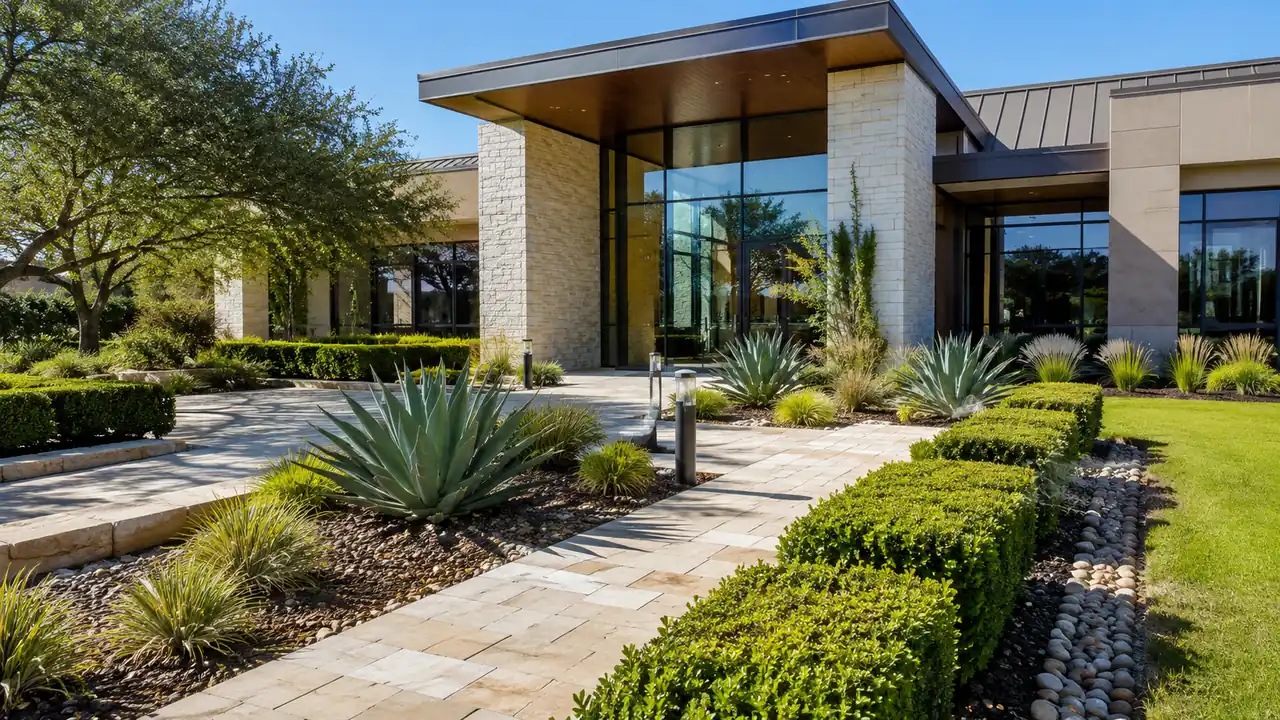
Commercial landscaping affects a business's curb appeal, customer first impression, and, in many cases, its liability exposure and property value over time. This guide covers what any commercial property owner nationally needs to know about planning, installing, and maintaining landscaping for a commercial space, from initial design planning during a new buildout through ongoing maintenance contract management.
Quick Answer: Commercial landscaping should be planned alongside site and building design, not added as an afterthought once construction is otherwise complete. Key decisions include plant selection matched to local climate, irrigation system design, hardscaping integration, and how maintenance responsibilities will be structured and contracted going forward. A well-planned commercial landscape balances upfront installation cost against long-term maintenance and water cost, with climate-appropriate plant selection being the single highest-leverage decision in that long-term cost equation.
Planning Landscaping Alongside Construction
The scope of "commercial landscaping" varies considerably depending on business type and property use, from a small foundation planting bed around a single-tenant retail entrance to an extensive, multi-acre corporate campus landscape with water features, extensive walking paths, and elaborate seasonal planting programs. Regardless of scale, the underlying planning principle stays consistent: landscaping decisions made in isolation from the broader site and building plan tend to produce a compromised result, while landscaping planned as an integrated part of the overall project tends to both function and look better while often costing less over the property's full lifecycle.
Commercial landscaping is frequently treated as a final, almost decorative step added after a building's construction is otherwise complete, when in reality several landscaping-related decisions, grading and drainage planning, irrigation main line routing, and hardscaping integration with walkways and parking, are far more efficiently handled as part of the original site and construction planning than retrofitted afterward. A landscape architect or designer brought into the planning process early, alongside the architect and general contractor, can identify opportunities to route irrigation lines during initial site utility work and coordinate grading to support both proper drainage and healthy plant growth from the start.
Retrofitting landscaping and irrigation infrastructure after paving, building construction, and site grading are already complete is possible but generally more expensive and more constrained by decisions already locked in during construction, sometimes resulting in a landscape design compromised by drainage patterns or utility placement that were never designed with landscaping needs in mind. Business owners planning a new commercial buildout should raise landscaping planning explicitly during early design conversations rather than assuming it will be addressed adequately once construction is otherwise finished, since a designer brought in after grading and utility placement are already locked in has far fewer genuine options to work with regardless of skill or budget.
Plant Selection Fundamentals
Plant selection is the single highest-leverage decision in commercial landscape planning, directly affecting both installation cost and, more significantly, long-term maintenance and water cost over the life of the property. Selecting plant species genuinely well-suited to the local climate zone, rather than species chosen primarily for aesthetic appeal without regard to climate fit, reduces water requirements, reduces the frequency of plant replacement due to stress or death, and reduces the intensity of ongoing maintenance needed to keep the landscape looking presentable.
A well-designed commercial plant palette typically layers several categories: structural or anchor plants, often trees or larger shrubs providing the landscape's basic form; mid-size shrubs and groundcover providing texture and fill; and, where budget allows, a smaller category of seasonal color plants providing changing visual interest at high-visibility points like a building entrance. Concentrating higher-maintenance seasonal color plants in a limited, high-visibility area while using lower-maintenance, climate-adapted species for the bulk of the landscape is a common and effective cost-management strategy that still delivers meaningful visual impact where it matters most.
Irrigation System Design
An irrigation system should be designed as an integrated part of the landscape plan, not selected generically after plant selection is already finalized, since different plant types and zones within a property often have genuinely different water needs that a single, uniform irrigation zone cannot serve well. Drip irrigation, delivering water directly to a plant's root zone rather than broadcasting it across an entire area, is generally more water-efficient for planting beds than overhead spray irrigation, while turf areas typically still require a spray-based system suited to covering broader open areas evenly.
Smart irrigation controllers, which adjust watering schedules automatically based on weather data, soil moisture sensors, or both, have become increasingly standard on commercial installations because they reduce water waste and often pay for themselves over a period of a few years through reduced water utility costs, particularly in a climate with meaningful seasonal variation in rainfall and heat. Confirming a proposed irrigation design accounts for any local water utility restrictions on watering days or times, which many municipalities maintain, especially during drought periods, is a practical planning step that avoids designing a system around an assumption of unrestricted watering access.
Hardscaping and Site Features
Hardscaping, the non-plant structural elements of a landscape design, walkways, retaining walls, decorative paving, seating areas, and similar features, plays a significant role in a commercial property's overall look and functional usability, and it should be planned in coordination with plant selection rather than as an entirely separate design exercise. A well-integrated hardscape design considers pedestrian flow patterns to and from building entrances, parking areas, and any outdoor seating or gathering space, ensuring the landscape supports how people actually move through the property rather than existing purely as a decorative backdrop.
Material selection for hardscaping elements should account for the local climate and expected maintenance capacity, since some materials, natural stone paving for example, offer a premium appearance but require more specialized and costly maintenance and repair over time than a more standardized concrete or engineered paver system. A property owner should weigh the upfront aesthetic appeal of a premium hardscape material against its realistic long-term maintenance demands, particularly for a property where landscaping maintenance is contracted out rather than handled by in-house staff familiar with a specific specialized material's care requirements.
ADA and Accessibility Considerations
Commercial landscaping design must account for accessibility requirements under the Americans with Disabilities Act, particularly around walkway width, surface material and slope, and clear path requirements connecting parking areas, building entrances, and any outdoor amenity spaces. A landscape design that looks visually appealing on paper can still fail practical accessibility standards if walkway width narrows below required minimums at a planting bed edge, or if a decorative surface material creates an uneven or slip-prone walking surface that does not meet accessibility standards, a gap that is far easier and cheaper to catch during design review than after installation is already complete.
Coordinating landscape design accessibility review with the same architect or design-build team handling the building's own ADA compliance, rather than treating landscaping accessibility as a separate, later-stage check, produces a more genuinely integrated and compliant result. This coordination matters particularly at transition points, where a parking area meets a walkway, or where a walkway meets a building entrance, since these transition zones are common places where accessibility requirements are inadvertently overlooked during design.
Structuring a Maintenance Contract
Deciding between an in-house landscaping crew and an outsourced maintenance contract is worth evaluating explicitly for a larger commercial property or a business with multiple locations, since the calculation shifts meaningfully with scale. A single-property business almost always finds outsourcing more cost-effective, since maintaining dedicated equipment and staff for a single site rarely achieves the efficiency a specialized landscaping company achieves across many client properties. A larger multi-location business or a property with unusually extensive or specialized landscaping may find an in-house team, or a hybrid model combining in-house staff with outsourced specialty services like tree care, more cost-effective at sufficient scale, though this crossover point varies considerably by property type, region, and the local availability of specialized commercial landscaping vendors.
A commercial landscaping maintenance contract should specify exact scope in writing: mowing and edging frequency, pruning and trimming schedule, irrigation system inspection frequency, fertilization and pest management approach, and seasonal cleanup responsibilities. A vague scope, relying on general language like "regular maintenance" without specifying frequency and exact included services, invites disputes later about whether a specific service was included in the base contract price.
Contract length and renewal terms are worth negotiating explicitly as well. Many commercial landscaping contracts run on an annual basis with automatic renewal unless canceled within a specified notice window, and understanding this renewal and cancellation structure before signing avoids an unwanted automatic renewal that locks a property into another full year with a provider the owner intended to switch away from. Requesting quarterly or semi-annual performance reviews built into the contract, rather than only interacting with the landscaping provider reactively when a problem arises, helps maintain service quality consistency over a multi-year relationship.
Seasonal Management Approach
Commercial landscaping needs shift meaningfully across seasons in most climate zones, and a maintenance approach that adjusts service frequency and focus seasonally, rather than applying identical service every month year-round, both better serves the landscape's actual needs and can represent a genuine cost efficiency. Peak growing season typically demands more frequent mowing and trimming, while cooler or dormant periods shift focus toward structural pruning, fertilization timed to support root development, and preparation for the next growing cycle.
A maintenance provider genuinely experienced with commercial properties in a specific region will typically propose this kind of seasonally adjusted service schedule proactively rather than defaulting to a flat, undifferentiated monthly scope regardless of season, and a business evaluating competing maintenance bids should ask directly how each provider's proposed schedule adjusts across the year as one useful signal of genuine regional landscaping expertise versus a more generic, less locally tailored service approach.
Landscaping ROI and Property Value
Sustainability certifications relevant to commercial real estate, such as LEED, increasingly include landscape-specific credit categories covering water efficiency, native plant use, and stormwater management, and a business pursuing this kind of certification for marketing, tenant attraction, or corporate sustainability goals should factor these specific credit requirements into landscape design decisions from the outset rather than retrofitting a design to meet certification requirements after the fact, since some credits depend on decisions made before a single plant goes into the ground.
Well-maintained commercial landscaping delivers a measurable return through improved curb appeal and first impression, a factor that studies on commercial property leasing and retail foot traffic have consistently linked to customer perception and, in some retail contexts, to actual purchasing behavior. Beyond the customer-facing impact, quality landscaping maintenance also protects the underlying property value by preventing the kind of deferred maintenance issues, overgrown vegetation obscuring signage or sightlines, drainage problems caused by neglected grading, that can become expensive to correct once significantly deteriorated.
For a business owner evaluating whether to invest in a more elaborate landscape design versus a purely functional, minimal approach, weighing the upfront and ongoing cost difference against the realistic impact on customer perception and property value for that specific business type and location is a more useful and durable framework than treating landscaping purely as a discretionary cosmetic expense with no bearing on the bottom line. A restaurant or retail business relying heavily on walk-in customer traffic and first impression generally benefits more from landscaping investment than a warehouse or light-industrial property where landscaping's practical impact on the business's core day-to-day operations is comparatively more limited.
Stormwater Management and Drainage
Commercial properties, particularly those with substantial paved parking and building footprint relative to permeable landscaped area, generate significant stormwater runoff during rain events, and how a site's landscape design handles that runoff has real implications for both regulatory compliance and the long-term health of the landscape itself. Many municipalities impose stormwater management requirements on commercial development, sometimes requiring detention or retention features designed to slow runoff release into the municipal storm system, and landscape design is frequently integrated with these requirements through features like bioswales, rain gardens, or strategically graded planting areas that both manage water and serve a genuine aesthetic function.
Poor drainage planning around a commercial landscape does not just create a regulatory compliance problem; it directly threatens plant health, since standing water or persistently saturated soil around plant root zones is one of the most common causes of plant failure in commercial landscaping, often misdiagnosed as a watering or plant selection problem when the underlying issue is actually inadequate site drainage. A landscape designer coordinating closely with the civil engineer handling a site's stormwater plan, rather than treating grading and drainage as purely an engineering concern separate from landscape design, produces a result that satisfies both regulatory requirements and long-term plant health simultaneously.
Permeable paving materials, which allow water to filter through rather than running off entirely, are an increasingly common tool in commercial landscape and hardscape design specifically to help manage stormwater volume while still providing a functional walking or parking surface. These materials typically cost more upfront than standard impermeable paving and require some specific maintenance considerations to prevent pore-clogging over time, but they can meaningfully reduce the size and cost of separate detention infrastructure required elsewhere on a site, making them worth evaluating as part of an integrated site and landscape design rather than dismissing purely on upfront material cost, particularly on a site where stormwater detention requirements would otherwise consume valuable buildable or landscaped area.
Selecting a Commercial Landscaping Contractor
Selecting a commercial landscaping contractor, whether for a one-time installation project or an ongoing maintenance relationship, should involve verifying genuine commercial property experience specifically, not just general landscaping experience that may be primarily residential in nature. Commercial properties carry different liability, scheduling, and scale considerations than residential lawns, and a contractor whose crew and equipment are sized and trained for residential work may struggle to deliver consistent quality on a larger commercial property with a compressed service window around business hours.
Requesting references specifically from other commercial properties of comparable size and complexity, and following up with those references directly rather than accepting a written testimonial at face value, is the most reliable diligence step available to a business evaluating a landscaping contractor for the first time. Asking a prospective contractor how they handle an unexpected issue, an irrigation break discovered mid-week, a plant that unexpectedly dies, reveals whether they have an established communication and correction process or a more reactive, ad hoc approach that tends to produce longer resolution times and more owner frustration when something inevitably goes wrong on an active commercial property.
Insurance verification is a non-negotiable step in commercial contractor selection: a landscaping company working on a commercial property should carry general liability insurance sufficient to cover potential injury or property damage claims, and a property owner should request a certificate of insurance directly, confirming it with the carrier itself when the project's stakes warrant that extra step, rather than simply taking a contractor's verbal assurance of coverage. For any project involving larger equipment, tree removal, or hardscaping installation with heavier machinery, confirming the contractor's equipment operators carry appropriate training and certification is an additional, worthwhile diligence step before work begins on an active commercial property, and a contractor genuinely confident in their crew's training will typically volunteer this information readily rather than requiring it to be pulled out through direct, pointed questioning.
Key Takeaways
- Plan landscaping alongside construction and site design, not as an afterthought once building work is complete.
- Climate-appropriate plant selection is the highest-leverage decision for long-term maintenance and water cost.
- Irrigation should be designed as part of the landscape plan, with drip and spray zones matched to actual plant needs.
- Coordinate landscaping accessibility review with the building's own ADA compliance planning, especially at transition points.
- Maintenance contracts should specify exact scope, frequency, and renewal terms in writing to allow fair comparison.
Frequently Asked Questions
When should landscaping be planned in a commercial buildout?
Alongside architectural and site design from the early planning phase, not as a final step added after construction is otherwise complete.
What is the most important factor in commercial landscape cost?
Plant selection matched to local climate is the highest-leverage decision, directly affecting both installation and long-term maintenance and water cost.
Does commercial landscaping need to meet ADA requirements?
Yes. Walkway width, surface material, and clear path requirements connecting parking, entrances, and amenity spaces must meet ADA accessibility standards.
What should a landscaping maintenance contract specify?
Exact mowing and trimming frequency, irrigation inspection schedule, fertilization approach, seasonal cleanup responsibilities, and contract renewal terms.
Planning a new commercial buildout with landscaping needs? Talk to Prestige 360 Design about coordinating landscape design with the rest of your project.
Related Services