Insights
Commercial Renovation Costs Calculator: Texas Guide (2026)
April 29, 2026
Commercial Renovation Cost Calculator: A Texas Guide
Quick answer: A commercial renovation cost calculator estimates project cost by square footage, use type, and finish level. Texas commercial renovations typically run $50 to $250 per square foot in 2026, with tenant improvements at $75 to $150, restaurant build-outs at $150 to $400, and medical or dental clinics at $200 to $500. Hidden costs commonly include permits, fixtures, and post-construction punch list work. Used as a commercial remodel cost estimator, the same per-square-foot framework applies to retail, restaurant, medical, and office remodels.
Key Takeaways
- Understand key factors impacting commercial renovation costs in the San Antonio-Austin corridor.
- Learn how to accurately estimate material, labor, and permitting expenses for your project.
- Discover common estimating mistakes and how to avoid them to stay on budget.
- Explore the benefits of using a commercial renovation cost calculator for initial project planning.
- Gain insights into the ROI of strategic commercial property repositioning and tenant improvements.
Embarking on a commercial renovation project in the dynamic San Antonio-Austin corridor? Whether you’re revitalizing a restaurant in New Braunfels, upgrading office space in San Marcos, or repositioning a retail property in Boerne, understanding the financial landscape is crucial. The costs associated with commercial renovations can vary significantly, often leading to budget overruns and project delays. Navigating this complex terrain requires a strategic approach, starting with an accurate cost estimate.
This guide provides a comprehensive overview of commercial renovation costs in the Texas Hill Country, focusing on the factors that influence pricing and offering practical strategies for effective budgeting. We’ll delve into the intricacies of material costs, labor expenses, permitting fees, and the often-overlooked soft costs that can impact your bottom line. Moreover, we’ll explore the advantages of utilizing a commercial renovation cost calculator as a valuable tool in your initial planning phase. By understanding these key elements, you can confidently move forward with your commercial renovation project, maximizing your return on investment and achieving your desired brand experience.
Specifically, we’ll cover:
What is a Commercial Renovation Cost Calculator?
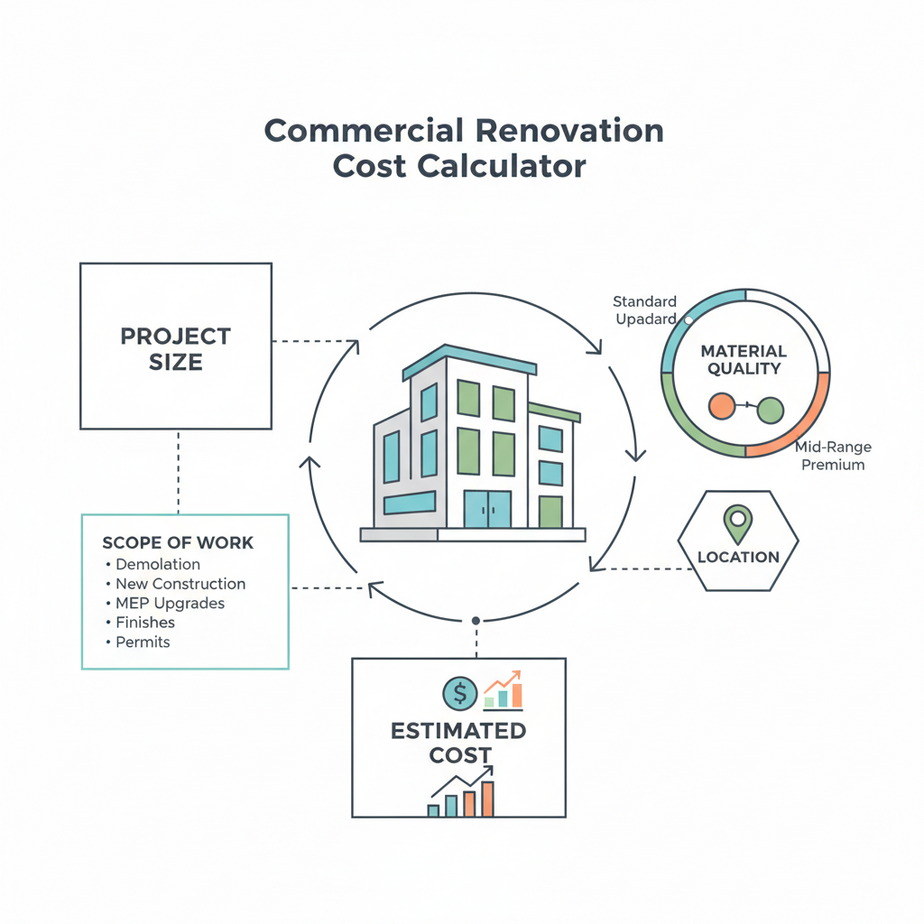
A commercial renovation cost calculator is a tool designed to estimate the expenses associated with remodeling or upgrading a commercial space. Unlike residential projects, commercial renovations often involve more complex systems, stricter regulatory compliance (including permitting), and specialized materials tailored to the specific business type. These calculators take into account various factors such as the size of the space, the scope of work (e.g., demolition, construction, electrical, plumbing, and interior finishes), material costs, labor rates, and any necessary permits or professional fees.
Think of it as a preliminary budgeting tool. While no calculator can replace a detailed quote from experienced professionals, it provides a valuable starting point for business owners, developers, and investors to understand the potential financial commitment involved in a renovation project. This allows for more informed decision-making during the initial planning stages and helps to avoid significant budget overruns down the line. The accuracy of the calculator depends heavily on the quality of the input data. Overly optimistic or inaccurate assumptions will lead to an unrealistic estimate. For instance, failing to account for regional material cost differences or underestimating labor hours can significantly skew the results.
In the commercial real estate world, understanding renovation costs is crucial for projects like tenant improvements, property repositioning, and adapting spaces for new businesses. Whether you’re planning a complete overhaul or a minor refresh, a cost calculator can help you determine if your vision aligns with your budget. For example, a restaurant owner considering a design overhaul needs to factor in specialized equipment, kitchen upgrades, and compliance with health codes, all of which impact the final cost. Similarly, a retail store looking to enhance its brand experience through custom fixtures and displays needs to accurately estimate these expenses to ensure a profitable investment. Prestige 360 understands the intricacies of commercial renovations, and while a calculator is a good starting point, we emphasize the importance of professional expertise to navigate the complexities involved.
Benefits of a Commercial Renovation Cost Calculator for Business Planning
Using a commercial renovation cost calculator offers numerous benefits, primarily centered around improved financial planning and risk mitigation. One of the most significant advantages is the ability to create a more realistic budget. By inputting project-specific details, businesses can generate a preliminary cost estimate, which serves as a benchmark for further discussions with contractors and design professionals. This initial estimate helps in securing financing, attracting investors, and making informed decisions about the scope of the renovation.
Furthermore, a cost calculator aids in evaluating the potential return on investment (ROI) of a renovation project. For instance, if a retail store is considering a redesign to improve customer flow and increase sales, the calculator can help estimate the cost of the renovation. This cost can then be compared against projected revenue increases to determine if the project is financially viable. Similarly, for office renovations aimed at improving employee productivity and attracting talent, the calculator helps quantify the investment needed to achieve these goals.
Another crucial benefit is the ability to compare different renovation options and prioritize features. A business might be considering several design alternatives, each with varying costs. The calculator allows for a side-by-side comparison of these options, enabling decision-makers to allocate resources effectively. This is particularly useful in tenant improvement projects, where landlords and tenants need to agree on the scope and budget of the renovation. Moreover, using a cost calculator early in the planning process can help identify potential cost-saving opportunities. For example, choosing alternative materials or adjusting the project timeline can significantly impact the overall expense. By understanding these trade-offs, businesses can optimize their renovation plans to achieve the desired outcome within their budget. Need help with space planning? Contact Prestige 360 today!
How a Commercial Renovation Cost Calculator Works: The Process
The functionality of a commercial renovation cost calculator revolves around a series of inputs and calculations designed to produce an estimated project cost. The process typically begins with defining the scope of the renovation. This involves specifying the type of work to be performed, such as demolition, construction, electrical, plumbing, HVAC, and interior finishes. Each category has associated costs that need to be estimated.
Next, the user inputs the dimensions of the space to be renovated. This is crucial as many costs are calculated on a per-square-foot basis. The calculator then prompts for details about the materials to be used. This includes flooring, wall finishes, lighting fixtures, and any specialized equipment required for the business. Material costs can vary widely depending on quality, brand, and availability, so accurate input is essential. Labor costs are another critical component. The calculator may ask for the number of workers needed, their hourly rates, and the estimated duration of the project. These figures should account for both skilled tradespeople (e.g., electricians, plumbers, carpenters) and general laborers.
Permitting and professional fees are often overlooked but can significantly impact the overall cost. The calculator should include fields for these expenses, allowing users to input estimated amounts based on local regulations and the complexity of the project. Once all the data is entered, the calculator performs the necessary calculations to generate a total estimated cost. This estimate is typically broken down by category, providing a detailed overview of where the money will be spent. It’s important to remember that the output is an estimate, not a guaranteed price. Factors such as unforeseen issues, changes in material costs, and scope creep can all affect the final expense. Therefore, it’s advisable to use the calculator as a starting point and consult with experienced contractors and designers to refine the budget. Want to learn more about our turnkey solutions? Contact us!
Commercial Renovation Cost Calculators in San Antonio & Central Texas: Local Market Insights
In the rapidly growing San Antonio-Austin corridor, including cities like Boerne, New Braunfels, and San Marcos, understanding commercial renovation costs is more critical than ever. The region’s booming economy and influx of new businesses are driving increased demand for commercial space, leading to a surge in renovation projects. A commercial renovation cost calculator is an invaluable tool for businesses looking to establish or expand their presence in this competitive market.
The San Antonio-Austin corridor presents unique advantages, including a skilled workforce, a business-friendly environment, and a strategic location. However, it also faces challenges such as rising construction costs and increased competition for resources. A cost calculator helps businesses navigate these challenges by providing a clear understanding of the financial implications of their renovation projects. It enables them to make informed decisions about budgeting, resource allocation, and project timelines. For instance, a restaurant owner planning to open a new location in Austin can use the calculator to estimate the cost of kitchen renovations, dining area upgrades, and compliance with local health codes. This information is crucial for securing financing and developing a realistic business plan. Similarly, a retail store looking to expand into San Antonio can use the calculator to assess the cost of tenant improvements, store layout redesigns, and merchandising enhancements. Retail design is a crucial part of the customer experience.
Moreover, the calculator helps businesses adapt to the evolving needs of the local market. As the San Antonio-Austin corridor continues to grow, businesses need to stay competitive by offering modern, functional, and aesthetically pleasing spaces. A cost calculator allows them to evaluate the financial feasibility of various renovation options, ensuring that they can achieve their desired outcomes within budget. Prestige 360 specializes in commercial interior design within a 100-mile radius of San Antonio, offering turnkey solutions that cover everything from initial concept to final execution. Our expertise in navigating the local market and understanding the nuances of commercial renovations ensures that our clients receive accurate cost estimates and exceptional results. By leveraging our knowledge and experience, businesses can maximize the ROI of their renovation projects and thrive in this dynamic region.
Common Mistakes to Avoid When Estimating Commercial Renovation Costs
Accurate cost estimation is the bedrock of any successful commercial renovation project. Underestimating can lead to budget overruns, stalled projects, and compromised quality. Here are five common mistakes to avoid during the estimation process:
- Failing to Account for Regional Cost Variations: Prices for labor and materials can fluctuate significantly depending on your location. Don’t rely on national averages. Obtain quotes from local suppliers and subcontractors to ensure your estimates reflect the actual costs in your area, especially in a diverse market like Texas, where costs can vary between San Antonio, Austin, and smaller towns in the Hill Country.
- Neglecting Permitting and Regulatory Compliance: Permitting fees and compliance requirements can add a significant layer to your overall renovation expenses. Research all necessary permits and inspections required for your specific project type and location. Overlooking these costs can throw your budget off track from the start.
- Ignoring Contingency Planning: Unexpected issues are almost inevitable in renovation projects. Hidden structural problems, unforeseen material price increases, or delays caused by weather can all impact your budget. Build a contingency fund of at least 10-15% of your total estimated cost to cushion against these surprises.
- Poor Communication with Contractors: Miscommunication or a lack of clarity in project specifications can lead to misunderstandings and inaccurate bids. Ensure you have detailed plans and communicate clearly with all contractors during the bidding process. This will help them provide accurate estimates and prevent costly change orders down the line.
- Relying Solely on Software: While estimating software can be a valuable tool, it shouldn’t be the sole basis for your cost projections. Software relies on pre-programmed data, which may not always reflect the specific nuances of your project or local market conditions. Supplement software estimates with real-world quotes and expert judgment.
Related Prestige 360 Services in Texas
Scoping a commercial renovation budget in Texas? Prestige 360 Design supports each stage of the project with these directly related services:
- Commercial Buildout Planning Texas - upfront scope definition, permits, and pricing accuracy.
- Commercial Finish Out Texas - shell-to-occupant-ready buildout for retail, restaurant, medical, and office tenants.
- Tenant Improvement Services - TI allowance planning and full coordination from lease review to Certificate of Occupancy.
- Professional Office Layout Texas - office space planning for law, finance, healthcare administration, and tech tenants.
Frequently Asked Questions
What is the 30% rule for renovations?
The “30% rule” is a general guideline suggesting that renovation costs should not exceed 30% of the property’s current market value. This helps ensure you don’t over-invest in renovations relative to the property’s overall worth. However, this is a simplified guideline and doesn’t account for ROI or specific business needs. Consider your long-term business goals and potential revenue increases when evaluating renovation budgets.
How much does a commercial renovation cost?
Commercial renovation costs vary widely depending on the project’s scope, location, and materials used. Generally, you can expect to pay anywhere from $50 to $800 per square foot. However, this is a broad range, and a detailed assessment is crucial for accurate budgeting. Factors include the complexity of the design, the extent of structural changes, and the quality of finishes.
How much does a renovation cost in 2026?
Renovation costs in 2026 are influenced by several factors, including material costs, labor rates, and overall economic conditions. Industry reports and cost guides (like those from RSMeans and Cushman & Wakefield) provide up-to-date data on construction costs across different regions and project types. Consult these resources and obtain local quotes for the most accurate estimates.
How to estimate commercial construction costs?
Estimating commercial construction costs involves a multi-step process. Start with detailed project plans and specifications. Obtain quotes from multiple contractors and suppliers. Factor in permitting fees, insurance costs, and a contingency fund for unforeseen expenses. Utilize cost-estimating software and consult with experienced professionals to refine your estimates.
How much remodeling can be done with $100,000?
The amount of remodeling you can accomplish with $100,000 depends heavily on the scope of the project and your location. In some areas, this budget might cover a complete small office renovation, while in others, it might only cover a partial renovation or tenant improvement project. Prioritize essential improvements and explore cost-effective design solutions to maximize your budget.
What are the key factors that impact commercial renovation costs?
Several key factors influence commercial renovation costs. These include the size and complexity of the space, the scope of the renovation (e.g., cosmetic upgrades vs. structural changes), the quality of materials and finishes, labor costs, permitting fees, and any unforeseen issues that arise during the project. Careful planning and budgeting are essential to manage these costs effectively. Understanding tenant improvement allowances is also crucial.
What is the best way to control costs during a commercial renovation?
Controlling costs during a commercial renovation requires proactive management. Start with a detailed budget and scope of work. Obtain multiple bids from qualified contractors. Regularly monitor expenses and track progress to identify potential cost overruns early. Be prepared to make informed decisions and prioritize essential improvements to stay within budget. Consider value engineering options to reduce costs without sacrificing quality.
Conclusion
Navigating the complexities of commercial renovation costs requires a strategic approach. By understanding the factors that influence pricing, utilizing appropriate estimation methods, and avoiding common pitfalls, you can create a realistic budget and ensure a successful project outcome. Remember that every project is unique, and seeking expert guidance can provide invaluable insights tailored to your specific needs.
Ready to transform your commercial space and create a compelling brand experience? Prestige 360 offers comprehensive commercial interior design and turnkey solutions throughout San Antonio, Austin, and the Texas Hill Country. From initial space planning to final installation, we’re committed to delivering exceptional results that align with your business goals. Schedule a Free Consultation today to discuss your project and discover how we can help you achieve your vision.
For small business owners, the SBA Small Business Store Management Guide provides authoritative resources on retail operations and planning.