Insights
Franchise Buildout Checklist: What Every Texas Franchisee Must Complete Before Opening Day
May 29, 2026
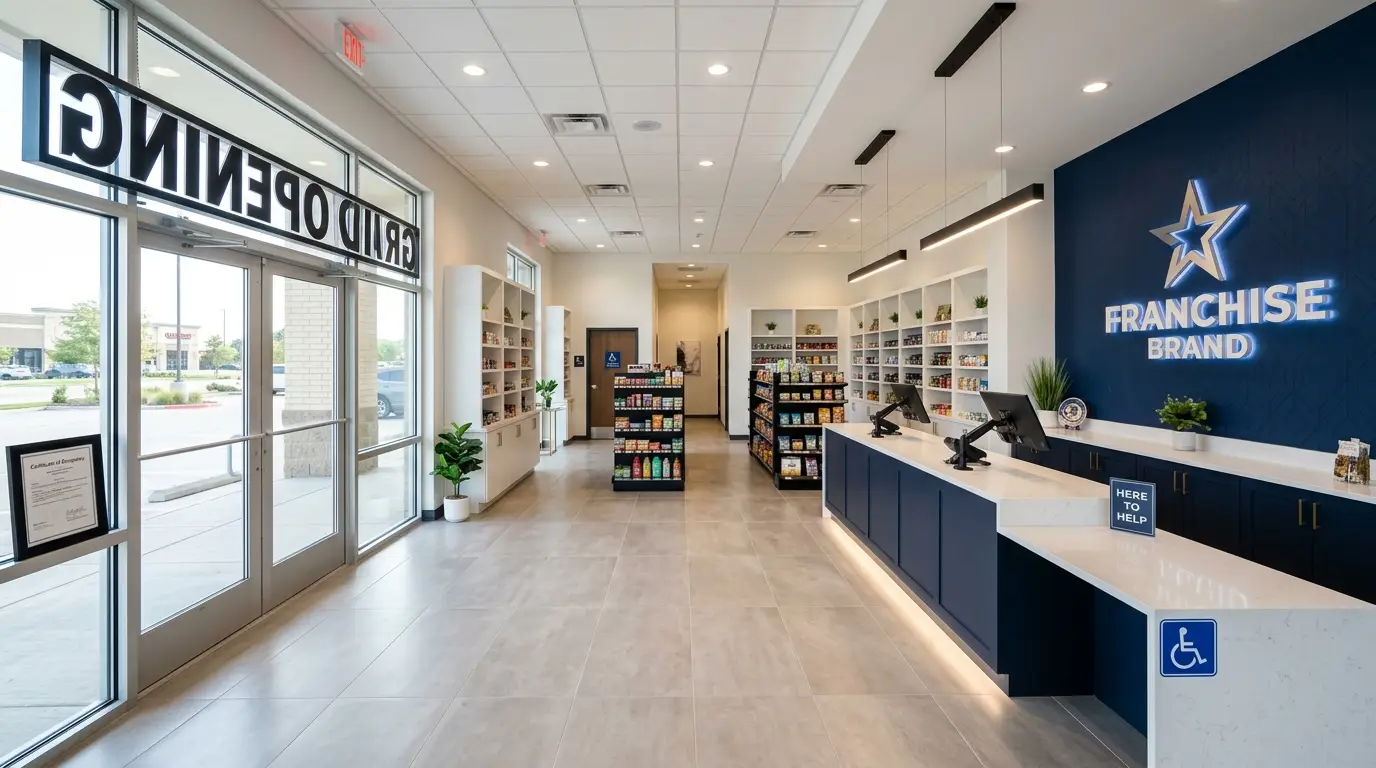
A franchise buildout is not the same as opening an independent business. You are working against three clocks at once: your lease commencement date, your franchisor’s required opening window, and the city permit and inspection schedule that does not care about either one. Miss any one of them and you are paying rent on a space you cannot operate, fees to a franchisor for a location that is not generating royalties, or penalties for missing your milestone dates. This checklist gives you the sequence, dependencies, and Texas-specific timelines you need to open a franchise location without the costly delays that 34% of new franchisees experience.
Quick Answer: A typical franchise buildout in Texas takes 90 to 180 days from lease commencement to opening day. Plan for 14 to 28 days of design and franchisor approval, 21 to 60 days of permitting (varies by city), 60 to 120 days of construction, and 14 to 21 days of FF&E install, training, and soft opening. Buildout costs run 150 to 400 dollars per square foot depending on concept type. 34% of opening delays trace back to permit and inspection issues that could have been prevented with earlier coordination.
Pre-Lease Phase Checklist
The most expensive franchise mistakes happen before the lease is signed. Once the lease commences, the rent clock starts and every day of delay is real money. The pre-lease phase is where you verify that the site can actually support the franchise concept within the franchisor’s requirements and the city’s code.
| Pre-Lease Item | Why It Matters | Who Handles It |
|---|---|---|
| Franchisor site approval letter | Confirms the site meets brand criteria | Franchisee submits, franchisor approves |
| Use permit verification with city | Confirms zoning allows the concept | Franchisee or attorney |
| Existing MEP capacity assessment | Electrical, plumbing, HVAC sized for concept | MEP engineer or design firm |
| Slab condition and subfloor inspection | Drain locations, slab levelness, structural | GC or architect |
| Grease trap or interceptor verification | Required for food concepts in most Texas cities | Plumbing engineer + city utility dept. |
| ADA path of travel from parking | Code-required, often missing in older centers | Architect or RAS reviewer |
| Landlord work letter review | What the landlord delivers vs. tenant responsibility | Real estate attorney |
| TI allowance terms and disbursement schedule | When tenant gets reimbursed for buildout | Real estate attorney + accountant |
Most franchisees skip the MEP capacity assessment because the landlord’s broker assures them the space “was a restaurant before” or “has 400 amps.” Both statements are often misleading. A previous tenant’s electrical configuration may not match what your concept requires, and the panel size on the disconnect may not reflect actual usable capacity after accounting for life safety loads and code derating.
A 2024 survey of multi-unit franchisees found that 34% of opening delays were caused by permit or inspection issues, and the majority of those issues traced back to discoveries made during construction that should have been identified during pre-lease due diligence: undersized utilities, missing grease traps, slab conditions that required remediation, and ADA non-compliance in the base building.
Design and Permitting Phase
Permit timelines in Texas vary dramatically by city. The same drawing set that takes 14 days in Houston can take 60 days in Austin. Build the permit timeline into your franchisor opening date negotiation, not into your construction schedule as a buffer.
| City | TI Permit (Typical) | Health Permit | Notes |
|---|---|---|---|
| Austin | 30 to 60 days | 14 to 21 days (after CO) | Longest in Texas; commercial permit backlog |
| Dallas | 14 to 30 days | 10 to 14 days | Expedited review available for fee |
| Houston | 10 to 21 days | 10 to 14 days | Fastest major Texas city for permits |
| San Antonio | 21 to 45 days | 14 to 21 days | Plan review backlog varies by season |
| Fort Worth | 14 to 30 days | 10 to 14 days | Similar to Dallas |
The drawing set required for a franchise TI permit in Texas typically includes architectural plans (life safety, demolition, construction, finish, and equipment), MEP drawings sealed by a Texas-licensed engineer, a structural letter if any load-bearing modifications are proposed, an accessibility (TAS/RAS) review for projects over 50,000 dollars in construction cost, and a fire and life safety plan reviewed by the local fire marshal.
Food concepts add a health department review that runs in parallel with the building permit. The health permit cannot be issued until the certificate of occupancy is in hand, but the health department plan review can happen during construction. Submit the health plans early to avoid a 2 to 3 week gap between CO and operational permit.
Brand Standards Coordination
The franchisor’s design package is not a suggestion. It is a contractual requirement that affects color specifications, material selections, lighting fixtures, signage, furniture, fixtures, and equipment. The franchisor’s design review process typically requires 2 to 4 weeks of back-and-forth between submission and approval.
The most efficient sequence is:
- Receive the franchisor’s brand standards package (architectural specifications, FF&E specs, signage requirements, color and material palette)
- Engage a local architect or design firm familiar with the brand standards to produce permit-ready drawings
- Submit drawings to franchisor for approval simultaneously with city permit submission
- Receive franchisor approval and city permit comments in parallel
- Revise drawings once to address both sets of comments, resubmit
- Receive franchisor final approval and city permit issuance
The most common franchisor coordination failure is selecting a GC or designer who has never worked with the brand. They produce drawings that meet local code but miss brand-specific items: the wrong color of laminate on the order counter, the wrong manufacturer of pendant lighting, the wrong tile grout color. Each revision adds 1 to 2 weeks. Three revisions adds a month to the schedule.
For franchisees opening their first commercial location in Texas, the cost of engaging a designer who has worked with the brand previously pays back through faster franchisor approval and fewer construction-phase change orders.
General Contractor Selection
The general contractor for a franchise buildout must understand both the brand standards and the local permit and inspection process. The cheapest bid is rarely the right choice. The right GC for a franchise buildout has previously built the same brand or a similar concept, understands the inspection sequence in your city, and has standing relationships with the subcontractors who will perform the specialty work (refrigeration, hood and exhaust, signage, point of sale).
| GC Selection Criterion | Why It Matters |
|---|---|
| Prior experience with the brand | Reduces submittal revisions and inspection failures |
| Active local jobs in the same city | Subcontractor availability and inspector familiarity |
| References from other franchisees | Verifies schedule and budget performance |
| Bond capacity and insurance coverage | Protects franchisee if GC defaults |
| Detailed schedule with critical path | Identifies dependencies and risk areas |
| Change order process and pricing | Prevents surprise costs during construction |
Get three bids on a detailed scope of work, not on a conceptual scope. The scope of work should reference the architectural drawing set, the FF&E schedule, and the franchisor’s brand standards as exhibits. Bids on conceptual scopes vary by 40 to 60% between bidders. Bids on detailed scopes typically vary by 10 to 20%, which is the real measure of competitive pricing.
FF&E Procurement and Timeline
Furniture, fixtures, and equipment for franchise buildouts have long lead times. Custom millwork, branded booth seating, and specialty equipment (combi ovens, espresso machines, custom POS) routinely run 8 to 16 weeks from order to delivery. Order FF&E based on the lease commencement date, not the construction start date, or you will end up holding the GC at substantial completion waiting for equipment to arrive.
| FF&E Category | Typical Lead Time |
|---|---|
| Branded signage (exterior) | 6 to 10 weeks plus city permit |
| Custom millwork (counters, casework) | 8 to 12 weeks |
| Branded booth seating and dining furniture | 10 to 14 weeks |
| Specialty kitchen equipment (combi, hood, walk-in) | 10 to 16 weeks |
| POS hardware and network equipment | 2 to 4 weeks |
| Standard restaurant equipment (prep tables, refrigeration) | 4 to 6 weeks |
| Lighting fixtures (branded pendants, decorative) | 6 to 10 weeks |
Build a procurement schedule that backs from the equipment installation date and adds a 2-week buffer for shipping delays. Order long-lead items first, even if construction is not yet permitted. The deposit money is at risk if the project does not proceed, but the delay cost of not ordering early is usually greater than the deposit at risk.
30-Day Opening Checklist
The 30 days before opening day are the highest-stress phase of any franchise buildout. Equipment is being installed, staff is being hired and trained, signage is being permitted, and the franchisor is verifying brand compliance. The opening checklist captures the dependencies that cause openings to slip by a week or more.
Days 30 to 21 Before Opening
- FF&E install complete; punch list to GC
- Health department pre-inspection scheduled
- Fire marshal final inspection scheduled
- POS system installed and connected to merchant processor
- Initial inventory order placed with franchisor-approved suppliers
- Staff training schedule confirmed with franchisor
Days 21 to 14 Before Opening
- Certificate of occupancy issued by city
- Health permit issued
- Signage permitted and installed
- Staff training begins on-site or at franchisor training facility
- Utility accounts (electric, gas, water, internet) verified active
- Insurance certificates filed (general liability, workers comp, property)
Days 14 to 7 Before Opening
- Franchisor brand compliance inspection
- Soft opening (friends and family) for staff practice and system testing
- Final menu pricing and POS programming verified
- Marketing launch (geo-targeted ads, grand opening promotion)
- Punch list items resolved with GC
- Initial deposit and operating cash float secured
Days 7 to 0 Before Opening
- Final inventory delivery and putaway
- Full staff dress rehearsal
- Final cleaning and decor placement
- Grand opening day staffing schedule confirmed
- Franchisor opening day support personnel on-site
The most common 30-day opening delay is the certificate of occupancy. The CO depends on passing all final inspections: building, electrical, plumbing, mechanical, fire, and health. A failure on any single inspection can push the CO by a week or more. Schedule pre-inspections with each trade before the official final inspection to identify and resolve issues without the formal failure on record.
What We See in Texas Franchise Projects
The most common opening delay we see in Texas franchise projects is signage. Brand exterior signage requires both a franchisor approval and a city permit, and the city permit timeline is often 30 to 60 days in cities like Austin and Dallas. Franchisees order the signage at the same time they order the rest of the FF&E and assume it will arrive in time, then discover during the final inspection sequence that the signage permit is not approved and the storefront cannot have brand signage installed until it is. Cities will issue a CO without the exterior signage in most cases, but the franchisor will not authorize the opening without signage.
The second pattern is electrical service capacity. Many Texas strip centers built before 2010 have shared electrical service to a tenant panel that was sized for the original use. A franchisee opening a quick-service restaurant in a former dry-goods retail bay often needs a service upgrade from 200 to 400 amps. The upgrade requires utility coordination (typically 4 to 8 weeks lead time in Texas markets) plus the city permit for the panel work. If this is identified after the lease is signed, the franchisee pays rent during the utility delay.
The third issue is grease trap capacity. Texas cities have specific grease trap sizing requirements based on fixture count and seating capacity. Existing grease traps in older spaces are often undersized for new franchise concepts. Replacement requires demolition of the slab section where the trap is located, installation of a larger trap, and re-pour of the slab. The work itself is 2 to 3 weeks, but the permit and inspection process adds another 2 weeks. Retail fit-outs in San Antonio and similar Texas markets benefit substantially from pre-lease grease trap assessment for any food concept.
For franchisees planning a new tenant improvement buildout, the three highest-impact pre-lease verifications are signage permit lead time in the target city, electrical service capacity for the concept, and grease trap or interceptor sizing for food concepts.
Texas Franchise Buildout Cost Range by Concept: Quick-service restaurants: 250 to 400 dollars per square foot. Fast-casual restaurants: 200 to 350 dollars per square foot. Fitness franchises: 150 to 250 dollars per square foot. Retail franchises: 120 to 200 dollars per square foot. Service franchises (printing, cleaning, mailing): 100 to 175 dollars per square foot. These ranges assume standard shell-condition spaces; second-generation spaces with existing infrastructure can reduce costs by 20 to 30%.
Key Takeaways
- Plan 90 to 180 days from lease commencement to opening for a typical Texas franchise buildout
- Permit timelines vary dramatically by city: Houston 10 to 21 days, Austin 30 to 60 days
- 34% of opening delays trace back to permit and inspection issues; most are preventable with pre-lease due diligence
- Order long-lead FF&E (signage, custom millwork, specialty kitchen equipment) immediately after lease execution, not at construction start
- Select a GC with prior experience on the brand or similar concept; cheapest bid is rarely the right choice
- Franchisor design approval typically takes 2 to 4 weeks; submit in parallel with city permit application
- The most common 30-day delay is failed final inspections; schedule pre-inspections with each trade before the official inspection
- Exterior signage requires both franchisor approval and city permit; in some Texas cities the permit takes 30 to 60 days
Frequently Asked Questions
How long does a franchise buildout take in Texas?
A typical franchise buildout in Texas takes 90 to 180 days from lease commencement to opening day. The schedule breaks down into roughly 14 to 28 days of design and franchisor approval, 21 to 60 days of permitting depending on the city, 60 to 120 days of construction, and 14 to 21 days of FF&E installation, staff training, and soft opening before grand opening. Cities with shorter permit timelines like Houston can compress the overall schedule to 90 days; cities with longer permit timelines like Austin push the typical schedule to 150 to 180 days.
How much does a franchise buildout cost per square foot?
Franchise buildout costs in Texas range from 100 to 400 dollars per square foot depending on the concept. Quick-service restaurants typically run 250 to 400 dollars, fast-casual restaurants 200 to 350 dollars, fitness franchises 150 to 250 dollars, retail franchises 120 to 200 dollars, and service franchises 100 to 175 dollars. Second-generation spaces with existing infrastructure that aligns with the new concept can reduce costs by 20 to 30%. The largest variables are kitchen equipment for food concepts, custom millwork and branded finishes, and any required electrical, plumbing, or HVAC upgrades.
What causes franchise opening delays?
The most common causes of franchise opening delays in Texas are permit and inspection issues (34% of delays), exterior signage permitting that runs separately from the building permit, long-lead FF&E that arrives late, franchisor design approval revisions, and pre-lease due diligence failures that surface during construction (undersized utilities, grease trap replacement, slab remediation). Most opening delays are preventable with thorough pre-lease site assessment and a procurement schedule that backs from the lease commencement date instead of the construction start date.
Should I use the franchisor’s recommended contractor or hire locally?
Use a local Texas general contractor who has prior experience with the brand or a similar concept. The franchisor’s recommended national contractors often have higher overhead and travel costs and lack the standing relationships with local subcontractors and city inspectors that drive schedule performance. The best path is to ask the franchisor for a list of approved or experienced GCs in your target city, then bid the work to three of them based on a detailed scope of work that references the brand standards and the architectural drawing set as exhibits.
When should I order FF&E for a franchise buildout?
Order long-lead FF&E immediately after lease execution, not at construction start. Branded exterior signage runs 6 to 10 weeks plus city permit, custom millwork 8 to 12 weeks, branded booth seating 10 to 14 weeks, and specialty kitchen equipment 10 to 16 weeks. Holding the GC at substantial completion while waiting for FF&E to arrive is a common and costly mistake. Build a procurement schedule that backs from the equipment installation date and adds a 2-week buffer for shipping delays.
Planning a Franchise Buildout in Texas?
Prestige 360 Design specializes in commercial buildout coordination across San Antonio, Austin, Dallas-Fort Worth, and Houston. We work with franchisees to manage design, permitting, GC coordination, and FF&E procurement so your opening day stays on schedule.
About the Author
Hugo Ramirez is the founder of Prestige 360 Design, a commercial interior design firm serving Texas businesses. With expertise in franchise and multi-unit buildout coordination, Hugo has helped franchisees across Texas align brand standards, city permitting, and construction schedules to hit opening day targets.