Insights
How to Choose a Commercial Interior Design Firm: 5 Questions to Ask
June 14, 2026
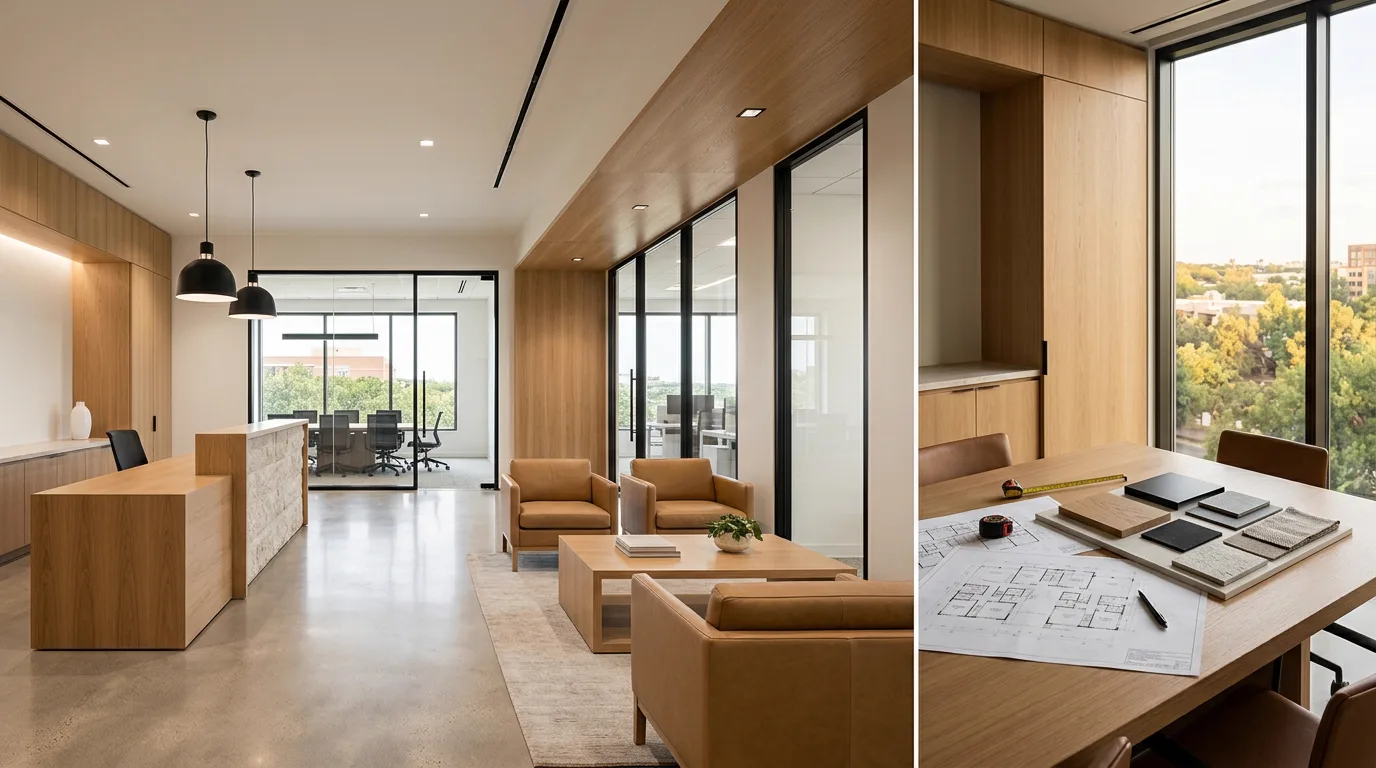
Quick answer: A commercial interior design firm handles the planning, design, and often the construction of non-residential spaces. The key distinction is between design-only firms (they draw, you build) and design-build firms (they design and manage construction under one contract). For most boutique commercial projects under 5,000 sq ft, design-build is faster, cheaper, and produces better outcomes with a single point of accountability.
Most business owners who hire a commercial interior design firm for the first time do it the wrong way. They call three firms, look at portfolios, pick the one with the best photos, and discover six months into the project that the firm handles residential more than commercial, subcontracts construction to someone they have never worked with, and has no experience pulling permits in their city. The result is a project that costs more, takes longer, and opens with problems that were completely avoidable.
Quick Answer: A commercial interior design firm handles the planning, design, and often the construction of non-residential spaces including retail stores, offices, restaurants, medical facilities, and tenant improvements. The key distinction is between design-only firms (they draw, you build) and design-build firms (they design and manage construction under one contract). For most boutique commercial projects, design-build is faster, cheaper, and produces better outcomes.
What Commercial Interior Design Actually Covers
Commercial interior design goes well beyond selecting finishes and furniture. A qualified commercial interior designer handles space planning, code compliance, permitting, structural coordination, lighting design, fixture specification, and construction documentation. The end product is a set of drawings and specifications detailed enough for a contractor to build from accurately.
For retail, restaurant, medical, and office projects in Texas, the design process also involves city permitting, fire marshal sign-off, ADA compliance review, and in some cases mechanical, electrical, and plumbing coordination. A designer who only handles aesthetics is not a commercial interior designer. They are a decorator, and the distinction matters when your project requires a certificate of occupancy.
Design-Only vs. Design-Build: Which Is Right for You
The single most important structural decision when hiring a commercial interior design firm is whether you want design-only or design-build service.
| Factor | Design-Only Firm | Design-Build Firm |
|---|---|---|
| Who manages construction | You (or a separate GC you hire) | The firm |
| Change order risk | Higher (design vs. build misalignment) | Lower (single contract, single source of truth) |
| Timeline accountability | Split between designer and contractor | Single point of accountability |
| Typical project cost | Design fee + GC markup separately | Single fixed-price contract |
| Best for | Large projects with dedicated project managers | Boutique commercial projects under 5,000 sq ft |
For most boutique retail brands, wellness studios, and specialty food operators opening a new location, design-build produces better outcomes. You have one contract, one point of contact, and one entity responsible for delivery. When something goes wrong, there is no finger-pointing between the designer and the contractor.
5 Questions to Ask Every Commercial Interior Design Firm
1. What percentage of your completed projects are commercial vs. residential?
Commercial and residential design are fundamentally different. Commercial work requires building code knowledge, permit management, ADA compliance, and coordination with trades that residential work rarely involves. A firm that does 80 percent residential and 20 percent commercial will apply a residential mindset to your project, which creates problems at permitting and inspection.
2. Do you handle permitting, or do I?
Permitting is where many commercial projects stall. If the firm produces drawings but leaves permitting to you, you are responsible for submitting to the city, responding to plan review comments, scheduling inspections, and obtaining the certificate of occupancy. That is a significant time commitment for a business owner. A full-service commercial interior design firm handles the full permitting lifecycle.
3. Who builds the project?
Some design firms subcontract construction to general contractors they have never worked with before. Ask specifically: do you self-perform construction, or do you have a preferred GC relationship? How long have you worked with them? What happens if there is a dispute between the design documents and what the contractor builds?
4. Can you show me a completed project in my city with a certificate of occupancy?
This is the most practical qualification question. A firm that has successfully permitted and built a commercial space in San Antonio knows the city’s plan review process, inspection sequence, and common code interpretations. A firm doing their first project in your city is learning on your budget and timeline.
5. What does your contract cover, and what are the exclusions?
Read the contract carefully. Common exclusions in design-only contracts include structural engineering, MEP coordination, permitting fees, fixture procurement, and construction management. These are not small items. Get a clear picture of what the fixed fee covers before you sign.
Red Flags to Watch For
- No completed commercial portfolio in your market or project type
- Unable to name the general contractor they would use for your project
- Vague timeline estimates with no milestone accountability
- Design fee quoted without clarifying whether permitting and construction coordination are included
- Portfolio that looks residential even when labeled as commercial
- No references from completed projects that required a certificate of occupancy
What Commercial Interior Design Costs in Texas
Design fees for commercial projects in Texas vary significantly based on scope, firm size, and service level. A rough framework:
What we see in our own work: boutique retail and tenant improvement projects under 2,500 square feet typically fall into a predictable cost range once you account for design, permitting, construction, and fixture installation together. The biggest variable is not the design fee. It is the construction scope, existing conditions, and how much structural or MEP work the space requires.
For boutique commercial projects, the total cost question is more useful than the design fee question in isolation. A design-build firm with a single fixed-price contract is often comparable in total cost to a design-only firm’s fee plus a separately-hired general contractor, and the design-build route includes coordination and accountability that the split model does not.
If you are planning a tenant improvement in a Texas commercial space, understanding your landlord’s TI allowance is the starting point. Our team works with clients through the commercial interior design process in Texas from lease review through certificate of occupancy, including negotiating the TI package with your landlord.
How Prestige 360 Design Works
We are a commercial interior design-build firm based in Texas. We do not hand clients a set of drawings and wish them luck with permitting and construction. We handle the full project under one fixed-price contract: design, permitting, construction, and fixture installation, delivered in 10 weeks for most boutique-scale projects.
Our client base is boutique retail brands, wellness studios, and specialty food operators opening their second or third location. These are business owners who have already built one successful location and want the second one to open on budget, on time, and ready to perform from day one.
We work across Texas, with completed projects in San Antonio, Austin, Houston, and New Braunfels. We have also worked on restaurant projects, wellness studios, and medical and dental spaces that required city permitting and certificate of occupancy in each market. More examples of our commercial work: retail space planning and restaurant layout design in Texas.
If you are evaluating commercial interior design firms for an upcoming project, we are glad to walk you through our process and show you completed work in your market. Schedule a consultation and we will put together a project overview specific to your space and timeline.
Key Takeaways
- Commercial and residential design are fundamentally different disciplines. Verify that the firm you hire works primarily in commercial, not residential.
- Design-build is usually the right choice for boutique commercial projects under 5,000 square feet. One contract, one point of accountability.
- Ask who builds the project and how long they have worked with that contractor. A design firm that subcontracts to unknown GCs creates risk.
- Permitting should be included in the scope. If a firm leaves permitting to you, you are managing a significant amount of work and risk.
- Total project cost matters more than design fee in isolation. Get the full picture before comparing proposals.
Frequently Asked Questions
What does a commercial interior design firm do?
A commercial interior design firm handles the planning, design, permitting, and in design-build models, the construction of non-residential spaces. This includes retail stores, restaurants, medical offices, wellness studios, and tenant improvements. The work covers space planning, code compliance, ADA requirements, fixture specification, lighting design, and construction documentation. Full-service firms also manage city permitting and contractor coordination through certificate of occupancy.
What is the difference between a commercial interior designer and a decorator?
A commercial interior designer produces construction-ready drawings, manages permitting, coordinates with engineers and contractors, and is accountable for code compliance and project delivery. A decorator selects finishes, furniture, and accessories. For any commercial space that requires a building permit or certificate of occupancy, you need a designer with commercial experience, not a decorator.
How much does commercial interior design cost in Texas?
Commercial interior design costs in Texas vary based on project scope, space size, and service level. Design-only fees typically range from 10 to 20 percent of the total construction cost. Design-build firms offer fixed-price contracts that bundle design, permitting, and construction into one total. For boutique retail projects under 2,500 square feet, getting a full design-build quote and comparing it to a design-only fee plus separate contractor estimate often reveals the design-build route is comparable or lower in total cost with significantly less client management burden.
How long does a commercial interior design project take in Texas?
Timeline depends heavily on the scope of work, the existing condition of the space, and the city’s permitting process. Boutique tenant improvement projects in Texas that go through a full-service design-build firm typically take 10 to 16 weeks from contract to certificate of occupancy, assuming no major structural or MEP surprises in the space. Permitting alone can take 3 to 6 weeks in larger Texas cities. Working with a firm that has existing relationships in your specific city’s permitting department reduces this timeline significantly.