Insights
Commercial Office Furniture Cost in San Antonio
July 26, 2026
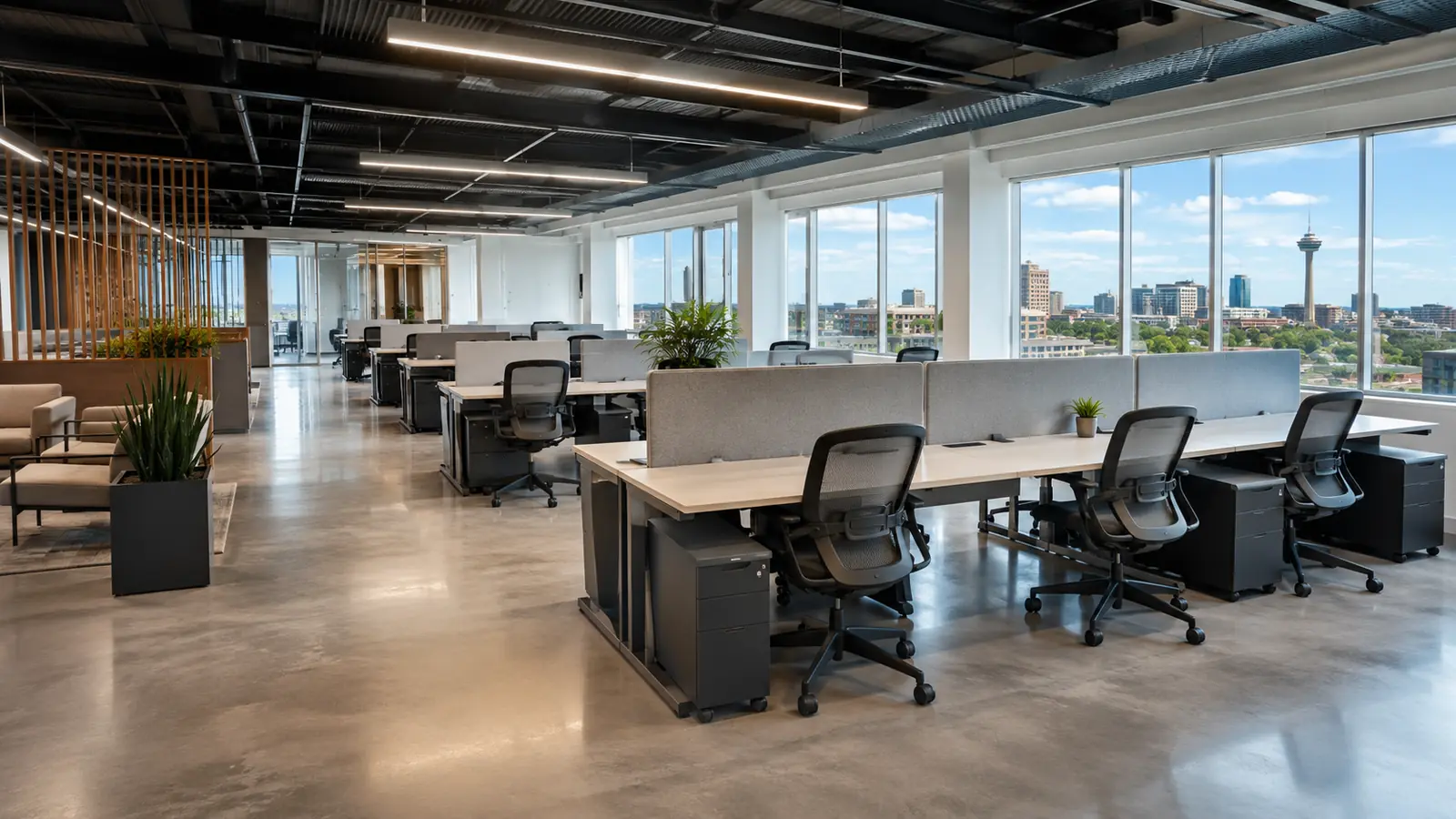
Office furniture is the line item most business owners underbudget on a commercial buildout, because it gets estimated per desk instead of per employee, and per employee is where the real number lives. A single workstation quote looks manageable. Multiply it by a full headcount, add conference rooms, reception, and break room furniture, and the total is routinely two to three times what an owner mentally set aside before the buildout started.
This guide breaks down what commercial office furniture actually costs in San Antonio in 2026, by furniture category and by quality tier, and where it fits inside a full buildout budget instead of being treated as an afterthought once construction is finished.
Quick Answer: Commercial office furniture in San Antonio typically runs $1,500 to $3,000 per employee for a standard new setup (desk, chair, and storage), $2,000 to $4,000 per station for panel-based cubicle systems, and can reach $8,000 to $12,000 or more per employee for a fully outfitted executive or high-end workstation. Office chairs alone range from roughly $70 for a basic task chair to $350 or more for an ergonomic model. Remanufactured and quality used furniture, widely available through several long-established San Antonio dealers, commonly runs 30 to 40 percent below new pricing for comparable brands and build quality. The number that moves a project budget the most is not the furniture line item itself, it is whether furniture was planned into the space layout during design or added after construction was already underway, which is when rush freight, mismatched finishes, and last-minute substitutions inflate the real cost.
Cost Per Employee, the Number That Actually Matters
Furniture budgets are almost always sized wrong because they are estimated per piece rather than per employee, and per employee is the number that scales correctly against a real headcount. A standard full setup, desk, ergonomic chair, and basic storage, runs $1,500 to $3,000 per employee for a functional but not premium configuration. A more complete setup with better ergonomics and finish quality runs $3,000 to $8,000 per employee, and a high-end executive or specialized workstation can run $8,000 to $12,000 or more once monitor arms, premium seating, and custom casework are included. On a 20-employee buildout, the difference between the low end and the mid tier of this range is $30,000, which is exactly the kind of gap that shows up as a surprise change order when furniture is priced after the space plan is finished instead of during it.
Office Furniture Cost by Category
| Category | Typical Cost Range | Notes |
|---|---|---|
| Task chair, basic | $70 to $150 | Adequate for low-hour use, limited adjustability |
| Ergonomic task chair | $200 to $350+ | Lumbar support, seat depth adjustment, recline control |
| Standard desk (non-adjustable) | $300 to $800 | Fixed-height, laminate or veneer surface |
| Height-adjustable sit-stand desk | $600 to $2,000 | Growing category, driven by wellness-focused workplace standards |
| Panel-based cubicle workstation, new | $1,500 to $4,000 per station | Includes panels, worksurface, and basic storage |
| Conference table (mid-size, 8 to 10 seats) | $1,500 to $5,000 | Varies widely by material and finish |
| Reception desk / lobby furniture | $2,000 to $8,000+ | Often custom or semi-custom to match branding |
| Break room furniture (per set) | $1,000 to $3,500 | Tables, chairs, and casual seating |
New, Remanufactured, and Used: What Each Tier Actually Means
"Used office furniture" covers three genuinely different products, and conflating them is where buyers get either an unpleasant surprise or an unnecessarily inflated bill.
- New. Full manufacturer warranty, current finish and fabric selections, longest lead time.
- Remanufactured. A used frame or base stripped down and rebuilt with new fabric, laminate, and hardware, commonly sold at 30 to 40 percent below new pricing for the same brand and comparable quality, often with a shorter but real warranty.
- Used, as-is. Sold in whatever condition it is in, the lowest cost tier, best suited to back-of-house, storage, or short-term space rather than any customer-facing area.
A remanufactured Steelcase or Herman Miller chair is frequently a better value than a new furniture-grade off-brand chair at the same price point, because the underlying mechanism and frame quality of a premium brand tends to outlast a budget brand's frame even after a full refurbishment cycle.
Fabric and upholstery grade is a related quality signal worth checking on seating specifically. Commercial-grade fabric is rated for a minimum number of double rubs, a standard abrasion test, and a fabric rated well below commercial standard will show visible wear at contact points, armrests and seat edges most commonly, within the first year of daily use regardless of how well the underlying chair mechanism performs.
Warranty terms differ meaningfully by tier and are worth confirming in writing before purchase, not assumed from the tier name alone. A reputable remanufacturer will disclose exactly which components are original versus replaced and what warranty coverage applies to each. Buying remanufactured from a dealer that will not provide that breakdown in writing is the single biggest red flag in this segment of the market, more so than price alone.
What Drives the Price Beyond the Furniture Itself
- Freight and delivery. Large furniture orders, particularly panel systems and casework, are priced with freight as a separate line item, and rush freight on a compressed timeline can add a meaningful percentage to the total order. Freight cost also scales with distance from the manufacturer's distribution point, which is one reason a dealer with local warehouse inventory can beat a direct-from-factory order on both cost and lead time for standard product lines.
- Installation labor. Panel-based systems and modular casework require assembly on site, typically priced separately from the furniture itself and scaled to the number of stations. A 20-station panel system installation commonly takes a two- to three-person crew one to two full days, and that labor cost is frequently left off a furniture-only quote until the buyer asks directly.
- Custom finishes and branding. A reception desk or conference table matched to a specific brand color or material adds cost and lead time compared to a stock finish option, and custom laminate or veneer matching can add two to four weeks to an otherwise standard order.
- Electrical and data integration. Modern workstations increasingly integrate power and data delivery into the furniture itself, grommets, in-desk outlets, and cable management channels, which adds both cost and a coordination point with the electrical subcontractor that needs to be resolved before the furniture arrives, not after.
- Storage and filing needs. Lateral files, mobile pedestals, and overhead storage are frequently underestimated in an initial furniture budget because they get planned late, after the desks and chairs are already selected, and retrofitting storage into a finished layout is more expensive than planning it in from the start.
How to Tell Furniture-Grade From Retail-Grade Before You Buy
Not every product marketed as "office furniture" is built to commercial duty standards, and the distinction matters more once furniture goes into an eight-hour-a-day, five-day-a-week environment rather than an occasional home office. Furniture-grade product is typically tested and rated to a commercial duty cycle, commonly a BIFMA certification in the United States, covering weight capacity, structural fatigue over repeated use, and stability. Retail-grade furniture, even when styled to look similar, is rarely tested to that same standard and can show frame failure, drawer slide wear, or chair mechanism failure within a year or two of daily commercial use where a BIFMA-rated product would still be performing normally. Asking a dealer directly whether a specific line is BIFMA-certified, rather than assuming commercial appearance equals commercial durability, is the simplest way to avoid furniture that looks right in a showroom but does not hold up in daily use.
Sales Tax and Capital Expense Treatment
Texas charges state and local sales tax on office furniture purchases, and unlike some capital equipment used directly in manufacturing, general office furniture does not qualify for a manufacturing exemption. On a large furniture order, that adds a meaningful percentage to the bottom line that some initial budgets forget to include, since a furniture dealer's quote is sometimes presented pre-tax by default. Furniture is also typically treated as a depreciable capital asset rather than an expense for tax purposes, which has real planning implications for the year a large furniture purchase is made versus spreading purchases across a phased rollout, a decision worth reviewing with an accountant before finalizing the timing of a large order rather than after the invoice is already paid.
Ergonomics: Where the Budget Actually Needs to Go
Of every furniture category in an office buildout, the task chair is the single item most worth spending above the minimum on, because it is the one piece of furniture in constant physical contact with an employee for most of the workday. A basic chair at the bottom of the price range lacks seat depth adjustment, lumbar support, and recline control, all three of which matter for anyone spending six or more hours a day seated. The cost difference between a basic and a properly ergonomic chair, often $150 to $250 per seat, is a rounding error against the total furniture budget but is the line item most likely to show up later as a workers' compensation or absenteeism cost if it gets cut to save money upfront. Desks are a lower priority for the ergonomic upgrade budget than chairs, since a fixed-height desk paired with a properly adjusted chair addresses most of the same postural concerns a sit-stand desk solves, at a fraction of the cost.
Furniture Selection and Space Planning Ratios
Furniture cannot be selected independently of the space plan, because the square footage allocated per employee determines which furniture categories are even physically viable. A dense open-plan layout built around 100 to 150 square feet per employee generally forces smaller-footprint benching or panel systems rather than large individual workstations, while a layout budgeted at 200 to 250 square feet per employee has more flexibility for sit-stand desks, larger storage, and more generous circulation space around each station. Locking the space plan before finalizing furniture selections, rather than the reverse, is what prevents a scenario where furniture ordered on assumption does not physically fit the finished layout.
Sourcing Office Furniture in San Antonio
San Antonio has a mature commercial furniture dealer market with several long-established local operators, some carrying exclusive dealer relationships with major manufacturers and others specializing in new, remanufactured, and used inventory at a range of price points. A companion guide, the best office furniture companies in San Antonio, ranks the real dealers serving the commercial market here in detail.
Phasing Furniture Purchases for a Growing Business
Not every buildout needs to furnish every seat on day one, and phasing the furniture purchase is a legitimate strategy for a business that expects to grow into a space rather than fill it immediately. The mistake to avoid is phasing without planning: if a company furnishes 15 of 30 planned seats initially and orders the remaining 15 from a different dealer or a different product line eighteen months later, finish and fabric discontinuation makes an exact match unlikely, and the office ends up visibly mismatched. The fix is to lock the furniture specification, brand, model, and finish, at the time of the initial order even if only half the quantity is purchased, and to place the balance of the order against that same specification when headcount actually grows, rather than re-specifying furniture from scratch each time.
Sustainability and Furniture Take-Back Programs
Several major office furniture manufacturers now operate formal take-back and recycling programs for furniture reaching end of life, and a number of San Antonio-area dealers handling both new sales and used inventory also accept trade-ins as part of a new furniture order. This matters for two practical reasons beyond the environmental consideration: a documented disposal or recycling path avoids the cost and logistics of a business having to arrange its own furniture removal at the end of a lease, and trading in existing furniture as part of a new order can offset a meaningful percentage of the new purchase price, particularly on quality furniture from a recognized brand that still has resale or remanufacturing value even after years of use.
Lead Time and Installation Timeline
Stock furniture from a dealer's existing inventory can often be delivered and installed within one to two weeks. Custom finishes, brand-specific color matching, or large panel-system orders commonly run four to eight weeks from order to delivery, and premium manufacturer lines can run longer during high-demand periods. On a buildout with a fixed opening date, furniture needs to be ordered as soon as the space plan and headcount are finalized, not after construction wraps, because a furniture delivery delay is one of the most common and most avoidable reasons a business opens with an empty or partially furnished space on its first day.
Why This Is a Buildout Line Item, Not an Afterthought
Furniture, fixtures, and equipment, commonly abbreviated FF&E, is one of the categories a standard contractor bid almost never includes, which is exactly why it gets treated as a separate purchase handled after construction rather than planned alongside it. Prestige 360 Design specifies and coordinates furniture procurement as part of the full commercial buildout, matching furniture selection to the finalized space plan, headcount, and brand standards, and scheduling delivery and installation against the same construction and certificate of occupancy timeline as every other trade. That coordination is what prevents a business from finishing construction on schedule and then waiting six additional weeks for furniture that should have been ordered during rough-in.
The failure pattern we see most often when furniture is left as a separate purchase: a business owner finalizes the space plan with the contractor, waits until construction is nearly finished to start shopping for furniture, and discovers that the specific pieces they want, whether that is a particular brand's ergonomic chair or a reception desk matched to a specific finish, carry a six-to-eight week lead time that was never factored into the opening date. The fix is not complicated, it is sequencing: furniture gets specified and ordered at the same point in the project timeline as long-lead construction materials, not after the drywall is painted.
Key Takeaways
- Budget furniture per employee, not per piece: $1,500 to $3,000 for a standard setup, up to $8,000 to $12,000 or more for a high-end configuration.
- Remanufactured furniture from a premium brand commonly runs 30 to 40 percent below new pricing and can outperform a new budget-brand alternative.
- Freight, installation labor, custom finishes, and electrical or data integration are the real cost drivers beyond the furniture price itself.
- Custom or brand-specific furniture orders can carry four to eight week lead times, so furniture needs to be ordered as soon as the space plan is finalized.
- Furniture priced and scheduled inside the full buildout, rather than as a separate purchase, is what keeps a business from opening on schedule into an unfurnished space.
Frequently Asked Questions
How much does commercial office furniture cost per employee in San Antonio?
A standard full setup, desk, ergonomic chair, and basic storage, typically runs $1,500 to $3,000 per employee. A more complete setup with better ergonomics and finish quality runs $3,000 to $8,000 per employee, and a high-end executive workstation can run $8,000 to $12,000 or more.
Is remanufactured office furniture a good value compared to new?
Remanufactured furniture from a premium brand commonly runs 30 to 40 percent below new pricing for comparable quality, often with a shorter but real warranty. A remanufactured premium-brand chair frequently outperforms a new budget-brand alternative at the same price point because the underlying frame quality tends to be higher.
How long does it take to get office furniture delivered and installed?
Stock furniture from a dealer's existing inventory can often be delivered and installed within one to two weeks. Custom finishes, brand-specific color matching, or large panel-system orders commonly run four to eight weeks.
Should office furniture be included in the buildout contract or purchased separately?
Including it in the buildout contract keeps furniture procurement on the same schedule as construction, coordinated against the finalized space plan and certificate of occupancy timeline. Purchasing it separately after construction is a common reason businesses open on schedule into a partially furnished space.
Prestige 360 Design specifies and coordinates commercial office furniture as part of full buildout projects across San Antonio. Talk to our team about planning furniture into your space plan before construction begins.
Related Services