Insights
Retail Store Layout Types: Which Floor Plan Actually Sells
June 14, 2026
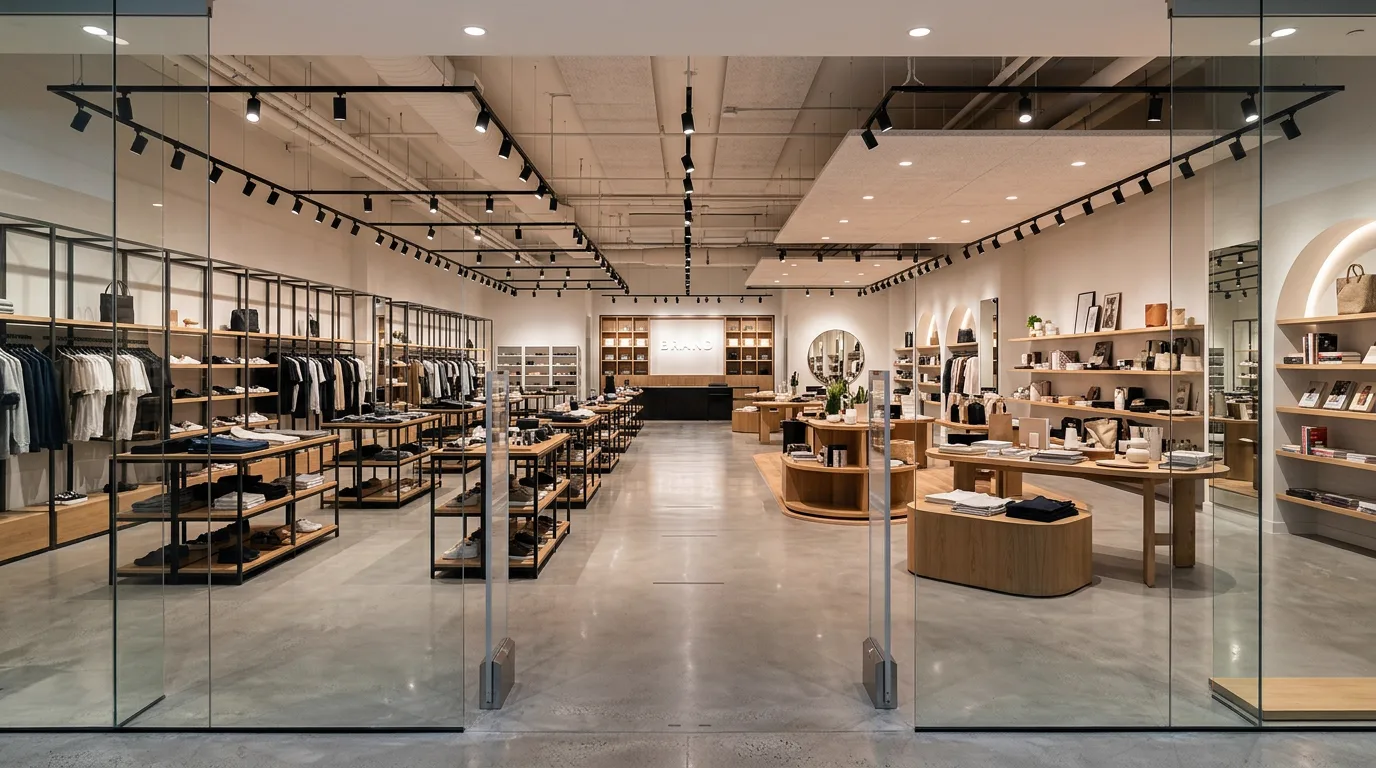
Quick answer: The five main retail store layout types are grid, free-flow, racetrack (loop), herringbone, and boutique hybrid. Grid layouts maximize product density. Free-flow encourages browsing and increases dwell time. Racetrack layouts increase exposure to the full store. Herringbone works for long narrow spaces. Most successful boutique retailers use a hybrid layout tailored to their specific footprint and product mix.
Walk into any well-designed retail store and you probably will not consciously notice the floor plan. That is the point. The layout does its job invisibly, moving you through the space in a way that feels natural while exposing you to more product than you intended to look at. Walk into a poorly designed store and you feel it immediately: confusion at the entrance, dead zones in the back, a checkout counter that is impossible to find. Store layout types are the foundation everything else is built on.
Quick Answer: The five main retail store layout types are grid, free-flow, racetrack (loop), herringbone, and boutique hybrid. Each controls customer traffic differently. Grid layouts maximize product density. Free-flow encourages browsing. Racetrack layouts increase exposure to the full store. The right choice depends on your product category, square footage, and customer behavior.
Why Layout Matters More Than Decor
Boutique owners often spend months choosing paint colors, fixtures, and signage. They spend far less time on the floor plan. This is backwards. The layout determines where customers go, what they see, how long they stay, and how much they spend. Decor influences perception. Layout determines behavior.
For a second or third retail location, the stakes are higher. You have sales data from your first store. You know which products move and which sit. A good layout for location two is built around that data, not copied from the first store’s footprint.
Grid Layout
The grid layout arranges fixtures in parallel rows running from the front to the back of the store. It is the most common layout in grocery, pharmacy, and hardware retail. Customers move through structured aisles in a predictable pattern.
| Advantage | Limitation |
|---|---|
| Maximum product density per square foot | Can feel clinical or impersonal |
| Easy for customers to navigate systematically | Customers often miss sections not in their path |
| Efficient use of wall space for signage | Low dwell time in boutique context |
| Lowers fixture cost per unit of inventory | Does not encourage impulse browsing |
For boutique retail, a pure grid is rarely the right choice. It works when customers come in with a specific product in mind and want to find it efficiently. If your revenue depends on discovery and impulse purchase, the grid fights you.
Free-Flow Layout
The free-flow layout has no fixed aisle structure. Fixtures, tables, and displays are arranged organically to create an environment that encourages wandering and discovery. It is the dominant layout in high-end apparel, home goods, and lifestyle boutiques.
Free-flow layouts maximize dwell time and impulse purchase rate. When there is no obvious path, customers slow down and explore. The risk is that some customers find the lack of structure frustrating, particularly if they came in to buy something specific and cannot find it.
The key to making free-flow work is strong visual anchors: a feature display in the center of the room, a hero product moment on the back wall, a lighting focal point that draws the eye from the entrance. Without anchors, free-flow becomes chaotic rather than inviting.
Racetrack / Loop Layout
The racetrack layout, also called a loop layout, creates a defined pathway that runs around the perimeter of the store and loops back to the entrance. Customers are guided through the entire selling floor before reaching the checkout counter.
This layout maximizes product exposure. Every customer who enters the store sees nearly everything you carry, which increases the chance of a discovery purchase. It is used extensively in home goods, big-box specialty retail, and department stores.
For boutique scale, a modified racetrack works well when the store is deep rather than wide. The path keeps customers moving through the full space rather than stopping halfway and heading back to the register.
Herringbone Layout
The herringbone layout uses angled fixtures arranged in a diagonal pattern along a central aisle. It is common in long, narrow spaces where a straight grid would create tunnel vision and discourage customers from moving to the back of the store.
The angled fixtures create natural sight lines across the store rather than straight ahead. This slows customer movement slightly and increases exposure to merchandise on both sides. It is a practical solution for converted retail spaces in older buildings where the footprint is longer than it is wide.
Boutique Hybrid Layout
Most successful boutique retailers use a hybrid that combines elements of two or more layout types. A common configuration: grid shelving along the perimeter walls for organized product display, free-flow tables and fixtures in the center of the floor for discovery and impulse purchase, and a racetrack-inspired pathway guiding customers from the entrance to the back of the store and toward the checkout counter.
The hybrid approach lets you match the layout to how your specific customer shops. It requires more planning upfront but produces better results than committing entirely to a single layout type that was designed for a different retail category.
How to Choose Your Retail Layout
| Your Situation | Recommended Layout |
|---|---|
| High-volume, product-dense, customers know what they want | Grid |
| Lifestyle boutique, high average transaction, experience-driven | Free-flow or hybrid |
| Deep narrow space, want full store exposure | Herringbone or racetrack |
| Second location, optimizing based on first store data | Hybrid built around top-performing zones |
| Wellness or specialty food, dwell time is key metric | Free-flow with strong anchor points |
The layout question should be answered before you sign a lease, not after. The shape and dimensions of the space determine which layouts are even possible. A 20-foot wide by 60-foot deep space needs a completely different approach than a 40-foot by 40-foot square footprint.
A good retail space planning process starts with the footprint and customer flow goals before any fixtures are specified. The fixture vendor should not be driving the layout decision.
How Prestige 360 Design Plans Your Layout
Our commercial retail design process starts with the floor plan, not the finish schedule. Before we specify a single fixture or select a tile, we model customer flow based on your store’s footprint, your product mix, and your average transaction profile.
For boutique retail brands opening a second location in Texas, we review performance data from the first store to identify which zones drove transactions and which were underperforming. The second store’s layout is built to amplify what worked and fix what did not.
We deliver full design-build under one contract: floor plan, permitting, construction, fixture installation, and lighting. Our retail design work covers everything from a 1,200-square-foot specialty boutique to a 4,000-square-foot multi-department store. And because we handle commercial interior design across Texas, we know the permitting requirements in San Antonio, Austin, Houston, and surrounding markets before we start drawing.
If you are planning a new retail location and want a layout designed to sell, schedule a consultation. We will show you how the floor plan choices affect your projected revenue before anything is built.
Key Takeaways
- Layout controls customer behavior more than any other design element. Decor is secondary.
- Grid layouts maximize product density but reduce dwell time in boutique contexts.
- Free-flow layouts increase dwell time and discovery purchase but require strong visual anchors.
- Racetrack layouts maximize product exposure by guiding customers through the entire store.
- Most successful boutique retailers use a hybrid layout tailored to their specific footprint and product mix.
- Layout decisions should be made before signing a lease, not after.
Frequently Asked Questions
What are the main retail store layout types?
The five main retail store layout types are: grid layout (structured parallel aisles, maximum product density), free-flow layout (organic fixture arrangement for browsing and discovery), racetrack or loop layout (defined perimeter path that exposes customers to the full store), herringbone layout (angled fixtures for narrow or deep spaces), and boutique hybrid (a combination tailored to specific product mix and customer behavior). Most successful boutique retailers use a hybrid approach.
What is a grid layout in a retail store?
A grid layout arranges display fixtures in straight parallel rows running from the front to the back of the store, creating defined aisles. It is the most common layout in grocery, pharmacy, and hardware retail because it maximizes product density and helps customers navigate systematically. It is less effective for boutique retail where dwell time and discovery purchase are the primary revenue drivers.
What is a free-flow layout in retail?
A free-flow layout places fixtures and displays without a fixed aisle structure, encouraging customers to wander and explore. It is the dominant layout in high-end apparel, home goods, and lifestyle boutiques because it increases dwell time and impulse purchase rate. Effective free-flow layouts require strong visual anchors, such as feature displays or back-wall moments, to prevent the space from feeling disorganized.
How do I choose the right layout for my retail store?
The right layout depends on your product category, store footprint, and how your customers prefer to shop. High-volume stores where customers buy specific items benefit from grid layouts. Experience-driven boutiques benefit from free-flow or hybrid layouts. Narrow or deep spaces benefit from herringbone or racetrack configurations. The layout decision should be made before signing a lease, since the space dimensions determine which options are viable.