Insights
What to Check Before Signing a Commercial Lease in Texas
May 26, 2026

Quick answer: What do you need to sign a commercial lease in Texas? Before signing, verify: (1) space measurements match your layout requirements, (2) permitted use clause covers your business type, (3) tenant improvement allowance is adequate for your build-out, (4) the space can be made ADA-compliant within budget, (5) your build-out cost estimate fits within TI allowance, and (6) exit clauses and assignment rights are acceptable. Getting a professional layout evaluation before signing is the single most important step -- it determines whether your concept is viable in the space before you are legally committed.
Most retail owners sign their lease before checking if the space actually works for their store. By the time they discover the electrical is undersized or the columns kill the floor plan, they are already locked in for five years.

Quick Answer: The 5 most critical things to check before signing a commercial lease for retail:
- Layout feasibility: confirm your floor plan, stockroom, fitting rooms, and checkout work within the actual square footage and column locations.
- Electrical capacity: verify the panel amperage supports your lighting, HVAC, POS systems, and any specialty equipment.
- Tenant improvement allowance: negotiate the TI before signing. Standard ranges from $60 to $80 per square foot in competitive markets. Do not accept the first offer.
- ADA compliance path: confirm the entry, restrooms, and service areas meet ADA requirements or budget for remediation in your build-out cost.
- Zoning confirmation: verify the space is zoned for your specific retail category, especially food, wellness, or service-based businesses that have additional permit requirements.
Why Most Retail Owners Sign the Wrong Lease
You found the perfect space. The location is right, the rent is manageable, and the landlord is motivated to fill it fast. So you sign. Three months into your build-out, you discover the electrical panel cannot support your lighting plan, the column in the center of the floor kills your display layout, and the HVAC unit serving your zone was designed for an office, not a retail store with a hundred customers cycling through on a Saturday.
This is not a rare scenario. It is the most common way first and second-location retail owners lose $30,000 to $100,000 before they open their doors. The lease looks fine on paper. The problems are in the walls, the ceiling, and the floor plan math.
A 2023 survey of independent retail operators found that nearly 60% reported their build-out cost exceeded initial estimates by more than 25%. The primary driver: conditions discovered after signing that were either not disclosed or not checked before the lease was executed. Most of these conditions are visible to anyone who knows what to look for.
“My biggest hold up is a lack of knowledge around building out a retail space. I signed thinking I could sort it out after. I couldn’t.”
Reddit: r/Entrepreneur, boutique owner, 2024
The good news: every one of these conditions can be identified before you sign. You just need to know what to look for, and ideally have someone in the room with you who has done this before.
The Layout Test: Can Your Store Actually Fit Here?
Square footage is a marketing number. What matters is usable square footage and how your specific store concept fits within it. A 1,800 sq ft space with two structural columns, a recessed HVAC closet, and an awkward entry can function like 1,200 sq ft. A clean 1,400 sq ft white box with ideal column spacing can outperform it.
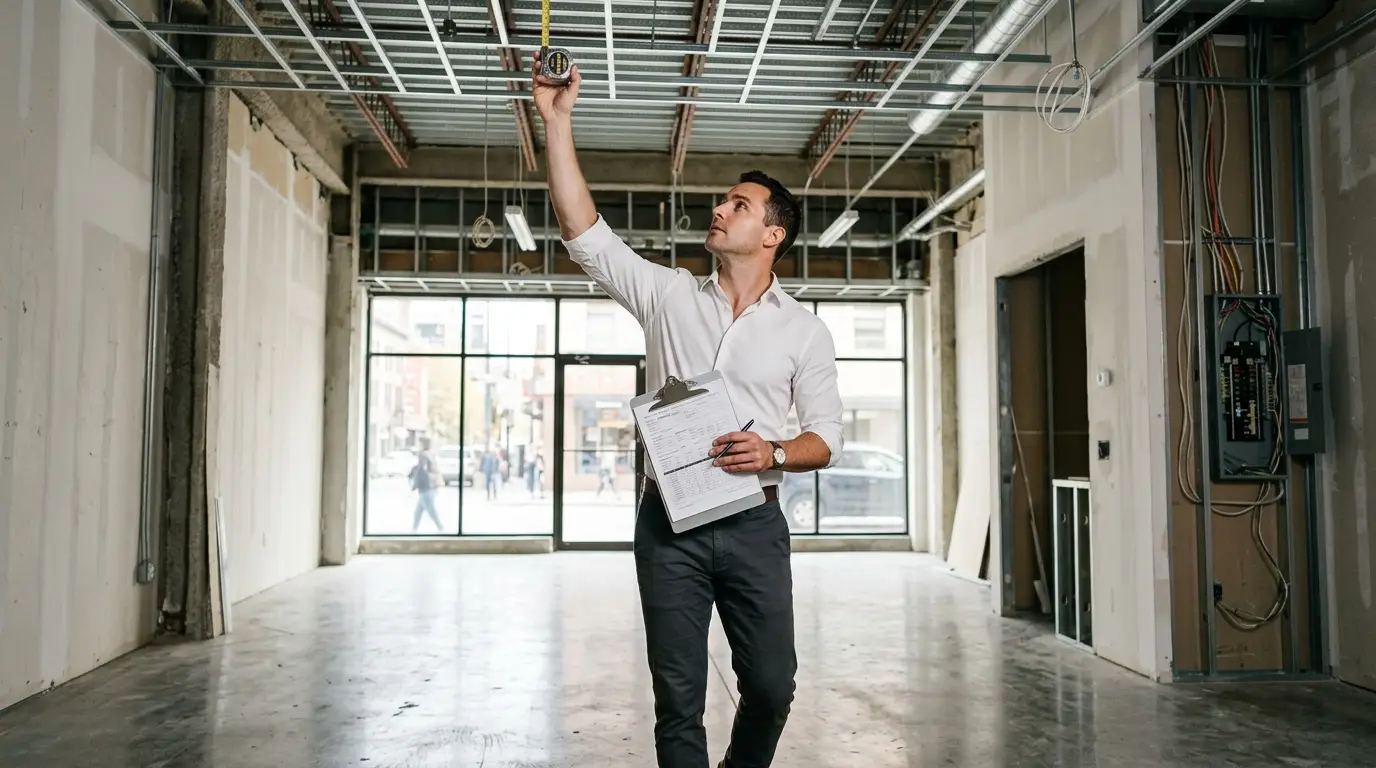
Before you walk into any showing with a landlord, sketch your minimum requirements: checkout counter placement, fixture runs, fitting room count, stockroom depth, and the entry sightline you need for your brand. Bring that sketch to the walk-through. Hold it up against the space. If it does not fit within the first five minutes, the space is not right for you regardless of the rent.
Space planning is not a post-lease task. It is a pre-lease decision tool. At Prestige 360 Design, we offer a free pre-lease layout review specifically for retail business owners. We overlay your concept onto the actual floor plate, including column locations and mechanical intrusions, and tell you whether the space works before you commit.
Not sure if the space works for your concept? Prestige 360 offers a free pre-lease layout review for retail business owners. Get Your Free Review
Column placement deserves its own conversation. Structural columns are permanent. They cannot be moved. If a column sits at the center of your primary display wall or in the middle of your sales floor grid, you are designing around a constraint that will frustrate customers and compromise your merchandising plan for the duration of your lease.
Structural and Mechanical Checks
These are the items that look invisible during a casual walk-through but become very expensive very quickly once you are into your build-out. A licensed contractor or experienced retail fit-out firm will catch all of them. If you are walking through without one, use this table as your checklist.
| Item | What to Check | Why It Matters |
|---|---|---|
| Electrical panel | Amperage and available circuits | Retail lighting loads are high. Panel upgrades cost $8,000 to $20,000+ |
| HVAC capacity | Tonnage per zone, unit age | Office HVAC is undersized for retail occupancy. Replacement is $10,000 to $30,000 |
| Ceiling height | Clearance to deck or finished ceiling | Display towers, gondolas, and wall systems require minimum 10 ft. Drop ceilings may hide issues |
| Plumbing rough-in | Location and capacity of existing lines | Wellness studios, salons, and food-adjacent retail need wet-wall proximity. Relocating costs $5,000 to $15,000 |
| Column locations | Spacing and placement on floor plate | Permanent obstructions. Cannot be moved. Must be designed around from day one |
| Loading / delivery access | Rear dock, alley clearance, elevator access | Carrying inventory through a public corridor is operationally unsustainable for most retail models |
Ask the landlord for the mechanical drawings. If they cannot produce them, hire a building inspector or bring your contractor for a one-hour walk-through before you finalize any offer. The cost of an inspection is trivial compared to the cost of discovering these issues mid-build.
The TI Allowance: What to Negotiate Before You Sign
The tenant improvement allowance is one of the most negotiable items in a commercial lease. Most first-time tenants do not know this. They accept whatever the landlord offers, assume it is the market standard, and discover too late that it covers roughly half of their actual build-out cost.
Market Reality: We see landlords offer $20 to $40 per square foot as the opening TI figure. In competitive markets, $60 to $80 per square foot is standard for retail build-outs, and landlords rarely volunteer this information. In high-demand corridors or anchor-tenant deals, $100+ per square foot is not uncommon.
The negotiation leverage depends on several factors: your lease term length, the landlord’s vacancy rate, your credit profile, and whether you have a build-out cost estimate from a licensed contractor. That last item is your most powerful tool. Walk in with a real number, not a guess.
The tenant improvement process works best when the design-build firm is involved before the lease is signed. We can produce a conceptual cost estimate based on the space and your program, which gives you a defensible number to anchor the TI negotiation. A $15,000 difference in TI on a 1,500 sq ft space is the difference between a finished store and a store where you ran out of money before the lighting was installed.
Also confirm whether the TI is paid upfront, reimbursed on completion, or disbursed in draw milestones. Cash flow timing matters significantly for small operators who are self-funding the build-out.
ADA, Permits, and Zoning: The Silent Deal-Killers
ADA compliance is not optional and it is not the landlord’s problem once you sign. In most lease structures, the tenant is responsible for ADA compliance within their leased premises. If the existing restroom does not meet ADA clearance requirements or the entry threshold fails, you are paying to fix it. Remediation can range from $5,000 to $40,000 depending on what needs to be modified.
Walk the path from the accessible parking spaces to your front door. Note the door hardware, the threshold height, and the clear floor space inside the entrance. Then walk to the restroom and check turning radius, grab bar placement, and sink clearance. These are the four most commonly failed ADA items in older retail shells.
Zoning is the other silent deal-killer. Commercial zoning districts vary in what retail categories they permit. A wellness studio, tattoo parlor, or food-sampling retail concept may require a conditional use permit or a change of use filing even if the space was previously occupied by a similar business. Confirm with the local planning department that your specific use is permitted before you sign, not during build-out permitting.
If the previous tenant was an office, restaurant, or medical facility, the change of use process adds time and cost to your permit timeline. Factor four to eight additional weeks into your opening schedule if this applies to your space.
What Hugo Ramirez Checks on Every Site Visit
Before founding Prestige 360 Design, I spent years managing retail projects for Nike, evaluating flagship and concept store locations across North America. We had a site evaluation protocol that ran 40 items before a location was approved. Here is what I still apply to every pre-lease walk-through I do for a client.
-
I check the entry sightline first, not the square footage.
What a customer sees the moment they enter tells me whether the space can deliver the brand experience the owner intends. If the sightline is broken by a column, a mechanical room door, or a fire exit, that is a design constraint that will never fully resolve, no matter the budget.
-
I open the electrical panel on every visit.
Most people do not look at it. The panel tells me immediately whether the previous tenant was a low-load use (office, salon) or a high-load use (restaurant, gym). If I see a 100-amp panel on a 2,000 sq ft space, I know a panel upgrade is coming. That is a $10,000 to $20,000 budget item the owner needs to know before signing.
-
I draw the floor plan on-site, in pencil, with measurements.
Landlord floor plans are almost always idealized. Column dimensions are softened, mechanical rooms are omitted, and the usable area is overstated. I measure the actual net floor area, mark the columns, identify any mechanical intrusions, and sketch the client’s program into it. If the program fits, we move forward. If it does not, we walk.
-
I ask for the lease modification history.
Prior tenant improvements sometimes create problems for the next tenant. Unauthorized wall additions, non-permitted plumbing, or altered structural elements can create permit headaches during your build-out. If the landlord cannot provide a clean permit history for the space, budget for a permit expediter and additional inspection time.
These four checks alone have saved Prestige 360 clients from signing leases that would have cost them more to fix than the business would earn in its first year. The walk-through is not a formality. It is a business decision.
The 12-Point Pre-Lease Checklist for Retail Owners
Use this checklist on every site walk before making a lease offer. If any item cannot be confirmed, ask the landlord to provide documentation or bring a licensed contractor for a second visit before signing.
-
Floor plan compatibility
Your store concept, stockroom, fitting rooms, checkout counter, and entry zone all fit within the actual (measured) floor plate, accounting for column locations and mechanical intrusions.
-
Electrical panel capacity
Panel amperage is sufficient for your lighting plan, POS systems, HVAC load, and any specialty equipment. Minimum 200-amp service for most retail uses.
-
HVAC tonnage and zoning
The HVAC unit serving your zone is sized for retail occupancy, not office load. Confirm the unit age and confirm the landlord’s maintenance responsibility in the lease.
-
Ceiling height clearance
Usable ceiling height (to deck or finished ceiling) supports your display systems, signage, and brand experience. Minimum 10 ft for most retail. Confirm whether the ceiling is open to structure or finished.
-
Column placement mapped
All structural columns are located and measured on your sketch plan. None fall in positions that permanently compromise your display layout or sightlines.
-
Tenant improvement allowance negotiated
TI is negotiated based on a real build-out estimate, not accepted at face value. Target $60 to $80 per square foot as a starting position in most markets. Confirm disbursement timing and documentation requirements.
-
ADA entry and restroom compliance
The accessible path from parking to your entrance and from your entrance to the restroom meets current ADA standards. If not, the remediation cost is included in your build-out budget.
-
Zoning permits your use
Local planning department has confirmed (or will confirm) your specific retail category is permitted in this zoning district without a conditional use permit delay.
-
Plumbing rough-in location confirmed
If your use requires wet areas (salon sinks, fitting room wet bar, wellness shower), existing plumbing rough-in location is compatible with your layout. Relocation budget is confirmed if not.
-
Prior permit history reviewed
Landlord has provided a permit history showing prior tenant improvements were permitted and approved. No unauthorized construction or open permits that could trigger a stop-work order during your build-out.
-
Delivery and loading access confirmed
Rear entry, dock, or loading zone access is workable for your inventory volume and delivery frequency. You are not carrying stock through a shared corridor or public mall space.
-
Build-out timeline in the lease
The lease includes a tenant improvement period (rent-free or at reduced rate) long enough to complete your build-out. Standard is 60 to 120 days depending on scope. This is negotiable and should be explicitly written into the lease terms.
If you can check all 12 items before signing, you are in a fundamentally stronger position than the vast majority of retail tenants who sign first and discover later. If you need help working through this list on a specific space, the retail fit-out San Antonio team at Prestige 360 is available for a no-cost pre-lease consultation.
Key Takeaways
- Nearly 60% of independent retail operators report build-out costs exceeding estimates by more than 25%, primarily due to conditions not checked before signing.
- Square footage is a marketing number. Usable square footage, after accounting for columns, mechanical rooms, and irregular layouts, is what determines whether your store concept fits.
- The tenant improvement allowance is negotiable. Standard is $60 to $80 per square foot in competitive markets, but landlords rarely volunteer this figure.
- ADA compliance, zoning verification, and prior permit history are the three silent deal-killers that most first-time tenants skip.
- A one-hour pre-lease walk-through with a licensed contractor or retail design firm can prevent $30,000 to $100,000 in post-signing surprises.
Prestige 360 Pre-Lease and Build-Out Services
Before signing a commercial lease in Texas, Prestige 360 can evaluate your prospective space so you know what you are committing to:
- Tenant Improvement Services - TI allowance review, permit coordination, and full build-out from lease review to Certificate of Occupancy.
- Commercial Buildout Planning Texas - pre-lease space evaluation, build-out cost estimates, and scope definition before you sign.
- Commercial Finish Out Texas - design-build service for shell commercial spaces in Texas.
- Retail Space Planning and Layout Design - layout evaluation for retail tenants considering a new space.
Frequently Asked Questions
What should I check before signing a commercial lease for a retail store?
Before signing a commercial lease for retail, verify: (1) the floor plan works for your store layout, (2) electrical capacity meets your fixture and lighting load, (3) HVAC is sized for your occupancy, (4) ceiling height accommodates your displays, and (5) the tenant improvement allowance is negotiated, not just accepted at face value. Also confirm ADA compliance, zoning permits retail, and there are no column placements that block your key sightlines.
What is a tenant improvement allowance and how do I negotiate it?
A tenant improvement allowance (TIA) is money a landlord provides to build out the space to your specifications. In competitive markets, $60 to $80 per square foot is standard, though landlords rarely volunteer this. Negotiate the TIA before signing, not after. Bring a design-build firm to the pre-lease walk-through so you have a real cost estimate to anchor the negotiation.
Can I get a free layout review before signing a commercial lease?
Yes. Prestige 360 Design offers a free pre-lease layout review for retail business owners. We assess whether the space works for your store concept, flag structural issues, and give you a build-out cost estimate, all before you commit to a lease.
What are the most common mistakes retail owners make before signing a commercial lease?
The most common mistakes are: signing without a layout test (discovering later the stockroom or fitting rooms cannot fit), accepting the first TI offer, skipping an electrical capacity check, ignoring column placement, and assuming zoning permits the intended use. These mistakes can cost $30,000 to $100,000 or more to fix after signing.
Hugo Ramirez
Founder, Prestige 360 Design | Former Nike Retail Project Manager
Hugo spent years managing retail project delivery for Nike before founding Prestige 360 Design. He has evaluated, negotiated, and built out retail locations across the U.S., from neighborhood boutiques to flagship stores. Prestige 360 Design is a San Antonio-based retail design and fit-out firm specializing in helping independent retail owners open their first and second locations with confidence.
Get a Free Pre-Lease Layout Review
Before you sign, let us walk the space with you. We will tell you whether it works for your concept, what the build-out will cost, and how to negotiate your TI allowance.
No commitment required. Available to retail business owners in San Antonio and surrounding markets.
Related Resources
- Retail Design Company – How Prestige 360 approaches every retail fit-out from concept to opening day.
- Tenant Improvement Services – What to expect from the TI process: design, permits, build, and opening.
- Retail Space Planning – How we test your store concept against any floor plate before you commit.
- Retail Fit-Out San Antonio – Local retail build-out expertise for San Antonio and surrounding markets.