Insights
Commercial Drywall Installation Cost in San Antonio
July 26, 2026
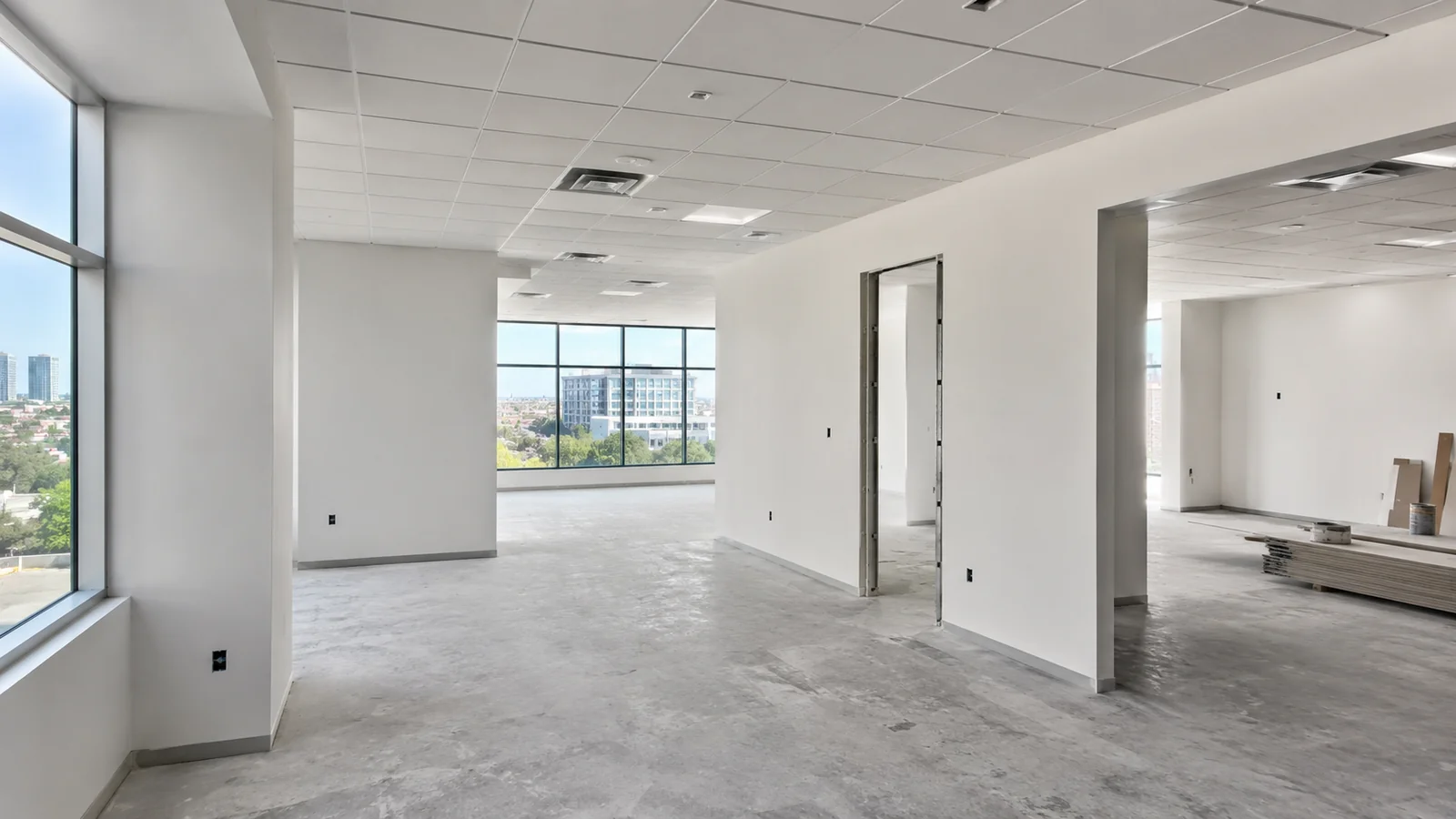
Drywall pricing looks deceptively simple on paper: a single per-square-foot number that seems, at first glance, easy enough to compare directly across competing quotes. In practice, a commercial drywall quote in San Antonio can range anywhere from $1.40 to $4.50 per square foot for what looks like essentially the same wall, and the real gap comes down to fire rating, finish level, and metal stud framing scope, none of which a bare per-square-foot number captures on its own.
This guide breaks down clearly what commercial drywall installation actually costs in San Antonio in 2026, what drives the real price beyond square footage, and how it fits into a full buildout instead of being priced as a standalone finish trade.
Quick Answer: Commercial drywall installation in San Antonio typically runs $1.40 to $2.20 per square foot for basic hang-and-finish work, with broader Texas commercial pricing running $1.50 to $3.50 per square foot for basic installation and $2.00 to $4.50 per square foot for a fully finished, higher-level wall. Labor represents 50 to 70 percent of the total cost, which is why finish level and crew efficiency, not material grade, drive most of the price difference between quotes. Fire-rated assemblies, required at specific separation walls by code, cost more than standard drywall because they use specific rated products and assembly methods that must match a tested and listed configuration exactly. Metal stud framing is sometimes bundled into a drywall quote and sometimes priced separately, and confirming which applies to a specific quote before comparing numbers avoids comparing two fundamentally different scopes of work.
Drywall Cost by Scope and Finish Level
| Scope | Typical Cost per Sq Ft | Notes |
|---|---|---|
| Basic hang and finish (Level 3-4) | $1.40 to $2.20 | Standard office, retail back-of-house |
| Higher finish level (Level 4-5) | $2.00 to $3.50 | Customer-facing spaces, smooth wall finish for paint or wallcovering |
| Fully finished, premium level 5 | $3.00 to $4.50 | Critical lighting conditions, glossy paint finishes |
| Fire-rated assembly (1-hour or 2-hour) | $2.50 to $5.00+ | Required at code-mandated separation walls |
| Metal stud framing (if not bundled) | $3 to $8 per linear foot | Priced separately by some contractors, bundled by others |
Finish Levels Explained: What Level 5 Actually Means
The drywall industry uses a standardized finish level scale from 0 to 5 that describes how much joint compound, sanding, and skim coating goes into a wall before it is ready for paint. Level 3 is common for surfaces getting heavy texture or wallcovering that hides minor imperfections. Level 4 is the standard for most commercial walls receiving flat or eggshell paint. Level 5, a full skim coat over the entire surface, is specified for walls under critical lighting, large expanses of glossy paint, or any surface where minor imperfections would be highly visible. Specifying a finish level below what the actual lighting and paint sheen requires is one of the more common and most visible mistakes on a commercial buildout, since the flaw only becomes obvious once the space is lit and painted, by which point fixing it means redoing finished work.
Fire-Rated Assemblies and Why They Cost More
Certain walls in a commercial building, separations between tenant spaces, corridors, stairwells, are required by code to carry a specific fire rating, commonly one-hour or two-hour, and a fire-rated wall is not simply thicker drywall. It is a tested and listed assembly, meaning the specific combination of stud spacing, drywall type and thickness, layer count, and fastener pattern has been fire-tested as a complete system and must be reproduced exactly to maintain its rating. Substituting even one component, a different fastener spacing or a non-rated drywall product, voids the rating regardless of how the wall looks once finished. This is why fire-rated assemblies cost more and why a contractor unfamiliar with the specific tested assembly required at a given location is a real risk, not just a quality concern.
Metal Stud Framing: Usually Bundled, Sometimes Not
Commercial interior walls are almost always framed with metal studs rather than wood, and whether that framing is included in a drywall quote or priced as a separate line item varies by contractor. Some drywall companies handle framing and hanging as one continuous scope; others frame separately from a general contractor's rough carpentry crew and only price the hang-tape-finish portion. Neither approach is wrong, but comparing a bundled quote against an unbundled one without adjusting for the difference produces a misleading price comparison, one of the more common apples-to-oranges mistakes in commercial drywall bidding.
Why Labor Drives Most of the Cost
Labor represents 50 to 70 percent of total commercial drywall cost, which means crew efficiency and finish quality matter more to the final price than the drywall material itself. Standard half-inch drywall is a commodity product with minimal price variation between suppliers, so the real cost driver between two quotes covering the same square footage is almost always labor: crew size, finishing skill level, and how efficiently the job is sequenced against other trades working in the same space. A noticeably cheaper quote on the same scope is more often explained by a faster, less careful finish than by a genuinely better material price.
Patch and Repair Work vs. Full New Installation
Not every commercial drywall need is a full new wall build; patch and repair work, closing an old doorway, fixing damage from a prior tenant, repairing a wall after equipment removal, is a genuinely different pricing category with its own considerations. Small patches are often priced with a minimum service call charge rather than a per-square-foot rate, since the labor to properly blend a patch into surrounding existing texture and finish is disproportionate to the small area actually being repaired. Matching existing texture is the detail most often underestimated on a patch job: a smooth Level 4 patch dropped into a wall with heavy orange-peel texture is visibly obvious even after paint, and a contractor experienced in texture matching is worth seeking out specifically for any patch work in a finished, occupied space where the seam needs to disappear rather than simply get covered.
Dust Containment in Occupied or Adjacent Spaces
Drywall work, particularly sanding, generates significant fine dust that travels further than most people expect, and this becomes a real operational concern on any project where construction is happening adjacent to an occupied space, a phased buildout in a multi-tenant building, or a renovation happening around a business that stays open during construction. Proper dust containment, plastic sheeting barriers, negative air pressure machines, sealed doorways, adds cost and time to a project but is essential when dust migration into an occupied neighboring space or an operating business risks a real conflict with a landlord, an adjacent tenant, or ongoing operations. Skipping containment to save a modest amount on a bid is a common source of costly disputes on multi-tenant or phased projects, disputes that end up costing far more in cleanup and relationship repair than proper containment would have cost upfront.
Sourcing Commercial Drywall in San Antonio
San Antonio has a mature commercial drywall and framing market with several established specialty contractors serving the Central and South Texas region, several of which have operated continuously for decades and built dedicated relationships with general contractors across the region's commercial construction industry. A companion guide, the best drywall contractors in San Antonio, ranks the real companies serving this market in detail, including their specific specialties in framing, fire-rated assemblies, and acoustic wall systems.
San Antonio Humidity and Drywall Curing
Joint compound cures primarily through evaporation, and San Antonio's noticeable humidity swings across the year genuinely affect how long each coat actually needs to dry before the next one can be safely applied, a detail a generic national installation timeline does not account for. During the more humid summer months, dry time between coats can run longer than the standard estimate a contractor might quote from a drier-climate benchmark, and pushing to the next coat before a layer is fully dry is a common cause of cracking or bubbling that surfaces after paint rather than during construction. A contractor experienced with local conditions builds this seasonal variability into the schedule rather than working off a fixed generic timeline that does not adjust for the specific month a project is being finished in.
Installation Timeline
A standard commercial drywall scope, framing, hanging, taping, and finishing, typically runs one to three weeks depending on square footage and finish level, with finishing (the taping, mudding, and sanding phase) taking longer than the hanging itself since each coat needs dry time before the next is applied. Level 5 finishes and fire-rated assemblies with multiple layers add time on top of standard scope. Drywall needs to be sequenced after rough electrical, plumbing, and mechanical work is inspected and approved, since walls close over that work, and sequenced before flooring and paint, making it one of the pivot points in a construction schedule where a delay cascades into every subsequent trade.
Drywall Types Beyond Standard: Moisture, Impact, and Sound
Standard half-inch drywall is the practical default for most commercial walls, but several specialty products exist specifically to address conditions that standard board simply does not handle well over the long term. Moisture-resistant drywall, commonly green or purple board, is specified for areas with elevated humidity, restroom walls, break room areas near sinks, and behind commercial kitchen equipment, where standard board can absorb moisture and degrade over time. Impact-resistant drywall, reinforced with fiberglass mats or denser core material, is specified in high-traffic corridors, stairwells, and any wall likely to take regular contact from carts, equipment, or heavy foot traffic, since standard drywall dents and punctures more easily under that kind of repeated impact. Sound-rated or acoustic drywall, denser and sometimes layered with a damping compound between sheets, is specified for conference rooms, private offices, and any wall separating spaces where speech privacy or noise isolation is a genuine functional requirement rather than a nice-to-have. Specifying standard board in a location that actually needs one of these specialty products is a common source of premature wall failure or ongoing noise complaints that only surface once the space is in daily use.
Corner Bead and Trim: A Small Detail With Outsized Visual Impact
Corner bead, the metal or vinyl strip that protects and defines outside wall corners, is a genuinely small line item on a drywall bid that nonetheless has an outsized effect on how professional and finished a completed commercial space actually looks to a customer walking through it. A poorly installed or low-quality corner bead shows as a wavy, uneven line at every outside corner in a space, a flaw that is subtle in isolation but adds up across an entire commercial interior with dozens of corners, columns, and openings. Vinyl bead is more resistant to denting than standard metal bead and is worth the modest upcharge in high-traffic commercial corridors where a metal corner is more likely to take an impact and bend, creating a visible flaw that then has to be repaired rather than simply repainted. This is a small enough line item that it rarely gets its own discussion during bidding, but a contractor who defaults to vinyl in high-traffic areas without being asked is signaling a real attention to long-term durability that extends to how they approach the rest of the job as well.
Why This Belongs in the Buildout Schedule, Not a Standalone Bid
Drywall sits at a genuine scheduling chokepoint in any commercial buildout: it cannot start until rough-in inspections pass, and nothing behind it, paint, flooring, fixtures, can proceed until it is finished and dry. That position in the schedule is exactly why bidding it out to whichever contractor is cheapest without regard to how they sequence with the rest of the project is a false economy: a drywall crew that shows up on their own schedule rather than the project's schedule can turn a two-day gap into a two-week delay felt by every trade that follows.
The coordination problem compounds when framing, drywall, and paint are bid to three different contractors with no single party responsible for how the handoffs between them actually happen. A framing crew that finishes early but leaves the space for the drywall crew to discover issues on their own start date loses time neither party is contractually responsible for recovering. Managing this handoff explicitly, rather than assuming three separately bid trades will naturally sequence themselves correctly, is what keeps a tight construction schedule from slipping one trade at a time.
Prestige 360 Design schedules drywall as part of the full buildout construction sequence, coordinating the rough-in inspection timeline with the framing and drywall crew's start date so the schedule does not lose days waiting on a trade that was bid separately and scheduled independently of everything around it.Key Takeaways
- Commercial drywall in San Antonio runs $1.40 to $2.20 per square foot for basic work, up to $3.00 to $4.50 for premium Level 5 finishes.
- Labor represents 50 to 70 percent of total cost, making crew efficiency and finish quality the real price drivers, not material grade.
- Fire-rated assemblies must reproduce a tested configuration exactly; substituting any component voids the rating regardless of appearance.
- Metal stud framing is sometimes bundled into a drywall quote and sometimes priced separately, which needs confirming before comparing quotes.
- Drywall sits at a scheduling chokepoint between rough-in inspections and every finish trade behind it, making sequencing as important as the bid itself.
Warranty Coverage on Drywall Work
Drywall installation warranties typically cover workmanship, cracking, popping fasteners, visible seams, for a period commonly running one to two years from the general contractor or drywall subcontractor directly, separate from any manufacturer warranty on the drywall material itself, which is usually limited to product defects rather than installation quality. Reading the specific warranty terms before signing a contract matters more on drywall than on some other trades because cracking and seam visibility often do not show up until a building goes through its first full seasonal humidity cycle, meaning a defect from poor installation can surface well after a shorter warranty period has already expired. Confirming warranty length and what specifically it covers, workmanship versus material, is worth doing explicitly rather than assuming a standard one-year term applies universally across every contractor in the market.
Frequently Asked Questions
How much does commercial drywall installation cost in San Antonio?
Commercial drywall in San Antonio typically runs $1.40 to $2.20 per square foot for basic hang-and-finish work, with premium Level 5 finishes and fire-rated assemblies running $3.00 to $4.50 or more per square foot.
What is a Level 5 drywall finish?
Level 5 is a full skim coat applied over the entire drywall surface, specified for walls under critical lighting or glossy paint finishes where minor imperfections would otherwise be highly visible.
Why do fire-rated drywall assemblies cost more?
A fire-rated wall is a tested and listed assembly where the specific stud spacing, drywall type, layer count, and fastener pattern have been fire-tested as a complete system. Substituting any component voids the rating, requiring more precise materials and installation.
Is metal stud framing included in a drywall quote?
It depends on the contractor. Some bundle framing with drywall hanging and finishing; others price framing separately. Confirming which applies before comparing quotes avoids an apples-to-oranges price comparison.
How long does commercial drywall installation take?
A standard scope typically runs one to three weeks depending on square footage and finish level, with the finishing phase taking longer than hanging since each coat needs dry time before the next is applied.
Do I need special drywall for a restroom or break room wall?
Yes. Moisture-resistant drywall, commonly green or purple board, is specified for areas with elevated humidity, since standard board can absorb moisture and degrade over time.
How is a small drywall patch repair priced compared to new installation?
Small patches are often priced with a minimum service call charge rather than a per-square-foot rate, since matching existing texture requires disproportionate labor relative to the small area repaired.
Prestige 360 Design coordinates commercial drywall as part of full buildout projects across San Antonio. Talk to our team about scheduling your drywall phase correctly against the rest of your construction timeline.
Related Services