Insights
Commercial Epoxy Flooring Cost in San Antonio
July 26, 2026
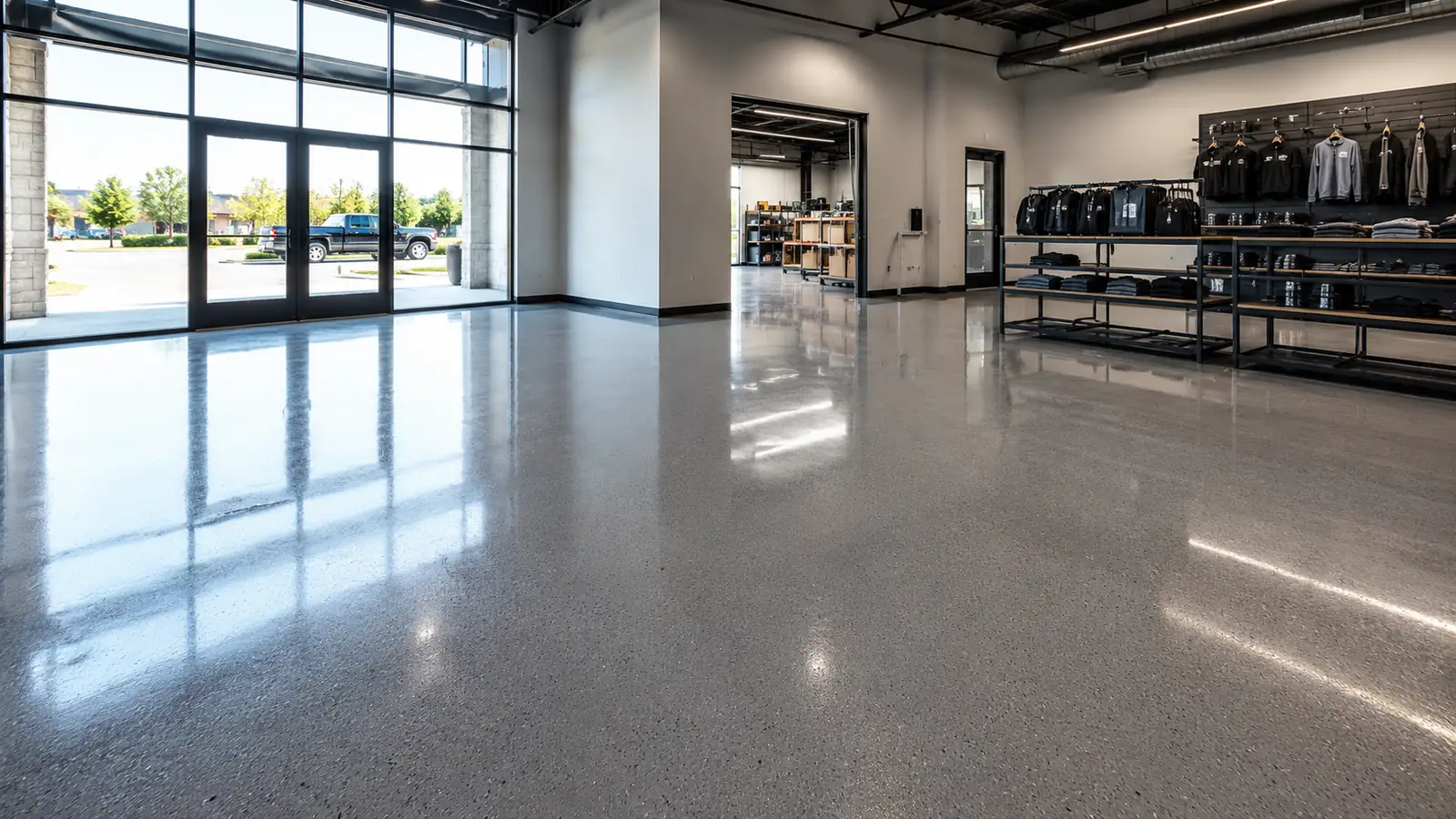
Epoxy flooring quotes in San Antonio can range from $5 to $15 or more per square foot for what looks like the same product on paper, and the gap almost never comes down to the installer padding the bill, even though that is usually the first assumption a business owner comparing quotes makes. It comes down to slab condition, coating system, and finish, three variables that do not show up in a one-line "epoxy floor" estimate but that determine most of what a business actually pays.
This guide breaks down commercial epoxy flooring cost in San Antonio for 2026, what drives the price beyond the square footage, and how it fits into a full buildout instead of being priced as a standalone finish decision independent of everything else happening in the space.
Quick Answer: Commercial epoxy flooring in San Antonio typically runs $6 to $15 per square foot installed, with solid-color systems on light-use floors at the lower end, around $5 to $8 per square foot, and heavy-duty industrial systems with thicker builds and specialized top coats running $10 to $15 or more per square foot. The single biggest cost driver is not the coating itself, it is the condition of the existing concrete slab: cracks, moisture, and prior coatings that need to be ground off before a new system can be applied can add $1 to $4 per square foot in prep work before a drop of epoxy goes down. Decorative systems, metallic and flake finishes in particular, add cost over solid color but are frequently requested for customer-facing retail and hospitality floors where appearance matters as much as durability.
Epoxy Flooring Cost by System and Finish
| System / Finish | Typical Cost per Sq Ft | Best Fit |
|---|---|---|
| Solid color epoxy, single coat | $5 to $8 | Light-use retail, office, showroom floors |
| Solid color epoxy, multi-coat with topcoat | $7 to $10 | Moderate traffic retail and commercial space |
| Flake broadcast system | $8 to $12 | Decorative retail, gyms, break rooms, added slip resistance |
| Metallic epoxy | $10 to $15+ | High-end retail, showrooms, restaurants wanting a signature floor |
| Quartz-filled system | $9 to $14 | Food service, healthcare, areas needing chemical and slip resistance |
| Heavy-duty industrial (thick-build, chemical-resistant topcoat) | $10 to $18+ | Warehouses, manufacturing floors, forklift traffic |
| Slab prep and repair (grinding, crack fill, moisture mitigation) | $1 to $4 additional | Any slab with cracks, prior coatings, or moisture issues |
Why Slab Condition Is the Real Cost Driver
Two identical 5,000 square foot warehouses in the same San Antonio submarket can receive wildly different epoxy quotes for the exact same coating system, and the difference is almost always the slab underneath, not the crew or the product being applied. A clean, level, previously uncoated slab with no moisture issues is the fastest and cheapest surface to prep, often just a mechanical grind or shot-blast to open the pores of the concrete before the epoxy is applied. A slab with an existing coating, visible cracks, or elevated moisture content needs that coating stripped, cracks filled and cured, and in some cases a moisture vapor barrier applied before epoxy will bond and hold. Skipping proper prep to save money on a problem slab is the single most common reason a commercial epoxy floor fails within the first year, showing up as bubbling, peeling, or delamination in isolated patches rather than a clean, uniform coating.
What "Prep Included" Actually Means on a Quote
The phrase "prep included" on an epoxy flooring quote means very different things from one contractor to another, and it is worth asking for a written definition rather than accepting the phrase at face value. For some contractors, included prep means a light mechanical scuff sufficient for a slab in good condition, with any crack repair or coating removal billed as an add-on once the crew is on site and finds a problem. For others, included prep genuinely covers full diamond grinding and minor crack repair as part of the base price, with only major structural issues billed separately. Getting a specific, written scope for what prep is and is not included, before signing, is what prevents a project from discovering a mid-installation change order once the crew starts grinding and finds conditions the quote did not account for.
Coating Systems: Solid Color, Flake, Metallic, and Quartz
- Solid color epoxy. The most cost-effective system, a uniform color coat that works well for back-of-house, warehouse, and budget-conscious retail applications where appearance is secondary to durability and cost.
- Flake broadcast systems. Colored vinyl flakes broadcast into a base coat and sealed with a clear topcoat, adding both visual texture and slip resistance, a common choice for gyms, break rooms, and retail floors that need to hide dirt and wear better than a solid color.
- Metallic epoxy. A decorative system using metallic pigments and solvent manipulation to create a marbled, three-dimensional visual effect, priced at the top of the range and typically reserved for customer-facing floors where the floor itself functions as a design feature.
- Quartz-filled systems. Colored quartz aggregate broadcast into the base coat, delivering strong chemical and slip resistance, a common specification for commercial kitchens, healthcare facilities, and any floor needing to meet a specific slip-resistance standard.
Color Choice and Practical Maintenance Impact
Color selection on a commercial epoxy floor is not purely aesthetic; it has a real, measurable effect on how the floor looks between cleanings. Very dark colors, particularly black and dark gray, show dust, tire marks, and fine scratches more visibly than a mid-tone gray or a color with some texture or fleck built in. Very light colors show oil stains, tire marks, and general grime more readily than a mid-tone. Facility managers who have run floors of different colors through years of daily use consistently report that mid-tone grays and colors incorporating a flake or texture element hide the between-cleaning wear that a true solid black or solid white floor makes immediately visible, which is worth factoring into a color decision beyond simply matching brand colors.
Epoxy Flooring by Commercial Use
| Business Type | Typical System | Key Consideration |
|---|---|---|
| Warehouse or distribution facility | Heavy-duty industrial, solid color | Forklift traffic, chemical resistance, thick-build for impact |
| Restaurant or commercial kitchen | Quartz-filled or heavy-duty | Health code slip resistance, chemical resistance to cleaning agents |
| Retail showroom | Metallic or flake broadcast | Appearance as a design feature, moderate foot traffic durability |
| Gym or fitness studio | Flake broadcast | Slip resistance, durability under equipment weight and movement |
| Auto shop or car wash | Heavy-duty industrial | Chemical resistance to oil, fluids, and cleaning chemicals |
| Office or professional space | Solid color or light flake | Lower traffic, cost efficiency prioritized over decorative finish |
San Antonio Climate and Slab Moisture
San Antonio sits on clay-heavy soil across much of the metro, and that soil composition affects slab moisture behavior more than a generic national cost guide accounts for. Clay soil expands and contracts significantly with moisture changes across the wet and dry seasons, which can drive moisture vapor transmission through a slab at levels that cause epoxy to fail even on a slab that looks structurally fine at the surface. A moisture vapor test before installation, not assumed from a visual inspection, is the difference between a floor that lasts a decade and one that needs to be redone within two years because the coating was applied over a slab pushing moisture through it faster than the coating could handle.
Installation Timeline and Cure Time
A standard commercial epoxy installation on a properly prepped slab typically takes two to five days depending on square footage and the number of coats specified, most of that time driven by cure time between coats rather than active labor. Full cure to handle heavy foot traffic is commonly 24 to 72 hours after the final coat, and full cure to handle vehicle or forklift traffic can run five to seven days. On a buildout with a fixed opening date, epoxy flooring needs to be scheduled toward the end of construction, after other trades that generate dust and debris are finished, but with enough buffer before opening day to allow full cure, which is a scheduling detail that gets missed when flooring is treated as a last-minute finish rather than a phase with its own real timeline.
Maintenance and Expected Lifespan
A properly installed commercial epoxy floor commonly lasts 10 to 20 years in light to moderate traffic settings and 5 to 10 years in heavy industrial use before a full recoat is needed, with lifespan driven far more by proper initial installation and slab prep than by the coating brand. Routine maintenance is comparatively simple, regular sweeping and occasional wet mopping with a pH-neutral cleaner, but harsh solvents and abrasive scrubbing pads can dull the topcoat's sheen and chemical resistance over time. A floor showing early wear, dulling, or hairline cracking well before its expected lifespan is more often a sign of inadequate slab prep at installation than a coating defect.
Slip Resistance and Code Requirements
Certain commercial occupancies have a real, enforceable slip-resistance requirement at the floor coefficient of friction level, most consistently in commercial kitchens and healthcare facilities where health and safety codes reference a minimum slip-resistance standard. A smooth, glossy solid-color epoxy that looks appealing in a showroom is the wrong specification for a commercial kitchen floor that will regularly have grease, water, and food debris on it, which is why quartz-filled and textured flake systems, not solid color, are the standard specification in food service. Getting this classification right at the time of specification, rather than after a health inspector flags a smooth floor in a wet-work area, avoids the cost of removing and replacing a coating that never should have been specified for that use in the first place.
Recoat vs. Full Removal: What Decides It
A floor showing surface wear, minor dulling, or light scratching after several years is almost always a candidate for a recoat, applying a fresh topcoat over the existing system after light mechanical prep, at a fraction of the cost of a full tear-out and reinstallation. A floor showing delamination, bubbling, or coating separating from the slab in patches is a different problem entirely, one that usually traces back to inadequate original slab prep or moisture intrusion, and recoating over that kind of failure just seals the same problem under a new layer rather than fixing it. The distinction matters financially: a recoat commonly runs a fraction of the original installation cost per square foot, while a full removal and reinstallation, grinding off the failed coating before starting over, can approach or exceed the original installation price once disposal and additional prep are factored in.
Sourcing Epoxy Flooring in San Antonio
San Antonio has a competitive market of epoxy and concrete coating specialists serving commercial and industrial clients, several with specific experience across retail, healthcare, and manufacturing environments. A companion guide, the best epoxy flooring companies in San Antonio, ranks the real contractors serving this market in detail.
Slab Prep Methods: Grinding, Shot Blasting, and Acid Etching
The method used to prepare a slab before coating affects both cost and the strength of the final bond, and not all prep methods are equivalent despite being marketed similarly. Diamond grinding uses rotating diamond-segmented discs to mechanically abrade the surface, opening the concrete's pores for the coating to bond into, and is the most common and most reliable method for commercial work. Shot blasting fires small steel shot at the surface at high velocity, achieving a similar profile to grinding but often faster on large open floor areas, making it a common choice for large warehouse and industrial slabs. Acid etching, once a standard low-cost method, has fallen out of favor for commercial work because it produces an inconsistent surface profile and does not remove existing coatings or address surface contamination the way mechanical methods do, and most reputable commercial installers no longer rely on it as a primary prep method for anything beyond very light residential work.
Permits and Inspection for Flooring Work
Flooring installation on its own typically does not require a separate building permit in most Texas jurisdictions when it is a surface-level finish applied to an existing slab with no structural work involved. Where flooring is part of a larger tenant improvement or new construction project, it falls under the umbrella of that project's overall building permit rather than needing its own separate approval, which is one more reason flooring benefits from being scheduled and permitted as part of the whole buildout rather than treated as an independent, unpermitted trade running parallel to the rest of construction.
Why This Belongs in the Buildout Budget, Not a Separate Bid
Epoxy flooring is frequently priced by business owners as a standalone bid obtained after the general contractor's scope is already set, which creates two recurring problems. First, the flooring contractor and the general contractor do not always agree on who is responsible for slab prep, leaving a gap where cracks or moisture issues get discovered mid-installation with no clear owner for the fix. Second, flooring scheduled independently of the rest of construction risks conflicting with other trades still generating dust or requiring access to the same floor area. Prestige 360 Design specifies and schedules epoxy flooring as part of the full commercial buildout, coordinating slab prep responsibility and sequencing the flooring phase against the rest of the construction schedule so the floor goes down once, correctly, rather than needing rework because of a coordination gap between two separately hired contractors.
Key Takeaways
- Commercial epoxy flooring in San Antonio runs $6 to $15 per square foot, with solid color at the lower end and heavy-duty industrial or metallic systems at the higher end.
- Slab condition, not the coating itself, is the real cost driver: prep work for cracks, moisture, or existing coatings can add $1 to $4 per square foot.
- San Antonio's clay-heavy soil makes moisture vapor testing before installation especially important, since moisture transmission through the slab is a leading cause of early coating failure.
- Full installation takes two to five days, with cure time before vehicle or forklift traffic reaching five to seven days.
- A properly installed floor lasts 10 to 20 years in light to moderate use, with lifespan driven more by installation quality than by coating brand.
- Coordinating epoxy flooring inside the full buildout, rather than as a separately bid trade, prevents disputes over slab prep responsibility and scheduling conflicts with other construction trades.
Frequently Asked Questions
How much does commercial epoxy flooring cost in San Antonio?
Commercial epoxy flooring in San Antonio typically runs $6 to $15 per square foot installed. Solid-color systems on light-use floors run $5 to $8 per square foot, while heavy-duty industrial systems and decorative metallic finishes run $10 to $15 or more per square foot.
Why do epoxy flooring quotes vary so much for the same size floor?
The condition of the existing concrete slab is the biggest cost driver. A clean, level slab with no moisture issues costs less to prep than a slab with cracks, prior coatings, or elevated moisture, which can add $1 to $4 per square foot in prep work before installation begins.
Does San Antonio's soil and climate affect epoxy floor installation?
Yes. San Antonio's clay-heavy soil drives significant moisture vapor transmission through concrete slabs, which is a leading cause of epoxy coating failure. A moisture vapor test before installation, rather than a visual inspection alone, helps confirm the slab is ready for coating.
How long does a commercial epoxy floor last?
A properly installed commercial epoxy floor commonly lasts 10 to 20 years in light to moderate traffic and 5 to 10 years in heavy industrial use before a full recoat is needed. Lifespan depends more on installation quality and slab prep than on coating brand.
Should epoxy flooring be bid separately from the general contractor's scope?
Bidding it separately often creates a gap in responsibility for slab prep between the flooring contractor and the general contractor. Coordinating epoxy flooring inside the full buildout scope keeps slab prep responsibility clear and sequences the flooring phase correctly against other construction trades.
Prestige 360 Design coordinates commercial epoxy flooring as part of full buildout projects across San Antonio. Talk to our team about scheduling your flooring phase correctly against the rest of your construction timeline.
Related Services