Insights
Pharmacy Design and Layout in Texas (2026): Workflow, Compliance, Buildout
June 5, 2026
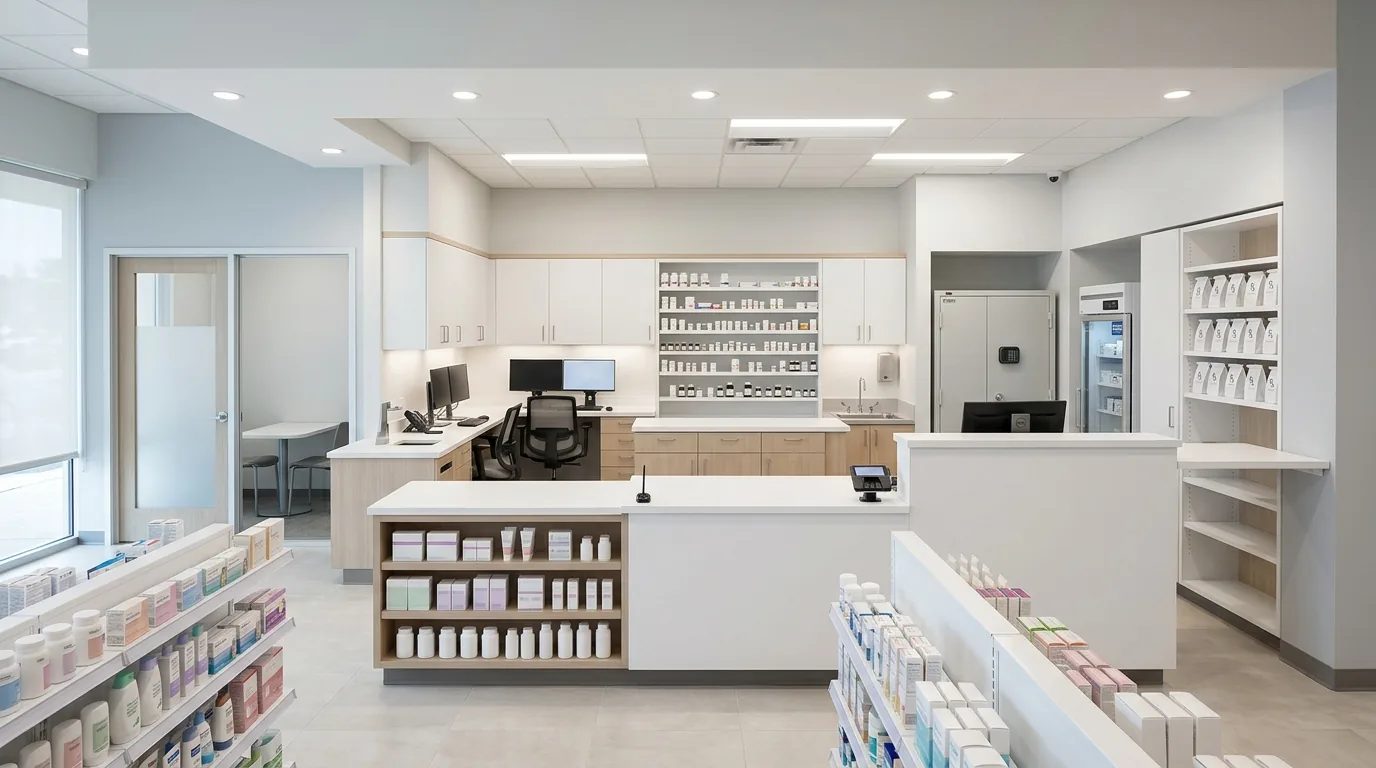
Quick Answer: A pharmacy layout in Texas is organized around the prescription workflow: drop-off, data entry, filling, pharmacist verification, and pickup, arranged so a prescription moves in one direction without backtracking. Around that spine you add secured storage for controlled substances, refrigeration for temperature-sensitive drugs, a private or semi-private counseling area for patient consultation, and a retail front for over-the-counter products. If you compound, you add dedicated USP-compliant rooms that carry their own ventilation and finish requirements. Design the workflow first; the room sizes and the plumbing and power follow from it.
Workflow Is the Floor Plan
Unlike a retail store, a pharmacy is a production environment. A prescription enters, moves through a defined series of steps, and leaves, and the layout either supports that flow or fights it all day. The single most important design decision is to lay out the workflow as a one-directional path, from intake to data entry to filling to pharmacist verification to pickup, so staff are not crossing paths or doubling back. A pharmacy designed as an open counter with no workflow logic slows every fill and increases error risk.
This is why a pharmacy is best designed from the operation outward, not from the four walls inward. The bench length, the shelving runs, the verification station sight lines, and the pickup counter are sized to the prescription volume and staffing. A thoughtful commercial space planning process maps the workflow before the walls, so the build serves the pharmacy’s daily throughput rather than constraining it.
A prescription should move in one direction. When the floor plan forces filled prescriptions back across the intake area, every fill costs extra steps and the verification sight lines suffer. Linear workflow is the heart of a good pharmacy layout.
The Core Pharmacy Zones
Most community pharmacies share a common set of functional zones. The proportions change with volume and services, but the zones and their relationships are consistent, and each carries its own utility and security needs.
| Zone | Function and Key Needs |
|---|---|
| Drop-off and intake | Receive prescriptions, queue management, ADA counter |
| Data entry and adjudication | Workstations, power and data, quiet focus |
| Filling and inventory | Shelving, counting, organized stock, work surface |
| Verification | Pharmacist station with sight lines over the operation |
| Will-call and pickup | Organized storage of completed scripts, ADA counter |
| Retail front of house | Over-the-counter products, low shelving, sight lines |
The pharmacist verification station deserves special attention because the pharmacist must legally oversee the operation. Its placement should command sight lines over filling, intake, and counseling so supervision is built into the geometry. The retail front, by contrast, follows familiar retail space planning logic, with low shelving and clear sight lines that keep the front secure and shoppable while the pharmacy operates behind it.
Compliance That Shapes the Build
A pharmacy is licensed and inspected by the Texas State Board of Pharmacy, and several requirements directly shape the construction. Controlled substances must be stored securely, which means a safe or substantially constructed, locked storage area with controlled access. Temperature-sensitive medications require dedicated, monitored refrigeration. A sink for hand hygiene and drug preparation is required. Security, alarms, and restricted access to the prescription area are expected.
| Requirement | Build Impact |
|---|---|
| Secured controlled-substance storage | Safe or hardened locked area, access control |
| Refrigeration for temperature-sensitive drugs | Dedicated power, monitoring, sometimes backup |
| Hand-hygiene and prep sink | Plumbing at the filling area |
| Restricted access to the prescription area | Barriers, doors, alarm and camera systems |
| Counseling area for patient privacy | Dedicated semi-private or private space |
These requirements are why a pharmacy cannot simply occupy a generic retail box without targeted construction. The secured storage, the monitored refrigeration, the prep sink, and the access control all have to be designed and built in, and they should be confirmed against the current Board rules during design rather than discovered at inspection.
Counseling and Privacy
Patient counseling is both a professional duty and a design requirement. Pharmacies are expected to offer a reasonable degree of privacy for the pharmacist to counsel a patient, which means a dedicated consultation area, semi-private or fully enclosed, rather than a conversation over an open counter. With patient health information involved, this privacy also supports HIPAA expectations.
A counseling space is not a luxury, it is part of practicing pharmacy. Designing a private or semi-private consultation area into the plan from the start avoids the awkward, non-compliant solution of counseling patients across a busy open counter.
The consultation area works best near the pickup point, so a patient receiving a new prescription can step aside for counseling without disrupting the queue. Placing it thoughtfully keeps the workflow moving while honoring the privacy the interaction requires.
Compounding Spaces
If the pharmacy compounds, the design grows significantly more demanding. Non-sterile compounding, sterile compounding, and hazardous-drug compounding each carry United States Pharmacopeia expectations, commonly referenced as USP 795 for non-sterile, USP 797 for sterile, and USP 800 for hazardous drugs. Sterile and hazardous compounding in particular require controlled environments with specific ventilation, pressure relationships, and finishes that are far beyond a standard pharmacy fit-out.
For an operator planning to compound, these rooms are the most expensive and technically exacting part of the build, involving cleanroom construction, dedicated air handling, and validated finishes. Deciding early whether and how the pharmacy will compound is essential, because adding compliant sterile or hazardous compounding later is far more disruptive and costly than designing it in from the start.
What a Pharmacy Buildout Costs
A pharmacy buildout ranges widely because the services define it. A straightforward community pharmacy with a clean workflow, secured storage, refrigeration, and a counseling room is a moderate commercial fit-out. Add sterile or hazardous compounding cleanrooms and the cost rises sharply with the specialized construction and air handling.
As with any tenant project, the starting condition of the space and the landlord allowance shape the real number. A second-generation pharmacy or clinical space with usable plumbing, power, and security in place costs less to adapt than a raw shell. Our breakdown of commercial buildout cost in 2026 covers how these elements flow into a project total, and tenant improvement cost per square foot in Texas explains how the landlord allowance reduces what the operator actually pays.
What We See in Texas Pharmacy Buildouts
When we design pharmacies across Texas, the projects that run smoothly are the ones that locked the workflow before the walls. We map the prescription path, intake to verification to pickup, as a one-directional flow first, then size the benches, shelving, and stations to the expected volume. Pharmacies designed around an arbitrary counter shape almost always fight their own layout later.
The second pattern is the compounding decision made too late. Whether the pharmacy will compound, and at what level, changes the entire build, because sterile and hazardous compounding require cleanroom construction and dedicated ventilation. We force that decision early so the rooms are designed in, not bolted on at multiples of the cost.
The third is security and the controlled-substance area. Operators sometimes treat secured storage as a cabinet to add at the end. We design the hardened storage, access control, alarms, and cameras into the plan from the start, because retrofitting compliant security into a finished space is disruptive and expensive.
The fourth is counseling privacy. A surprising number of layouts leave no real place to counsel a patient privately. We place a dedicated consultation area near the pickup so the pharmacy meets its privacy duty without breaking the workflow, and so the inspector sees compliance designed in rather than improvised.
Key Takeaways
- Design the prescription workflow first; a one-directional path from intake to verification to pickup is the heart of a pharmacy layout.
- Core zones are drop-off, data entry, filling, pharmacist verification, will-call pickup, and a retail front, each with its own utility and security needs.
- Texas State Board of Pharmacy requirements drive the build: secured controlled-substance storage, monitored refrigeration, a prep sink, and restricted access.
- A private or semi-private counseling area is part of practicing pharmacy and supports patient privacy; design it near the pickup point.
- Compounding, especially sterile (USP 797) and hazardous (USP 800), requires cleanroom construction and ventilation; decide early because it dominates cost.
- Starting from a second-generation pharmacy or clinical space and using the landlord allowance materially lowers the buildout cost.
Frequently Asked Questions
What is the most important principle in pharmacy layout design?
A one-directional prescription workflow. The layout should move a prescription from drop-off to data entry to filling to pharmacist verification to pickup without staff backtracking or crossing paths. This linear flow speeds every fill, reduces error risk, and gives the pharmacist clear sight lines to supervise the operation as required. Designing the workflow first, then sizing benches, shelving, and stations to the prescription volume, produces a far more efficient pharmacy than arranging a counter and forcing the workflow to fit it.
What construction does Texas pharmacy compliance require?
A pharmacy licensed by the Texas State Board of Pharmacy must provide secured storage for controlled substances with controlled access, monitored refrigeration for temperature-sensitive medications, a sink for hand hygiene and preparation, restricted access to the prescription area with appropriate alarms and cameras, and a counseling area offering patient privacy. These items must be designed and built in, which is why a pharmacy cannot simply occupy a generic retail box. Confirm the current Board rules during design rather than discovering requirements at inspection.
How does compounding change a pharmacy buildout?
Compounding adds dedicated rooms that follow United States Pharmacopeia standards: USP 795 for non-sterile, USP 797 for sterile, and USP 800 for hazardous drugs. Sterile and hazardous compounding require controlled cleanroom environments with specific ventilation, pressure relationships, and validated finishes, which are far more demanding and costly than a standard pharmacy fit-out. Decide early whether and at what level the pharmacy will compound, because designing these rooms in from the start is far cheaper and less disruptive than adding compliant compounding later.
Can a pharmacy go into a standard retail space?
A retail space can become a pharmacy, but it needs targeted construction, not just shelving. You must add secured controlled-substance storage, monitored refrigeration, a preparation sink, restricted access and security systems, and a private counseling area, and arrange the prescription workflow as a one-directional path. A second-generation pharmacy or clinical space with usable plumbing, power, and security already in place costs significantly less to adapt than a raw retail shell, so the starting condition of the space strongly affects the budget.
Design a Pharmacy That Works the Way You Fill
An efficient pharmacy starts with the workflow and the compliance built into the floor plan. Prestige 360 Design plans and designs community and clinical pharmacies across Texas, mapping the prescription path, designing secured storage and counseling privacy, and scoping compounding rooms when needed. Contact us to lay out a pharmacy around your workflow and your compliance.