Insights
Commercial Space Planning Guide: What Texas Business Owners Must Do Before Construction Starts
May 30, 2026

Commercial Space Planning Guide: What Texas Business Owners Must Do Before Construction Starts
Quick Answer: Commercial space planning is the technical process of translating a business’s operational needs into a compliant, functional floor plan before any construction begins. It is distinct from interior design in that it focuses on program, structure, code, and constructibility rather than aesthetics. In Texas, skipping or shortcutting this process is one of the most reliable ways to spend $20,000 or more correcting a mistake that should have been found on paper.
What Space Planning Actually Is (vs. Interior Design)
Business owners frequently conflate space planning with interior design. They are related disciplines that overlap in practice, but they answer different questions. Interior design asks: how should this space look, feel, and function for the people who use it? Space planning asks: can this space physically accommodate the program the business requires, and if so, how?
Space planning is fundamentally a technical and analytical exercise. It involves measuring the actual usable square footage of a space (which is rarely equal to the rentable square footage on your lease), identifying structural constraints, assessing mechanical, electrical, and plumbing capacity, confirming code compliance for the intended use, and producing a floor plan that locates every function in a position that is constructible, code-compliant, and operationally efficient.
Interior design, in the traditional sense, begins after space planning is complete. A space planner tells you where the walls, doors, plumbing fixtures, and electrical panels go. An interior designer then specifies finishes, furniture, lighting, and the experiential qualities of the space. In practice, commercial interior designers in Texas often perform both functions, particularly for tenant improvement projects in the $100,000-$500,000 range. But the distinction matters when you are hiring: a firm that leads with aesthetics and backs into code compliance is not the same as one that leads with your operational program and builds the design around it.
The output of space planning is a set of documents that typically includes: a dimensioned floor plan, a test-fit diagram showing that all required functions fit within the leased space, a code analysis confirming occupancy classification and egress compliance, and a preliminary coordination of mechanical, electrical, and plumbing requirements. These documents become the basis for construction documents and contractor bidding. Without them, your contractor is guessing, and guesses in construction cost money.
The 5-Stage Space Planning Process
A properly executed commercial space planning engagement follows five stages. Each stage must be completed before the next begins. Compressing stages or skipping them is how projects go sideways.
Stage 1: Programming. Programming is the information-gathering stage. The designer interviews key stakeholders to understand the business’s operational requirements: how many people will work in the space, what functions must be accommodated, what equipment and technology will be used, how the business receives and processes clients or customers, what growth is expected over the lease term, and what adjacencies are critical (which departments need to be near each other, which need separation). Programming also reviews any existing standards the business uses, such as corporate workplace standards for a franchise or corporate office, or clinical standards for a medical practice. The output is a written program document that lists every space, its required size, its required adjacencies, and its technical requirements.
Stage 2: Schematic Design. With the program in hand, the designer produces multiple block plans or bubble diagrams that explore how the program can be arranged within the physical space. This stage is intentionally loose. The goal is to test feasibility and identify the two or three layout options that best satisfy the program. A business owner typically reviews two or three schematic options and provides feedback before the designer proceeds. This is the cheapest stage at which to change your mind. Changes in schematic design are made with an eraser. Changes in construction documents require redrawing. Changes in construction require demolishing work already completed.
Stage 3: Design Development. The approved schematic is refined into a detailed floor plan with dimensioned rooms, door locations, partition heights, and preliminary specifications for finishes, casework, and MEP (mechanical, electrical, plumbing) requirements. This is the stage at which structural limitations, plumbing feasibility, and electrical capacity are fully resolved. If a proposed wall location conflicts with a structural beam or column, it gets moved in design development, not in the field.
Stage 4: Construction Documents (CDs). Construction documents are the full set of drawings and specifications that contractors use to build and that the city or county uses for permit review. For most commercial tenant improvements in Texas, CDs include: architectural floor plans, reflected ceiling plans, interior elevations, finish and fixture schedules, and coordinate drawings for mechanical, electrical, and plumbing. The CD set must be prepared and sealed by a licensed architect or engineer in Texas for projects that require a building permit. The permit threshold varies by jurisdiction but generally applies to any project involving structural work, new plumbing, or a change of occupancy.
Stage 5: Construction Administration. During construction, the design team reviews shop drawings, responds to contractor RFIs (requests for information), conducts site visits to verify work conforms to the CDs, and reviews applications for payment. This stage is often skipped by owners who believe they can manage the contractor directly. This is a false economy. A designer who observes the work catches substitutions, errors, and deviations before they become permanent. Construction administration typically costs 10-15% of the total design fee and saves multiples of that cost in error correction.
How to Calculate Square Footage Per Employee and Function
The most common space planning error is underestimating how much space different business functions require. Business owners routinely assume that more people can fit into a given footprint than is practical. The results are waiting areas that cannot accommodate peak patient load, open offices that are too loud to concentrate in, and conference rooms too small to seat the number of people who need to use them simultaneously.
Industry standards for commercial space by use type exist, but they are guidelines rather than requirements. The right answer for your business depends on your specific program, culture, and operational model. A law firm with senior partners who each need a private office requires substantially more square footage per person than a creative agency using an open bench model. Use these standards as a starting point, not an endpoint.
| Business / Function Type | Conservative (sq ft/person) | Moderate (sq ft/person) | Generous (sq ft/person) |
|---|---|---|---|
| Open plan office (workstation) | 80-100 | 100-150 | 150-200 |
| Private office (manager/director) | 100-120 | 120-150 | 150-200 |
| Executive office | 150-200 | 200-250 | 250-350 |
| Medical exam room (per patient) | 80-100 | 100-120 | 120-150 |
| Retail (per customer simultaneously) | 20-30 | 30-50 | 50-80 |
| Restaurant dining (full service) | 12-15 | 15-20 | 20-30 |
| Conference room (per seat) | 20-25 | 25-30 | 30-40 |
| Waiting area (per seat) | 15-18 | 18-25 | 25-35 |
When calculating total space needs, do not forget support functions. A 10-person office needs a break room (minimum 150-200 sq ft), a server or IT closet (minimum 60-80 sq ft), a supply and copy area (80-120 sq ft), restrooms (sized per IBC occupant load), and circulation. Circulation (the area consumed by corridors, lobbies, and pathways) typically adds 25-35% to the sum of all programmed spaces. A business that needs 1,500 square feet of net programmed space typically needs 1,900-2,000 square feet of gross leased space.
Rentable versus usable square footage is the other critical concept. Commercial leases are often quoted in rentable square footage, which includes a proportionate share of building common areas (lobbies, corridors, restrooms, mechanical rooms) added to your actual usable space via a “load factor” or “loss factor.” Load factors in Texas commercial buildings typically run 10-20% for multi-tenant office buildings. A space listed at 3,000 rentable square feet might provide only 2,500-2,600 usable square feet for your actual program. Always verify the usable square footage before assuming a space will fit your program. For detailed guidance on commercial lease evaluation, read our guide on what to check before signing a commercial lease in Texas.
Load-Bearing vs. Non-Load-Bearing: Why It Matters Before You Draw One Line
Before a single wall location is drawn in a space plan, the designer must understand the structural system of the building. This is not optional. Proposing a wall removal or opening in a load-bearing location without structural review can result in a building permit rejection, a contractor refusing to proceed, or, in the worst case, a structural failure.
In Texas commercial construction, the most common structural systems for the types of buildings where small businesses lease space are: concrete tilt-wall with steel joists and a metal deck roof, steel moment frame with a metal deck floor system, and wood-frame construction (primarily in smaller suburban strip centers). Each system has different characteristics for where structural elements are located and which partitions can be removed or relocated.
In tilt-wall construction, the exterior walls are load-bearing and cannot be penetrated for windows or doors without structural engineering review. Interior columns are typically exposed steel or concrete. The ceiling structure (joists and deck) spans between the exterior walls and interior columns, meaning interior partitions below the ceiling are almost universally non-load-bearing and can be relocated freely. This makes tilt-wall buildings highly flexible for tenant improvement work.
In older multi-story office buildings, interior masonry walls or concrete shear walls may be load-bearing even though they appear to be interior partitions. A space planner who has not reviewed the structural drawings of the building cannot know this from visual inspection alone. The space planner should always request as-built structural drawings from the building owner as part of the programming phase. Landlords are required to provide these in Texas if they exist. If they do not exist (common in older buildings), the project budget should include a structural engineer’s field investigation to identify load-bearing conditions before design proceeds.
Utility Capacity Assessment: The Step Most Owners Skip
The utility capacity assessment is the second most commonly skipped step in commercial space planning, after structural review. It is also the step whose absence most reliably produces expensive mid-construction surprises.
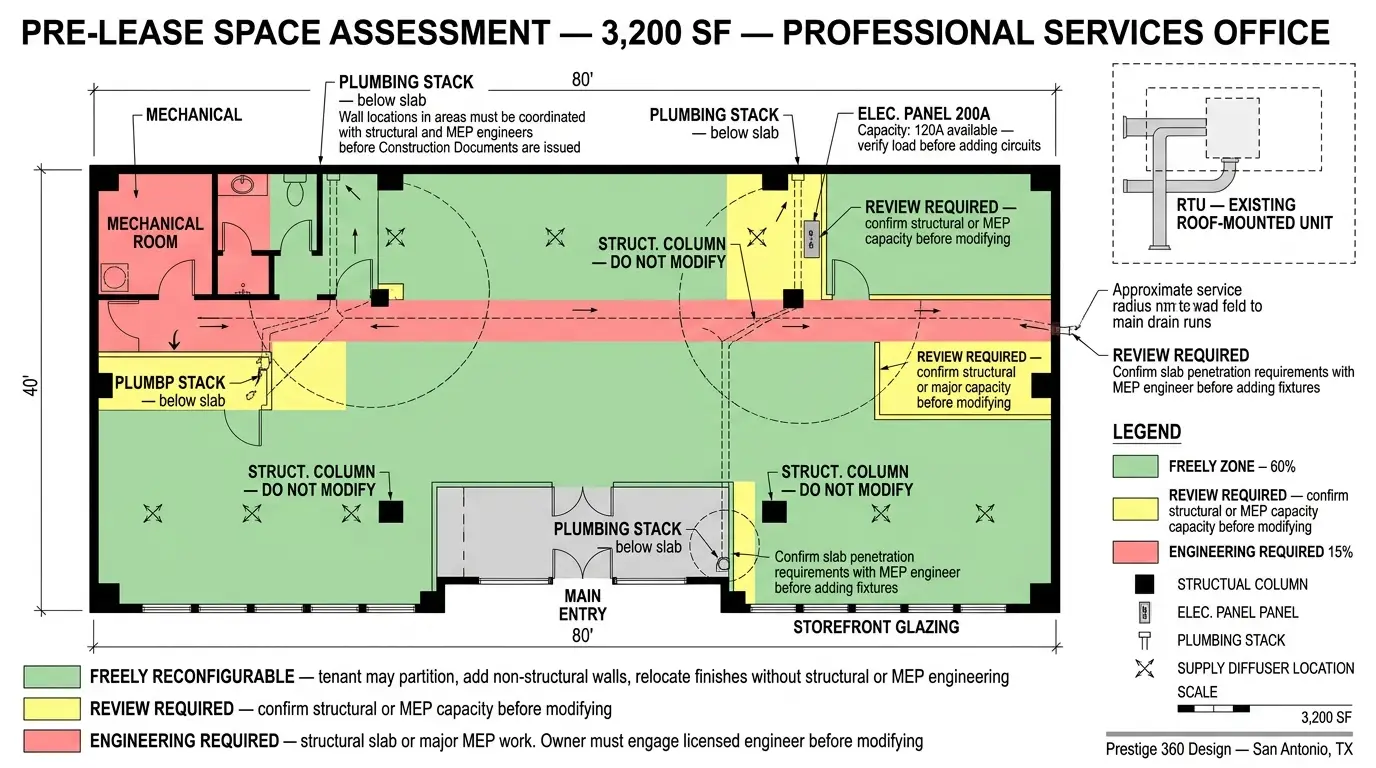
Every commercial space has three utility systems that must be assessed before a space plan is finalized: electrical, mechanical (HVAC), and plumbing. Each has a finite capacity, and each has a cost to upgrade if the planned use exceeds the existing capacity.
Electrical capacity is measured in amps. A typical small commercial suite in Texas is served by a 100-200 amp, 208V panel. A medical clinic, a restaurant, a beauty salon, or any business with significant equipment loads may need 400 amps or more. Upgrading electrical service from 100 amps to 400 amps requires a new electrical service entrance, a larger panel, and coordination with the utility provider. In San Antonio (CPS Energy) and Austin Energy territories, utility upgrades require a service application that can take 6-12 weeks to approve and schedule. This delay does not wait for your lease commencement date. Discover the need before you sign the lease, not after.
Real Cost of Missing a Utility Upgrade: A dental practice that leased a 1,800-square-foot suite in a North San Antonio strip center without a utility assessment discovered during construction that the existing electrical service could not support four dental chairs, an autoclave, a digital X-ray unit, and HVAC simultaneously. The service upgrade cost $18,500, required a 10-week CPS Energy scheduling delay, and pushed the opening date back 11 weeks, costing an additional $22,000 in lease payments for a space that was not generating revenue. Total preventable cost: $40,500. The pre-lease electrical assessment that would have caught this costs approximately $800-$1,500.
HVAC capacity is measured in tons of cooling and BTUs of heating. Standard commercial HVAC load calculations assume approximately 1 ton of cooling per 350-500 square feet for office use. A restaurant kitchen, a medical procedure room, a server room, or a fitness studio has dramatically different load requirements. If the existing HVAC system was sized for a previous tenant whose use was less demanding than yours, the system will not keep up, and the fix requires either replacing equipment or adding supplemental units. Both options are significantly more expensive than addressing the mismatch at the design stage.
Plumbing capacity matters for any business that needs more fixtures than the previous tenant had. A restaurant, a medical clinic, a salon, or any business with sinks, drains, or specialized plumbing needs must verify that the building’s main drain line has adequate capacity and that the water service is sized appropriately. In older buildings, the main drain line may be cast iron in poor condition, or the water heater may be undersized for a multi-fixture operation.
Texas Zoning and Building Code Triggers
Texas does not have a statewide zoning law. Zoning is administered by individual municipalities under their local land use ordinances. In San Antonio, Austin, Dallas, and Houston, the city’s zoning ordinance determines what uses are permitted in a given location. Before leasing a space, confirm that your intended use is permitted or conditionally permitted under the current zoning designation. This is not the landlord’s responsibility. It is yours.
Common use-category mismatches in Texas commercial leasing include: a medical clinic in a space zoned for retail but not healthcare, a restaurant in a space zoned for office use, a child care center in a building that lacks the required outdoor play area per the city’s development code, and a fitness studio in an office building whose occupancy classification does not allow assembly use. Zoning relief (variances, special use permits) is possible but takes 60-180 days and is not guaranteed.
Texas building codes are based on the International Building Code (IBC) as adopted by the state with local amendments. Building code triggers for tenant improvements in Texas include:
- Change of occupancy classification (e.g., from office/Business B to medical/Healthcare I-2) requires a full code compliance review for the new occupancy, including egress, fire suppression, and accessibility
- Any work valuation exceeding the jurisdiction’s permit threshold (typically $1,000 in most Texas cities) requires a building permit
- Adding or relocating plumbing fixtures requires a plumbing permit issued separately from the building permit
- HVAC modifications require a mechanical permit
- Electrical work beyond simple fixture replacement requires an electrical permit
The most significant code trigger for Texas tenant improvement work is an occupancy change. If you are moving into a space previously occupied by a different use type, the building must comply with current code for your use type. In practical terms, this means: if a previous tenant was an office and you are opening a restaurant, you may need to upgrade the fire suppression system, add a grease trap, upgrade the HVAC to commercial kitchen standards, and bring the restrooms into compliance with current ADA and code requirements. These are not optional. They are conditions of the certificate of occupancy.
What We See on Texas Space Planning Projects
We have done pre-lease space planning assessments and full space planning engagements for businesses across San Antonio, Austin, and the Hill Country. These are the patterns we see repeatedly.
The single most common and costly mistake is signing a lease before engaging a space planner. Business owners are often under time pressure during lease negotiation and defer the space planning engagement until after the lease is executed. By that point, the landlord’s tenant improvement allowance has been negotiated, the lease term has started, and the business owner discovers that the space requires a $40,000 electrical upgrade that the landlord’s TI allowance does not cover. A pre-lease test fit and utility assessment, which costs $2,500-$6,000, would have either revealed the issue in time to negotiate a larger TI allowance or prompted the owner to walk away from a space that was not viable for their use.
We also see business owners who underestimate growth. A professional services firm that starts with 6 employees takes 2,000 square feet. Eighteen months later they have 11 employees and no room to grow without moving or subleasing adjacent space. If the lease is for 5 years, they are now locked into a space that does not work for the next 3.5 years. Space planning that accounts for 3-year growth projections at the outset adds very little square footage cost and prevents a lease-term crisis.
The third pattern is a failure to coordinate the space plan with the building’s existing conditions. A designer who produces a space plan without reviewing as-built drawings, verifying plumbing stack locations, or confirming ceiling height under structural members produces a plan that looks good on paper and does not work in the field. The contractor who builds from that plan generates RFIs, change orders, and delays that cost more than the design savings.
Cost to Hire a Space Planner in Texas
Space planning services in Texas are priced three ways: as a flat fee for a defined deliverable (most common for pre-lease test fits), as a percentage of construction cost (most common for full-service engagements that include construction documents), or as an hourly rate (most common for limited-scope advisory engagements).
| Service Type | Typical Fee Range | What Is Included |
|---|---|---|
| Pre-lease test fit (single option) | $1,500-$3,500 | One floor plan option, basic code check, written summary |
| Pre-lease test fit (multiple options) | $3,500-$6,000 | 2-3 floor plan options, utility assessment summary, code analysis |
| Full space planning (programming through DD) | $8,000-$20,000 | Programming, schematic design, design development drawings |
| Full design service (through CDs) | 8-12% of construction cost | All stages through permit-ready construction documents |
| Full service including construction admin | 10-15% of construction cost | All stages through project closeout |
| Hourly advisory (code, utilities, review) | $125-$200/hour | Expert review, answering specific questions, reviewing contractor proposals |
| Project Complexity | Description | Estimated Design Timeline | Permit Timeline |
|---|---|---|---|
| Simple | Same occupancy, no structural changes, cosmetic improvements only | 2-4 weeks | 2-4 weeks (or over-the-counter) |
| Moderate | New partitions, plumbing additions, HVAC modifications | 4-8 weeks | 4-8 weeks |
| Complex | Occupancy change, structural modifications, MEP upgrades | 8-16 weeks | 8-16 weeks |
| Healthcare / Regulated | DSHS-regulated facilities, ASCs, licensed care | 12-20 weeks | 16-24 weeks (includes DSHS review) |
For context on what construction itself will cost once the space plan is complete, see our guides on tenant improvement costs per square foot in Texas and restaurant buildout costs in Texas. For medical office projects specifically, see our medical office layout design guide.
Key Takeaways
- Space planning is a technical discipline focused on feasibility, code compliance, and operational efficiency. It precedes interior design, it does not replace it.
- The 5-stage process (programming, schematic design, design development, construction documents, construction administration) must be followed in order. Compressing stages produces expensive errors.
- Usable square footage is 10-20% less than rentable square footage in most Texas commercial buildings. Always verify before assuming a space fits your program.
- Structural conditions must be reviewed before any wall locations are proposed. Request as-built structural drawings from the landlord before signing a lease.
- Electrical, HVAC, and plumbing capacity assessments must occur before lease execution, not after. Utility upgrades discovered mid-construction routinely add $15,000-$50,000 to project costs.
- Texas zoning and building occupancy classifications are separate from each other. A use permitted by zoning may still trigger a code-required occupancy change review that requires significant building upgrades.
- Pre-lease space planning assessments cost $1,500-$6,000. They routinely prevent mistakes that cost $20,000-$80,000 to correct after construction begins.
- Full-service space planning and design fees run 10-15% of construction cost. This is not an optional expense. It is the document set that controls your construction cost.
Frequently Asked Questions
What is commercial space planning and why does it matter?
Commercial space planning is the process of analyzing a business’s operational requirements and translating them into a buildable, code-compliant floor plan before construction begins. It covers square footage analysis, structural assessment, utility capacity review, zoning confirmation, and preliminary MEP coordination. It matters because mistakes caught on paper cost nothing to fix. Mistakes caught during or after construction routinely cost $20,000-$100,000 to correct, in addition to the delay costs of pushing back an opening date.
How much does a commercial space planner cost in Texas?
A pre-lease test fit in Texas costs $1,500-$6,000 depending on scope. A full space planning engagement through construction documents is typically priced at 8-12% of total construction cost. For a $250,000 tenant improvement, that means $20,000-$30,000 in design fees. Full-service engagements that include construction administration run 10-15% of construction cost. Hourly rates for advisory work run $125-$200 per hour for experienced commercial designers in San Antonio and Austin.
Do I need a permit for commercial tenant improvement work in Texas?
Most Texas cities require a building permit for any tenant improvement work that involves structural changes, new or relocated plumbing, HVAC modifications, or electrical work beyond simple fixture replacement. San Antonio, Austin, and most other Texas municipalities set the permit threshold at a valuation of $1,000 or more in work. Cosmetic work (paint, flooring replacement, furniture) typically does not require a permit. Work involving a change of occupancy classification requires a full code review regardless of the dollar amount of the work.
How much square footage does a commercial office need per person in Texas?
Industry standards for office space in Texas run 80-150 square feet per person for open-plan workstations, 120-200 square feet per person for private offices, and 20-30 square feet per seat for conference rooms. These figures represent net programmed space. Add 25-35% for circulation, support spaces, and common areas to arrive at total usable square footage needed. Then account for the building’s load factor (typically 10-20%) to determine the rentable square footage you need to lease.
Start Your Space Planning Process the Right Way
Prestige 360 Design provides pre-lease space planning assessments and full commercial design services for businesses across San Antonio, Austin, and the Texas Hill Country. We specialize in tenant improvement projects where getting the program right before construction starts determines whether the project comes in on budget and on time.
Contact our team to schedule a space planning consultation before your next lease signing or construction kickoff.