Insights
Coworking Space Design: Layout, Density, and Texas Buildout Guide (2026)
June 1, 2026
Coworking Space Design: Layout, Density, and Texas Buildout Costs (2026)
Quick Answer: A successful coworking layout balances density against experience. Plan roughly 50 to 80 square feet per member across the whole floor depending on the mix of hot desks, dedicated desks, and private offices, separate quiet focus zones from social cafe zones so noise does not bleed, and provide one phone booth per 8 to 10 members and one meeting room seat per 5 to 6 members. Acoustics, not desks, are the factor that decides whether members renew, so the acoustic strategy must be designed in from the first floor plan rather than added after complaints.
Zoning a Coworking Floor
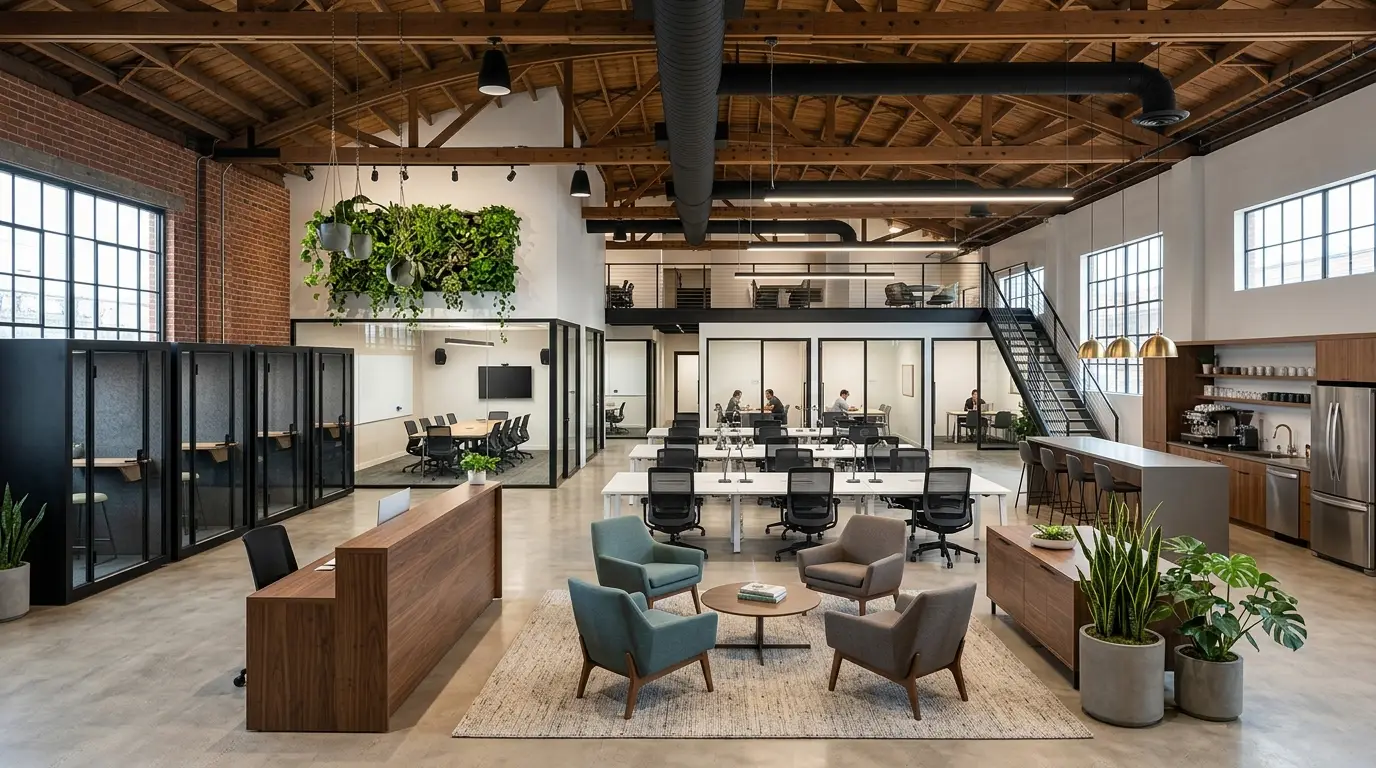
A coworking space is really several different workplaces sharing one envelope, and the design challenge is keeping their conflicting needs from colliding. The core zones are: reception and community front desk, open hot-desk seating, dedicated desk areas, private offices, phone booths, meeting and conference rooms, a lounge or social zone, and a cafe or pantry. Some spaces add wellness rooms, event areas, and podcast or content studios.
The single most important zoning decision is the separation of loud and quiet. The cafe, lounge, reception, and collaborative areas generate noise and energy. The dedicated desks, private offices, and focus rooms need calm. When these two worlds are mixed on an open floor, the members who pay the most (dedicated desk and private office members) are the ones disrupted, and they are the ones who churn. Place the social spine near the entrance and push the quiet, high-value zones to the back or to a separate acoustic enclosure.
Circulation is the connective tissue. Coworking members move constantly between their desk, the coffee, a phone booth, and a meeting room. Wide, legible aisles (a minimum of 44 inches, often 60 inches in primary paths) keep that movement from disturbing seated members and satisfy accessibility requirements at the same time. For a deeper look at planning an open commercial floor, see our guide on commercial space planning.
Member Density and the Economics of Space
Density is where coworking design meets the business model directly. Pack too many members in and the space feels cramped, acoustics degrade, and renewals fall. Spread too few and the space cannot cover its lease. The right density depends on the membership mix and the market positioning, from budget high-density operators to premium boutique spaces.
| Membership Type | Usable Sq Ft Per Member | Privacy | Revenue Per Sq Ft |
|---|---|---|---|
| Hot desk (open, unassigned) | 30-45 | Low | Lower per seat, high density |
| Dedicated desk (assigned) | 45-65 | Medium | Moderate |
| Private office (1-2 person) | 80-120 per office | High | Highest per square foot |
| Team suite (4-8 person) | 60-80 per seat | High | High and stable |
Blended across an entire floor, including shared amenities, circulation, and back-of-house, most coworking operators land at 50 to 80 usable square feet per member. A premium boutique space targeting professionals who want quiet and comfort runs at the higher end. A high-volume budget operator pushes to the lower end and accepts more acoustic and crowding tradeoffs. The mix of private offices to open desks is the lever that most affects revenue per square foot, because private offices command the highest rate per foot and tend to renew at higher rates than hot desks.
The Private Office Premium: Private offices and team suites typically generate 1.5 to 2.5 times the revenue per square foot of open hot-desk space, and they churn far less because a team that moves furniture and signage into a private suite is committed. Many operators who launch with a desk-heavy model later convert open area into private offices once they see the demand. Designing the open floor so that a section can be walled into private offices later, without moving sprinklers and HVAC awkwardly, protects that future flexibility.
Acoustics: The Number One Coworking Complaint
Ask any coworking operator what members complain about and the answer is noise. Phone calls, video meetings, keyboard clatter, and cafe conversation all compete in an open room. The modern coworking aesthetic of exposed ceilings, concrete or wood floors, and glass walls is acoustically hostile by default. Every one of those surfaces reflects sound.
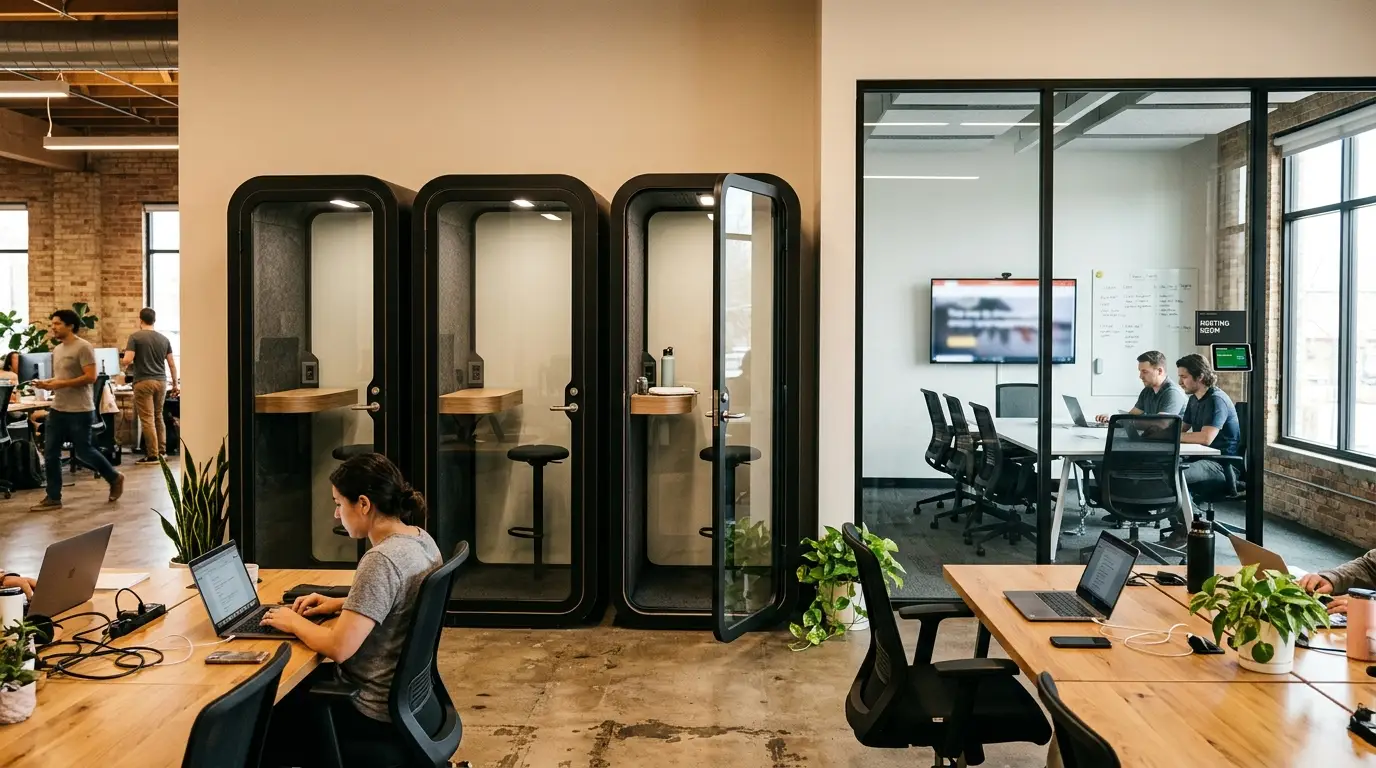
The acoustic strategy has three layers. First, separate noise sources from quiet zones by floor plan, putting distance and ideally a wall between the cafe and the focus desks. Second, treat the room with sound-absorbing materials: acoustic ceiling clouds or baffles, felt wall panels, carpet tiles in focus zones, and upholstered furniture. Third, provide enclosed spaces (phone booths and meeting rooms) so that calls and meetings physically leave the open floor rather than happening at a desk.
Glass-fronted private offices and meeting rooms look open and modern but only contain sound if they are built correctly. Full-height glass partitions with proper seals and a solid-core or glass door with gaskets can achieve usable acoustic separation. Glass that stops at the drop ceiling, with an open plenum above, lets sound travel over the top from room to room. For meeting rooms where confidential conversations happen, partitions should run to the deck with acoustic insulation in the wall cavity.
Phone Booths and Meeting Room Ratios
Phone booths are the workhorse of modern coworking. With video calls now a constant part of work, members need somewhere to take a call without disturbing the floor and without booking a full conference room. A practical ratio is one phone booth per 8 to 10 members. Spaces that under-provide booths see members taking calls at their desks, which generates exactly the noise complaints that drive churn.
Phone booths can be prefabricated pods (fast to install, movable, acoustically rated) or built-in millwork rooms. Prefab pods cost more per unit but install in a day, require no permit in many cases, and can be relocated as the floor evolves. Built-in booths are cheaper per square foot at scale but are permanent and require full construction.
| Space Type | Recommended Ratio | Typical Size | Notes |
|---|---|---|---|
| Phone booth (1 person) | 1 per 8-10 members | 15-25 sq ft | Video-call ready, power and ventilation needed |
| Small meeting room (2-4) | 1 per 25-35 members | 100-140 sq ft | Screen, whiteboard, video conferencing |
| Conference room (6-10) | 1 per 40-60 members | 200-300 sq ft | Often bookable by non-members for revenue |
| Meeting seat (all rooms) | 1 seat per 5-6 members | n/a | Total bookable meeting capacity |
Conference rooms can double as a revenue source when rented to non-members by the hour, so positioning at least one large room near the entrance with its own access makes sense. Phone booths and small rooms benefit from being distributed through the floor so a member is never far from one.
Power, Data, and HVAC for Flexible Layouts
Coworking layouts change. Desks get added, private offices get carved out, and amenities shift. The infrastructure has to support that flexibility, which means planning power and data for more density and more reconfiguration than a traditional office. Floor boxes or modular floor power feed open desk clusters without trailing cords. Every desk needs at least two power outlets and reliable data, whether wired or via dense wireless access point coverage.
HVAC is a frequent pain point because coworking occupancy is variable and dense. A zone designed for office-level occupancy can be overwhelmed when a coworking floor fills up. Zoning the HVAC so that the dense open area, the private offices, and the meeting rooms can be controlled separately prevents the common complaint that the open floor is stuffy while a private office is freezing. Meeting rooms in particular need responsive ventilation because a packed conference room heats up and gets stale quickly.
Biophilic and Brand-Driven Design
The interior is part of the product in coworking. Members choose a space partly on how it feels and looks, and the space competes on Instagram as much as on price. Biophilic design (plants, natural materials, natural light, living walls) consistently tests well with members because it softens the industrial shell and improves the perceived air quality and calm of the space.
Brand expression runs through the materials, color, signage, and the character of the lounge and cafe. A boutique space differentiates on a distinctive lounge, quality furniture, and thoughtful lighting rather than on the raw desk count. The design budget spent on the social and arrival zones returns more in member acquisition and retention than the same money spent making the back desks marginally nicer, because the arrival experience is what tours and social posts capture.
What We See in Texas Coworking Projects
We design coworking and flexible-office buildouts across San Antonio, Austin, and the Hill Country, and the same lessons surface repeatedly.
The most common regret is under-treating acoustics to save money in the budget. One operator opened a beautiful space with exposed ceilings, polished concrete, and glass everywhere, and within two months was fielding daily complaints about phone-call noise on the open floor. Retrofitting ceiling baffles, felt panels, and two additional phone booths after opening cost roughly 60 percent more than building them in would have, and it meant disrupting paying members. Acoustics belong in the original scope, not the value-engineering cut list.
The second pattern is building too many open desks and too few private offices. Demand for private and team suites in Texas markets has been strong, and operators who allocated most of the floor to hot desks often found themselves leaving revenue on the table while a waitlist formed for offices. We design floors so that a defined section can be converted to private offices later without fighting the sprinkler and HVAC layout.
The third is forgetting that the arrival and social experience sells memberships. Tours convert on the lounge, the cafe, and the light, not on the desk in the corner. We invest the design budget where prospects make their decision. For more on designing professional office interiors, see our guide on commercial office interior design.
Texas Coworking Buildout Cost Ranges
| Scope | Cost Range (per sq ft) | Notes |
|---|---|---|
| Light fit-out (open desks, minimal walls) | $45-$80 / sq ft | Furniture, lighting, basic acoustics, finishes |
| Standard coworking buildout | $80-$140 / sq ft | Private offices, meeting rooms, cafe, full acoustics |
| Premium boutique buildout | $140-$220 / sq ft | High-end finishes, custom millwork, biophilic features |
| Prefab phone booth (each) | $8,000-$16,000 | Acoustically rated, movable, power and ventilation |
| Acoustic treatment package | $5-$12 / sq ft | Ceiling clouds, panels, carpet in focus zones |
These ranges reflect tenant improvement pricing in the San Antonio and Austin metros and exclude furniture, IT infrastructure, and operating technology, which together commonly add $15 to $40 per square foot. For broader budgeting context, read our tenant improvement cost per square foot guide and review our commercial lease checklist before committing to a space.
Key Takeaways
- Separate loud zones (cafe, lounge, reception) from quiet zones (dedicated desks, private offices, focus rooms) by floor plan, not just by furniture.
- Blend to 50 to 80 usable square feet per member across the floor, adjusting for your private-office-to-hot-desk mix.
- Private offices and team suites generate 1.5 to 2.5 times the revenue per square foot of hot desks and churn less. Design the floor so open area can be converted to offices later.
- Acoustics decide renewals. Build ceiling treatment, felt panels, and enclosed spaces into the original scope.
- Provide one phone booth per 8 to 10 members and one meeting seat per 5 to 6 members.
- Build glass-fronted rooms to the deck with seals if they must contain confidential sound.
- Zone HVAC separately for dense open areas, offices, and meeting rooms to avoid hot-and-cold complaints.
- Invest the design budget in the arrival and social zones, because that is where tours convert.
Frequently Asked Questions
How many square feet do you need per member in a coworking space?
Across an entire coworking floor, including shared amenities, circulation, and back-of-house, most operators plan 50 to 80 usable square feet per member. Open hot desks run as low as 30 to 45 square feet per seat, dedicated desks 45 to 65, and private offices 80 to 120 per office. A premium boutique space sits at the higher end of the blended range, while a high-volume budget operator pushes toward the lower end.
How do you reduce noise in a coworking space?
Use a three-layer strategy. First, separate noisy zones like the cafe and lounge from quiet focus desks by floor plan and ideally a wall. Second, treat the room with sound-absorbing materials such as acoustic ceiling clouds, felt wall panels, carpet tiles in focus areas, and upholstered furniture. Third, provide enough enclosed phone booths and meeting rooms (about one booth per 8 to 10 members) so that calls and meetings leave the open floor entirely.
How much does it cost to build a coworking space in Texas?
In the San Antonio and Austin metros, a standard coworking buildout with private offices, meeting rooms, a cafe, and full acoustic treatment runs roughly $80 to $140 per square foot. A light fit-out with mostly open desks can start around $45 per square foot, while a premium boutique space with high-end finishes and custom millwork can reach $140 to $220 per square foot. Furniture, IT, and operating technology add another $15 to $40 per square foot.
How many phone booths and meeting rooms does a coworking space need?
Plan one phone booth per 8 to 10 members so video calls can leave the open floor, and provide about one meeting-room seat per 5 to 6 members across all bookable rooms. A practical room mix includes small 2-to-4-person rooms at one per 25 to 35 members, and a larger 6-to-10-person conference room per 40 to 60 members. Distributing booths and small rooms through the floor keeps every member close to an enclosed space.
Planning a Coworking Space in San Antonio or Austin?
Prestige 360 Design plans and designs coworking and flexible-office buildouts across San Antonio, Austin, and the Texas Hill Country. We balance member density against experience, engineer the acoustic strategy, and design floors that can flex as your membership grows.
Schedule a consultation with our team to review your space and membership model before you sign a lease.