Insights
Tenant Improvement Cost per Square Foot in Texas (2026)
May 28, 2026
Tenant improvement costs in Texas range from $15 to $200 per square foot in 2026, depending on the scope, the condition of your space, and which city you are building in. This guide breaks down the real numbers by project type and metro area so you can plan your budget, negotiate a stronger TI allowance, and avoid the cost surprises that derail most commercial buildouts.
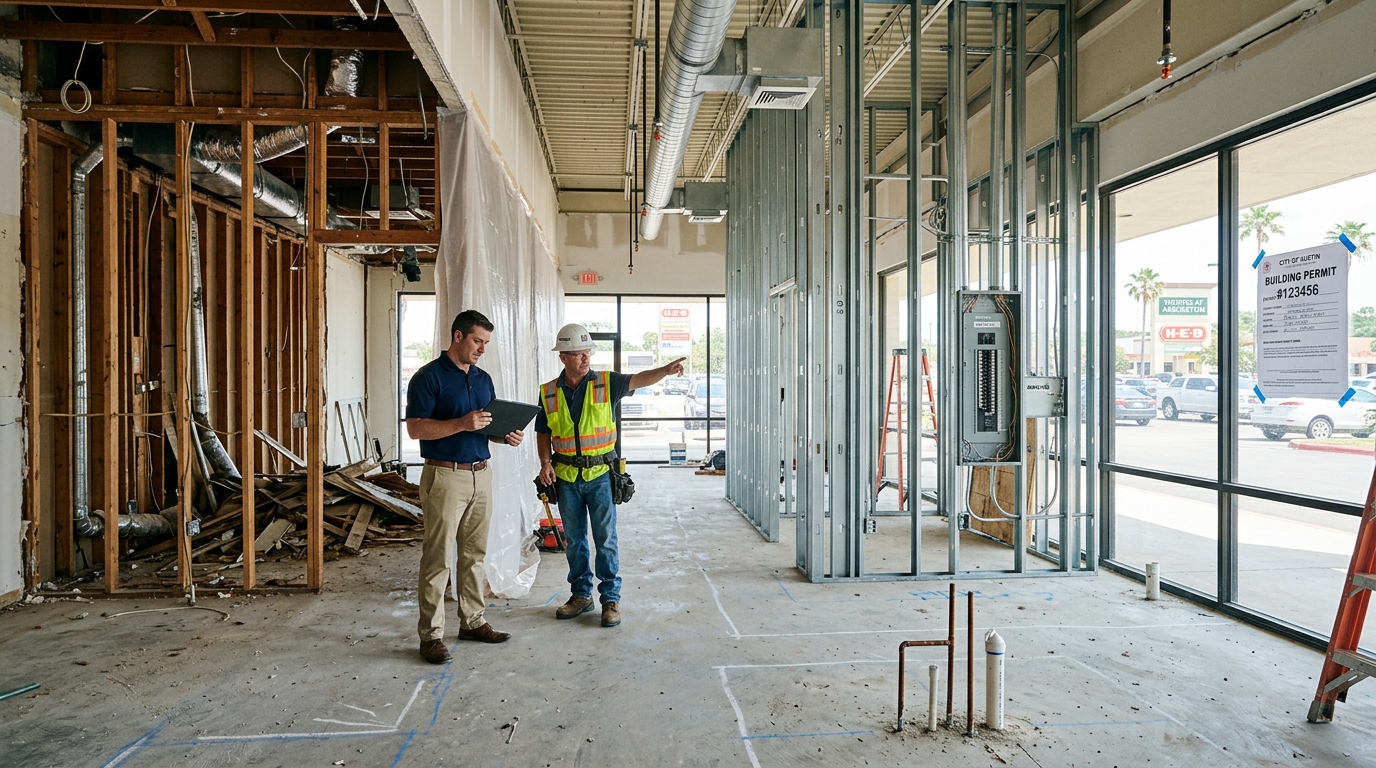
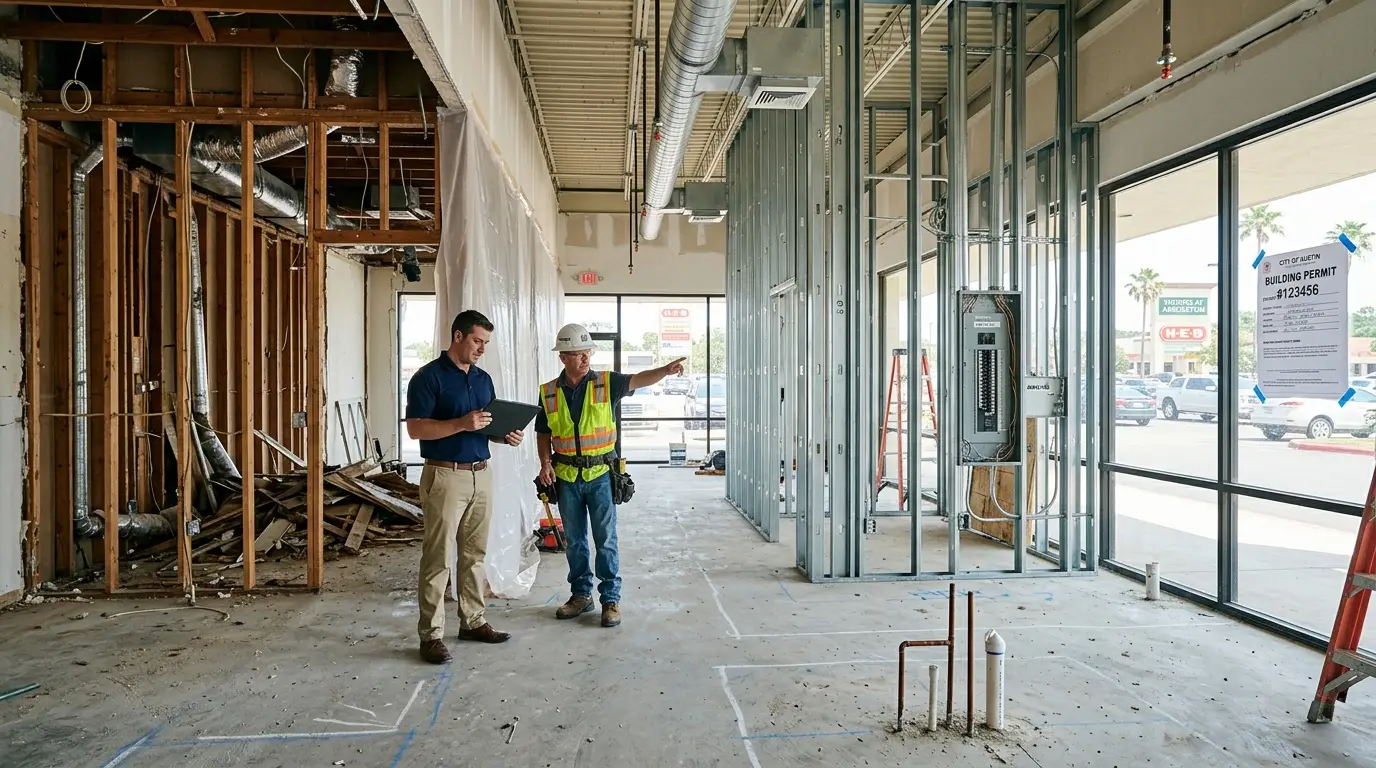
A tenant improvement project in progress: HVAC, electrical, and partitions are the biggest cost drivers.
Quick Answer: Tenant improvement cost per square foot in Texas averages $30 to $80 for most commercial spaces in 2026. A cosmetic refresh runs $15 to $30/sq ft, a moderate remodel costs $30 to $60/sq ft, and a full buildout ranges from $60 to $120/sq ft. Specialty spaces like restaurants can reach $100 to $200/sq ft. Landlords in Texas typically offer TI allowances of $20 to $50 per square foot for retail and office leases, meaning tenants cover the gap out of pocket. The variables that matter most are building age, HVAC condition, code compliance requirements, and your city’s labor market.
What Is a Tenant Improvement?
A tenant improvement (TI) is any modification made to a leased commercial space to prepare it for the tenant’s specific use. This includes demolition of existing layouts, new wall framing, electrical and plumbing upgrades, HVAC modifications, flooring, lighting, ADA compliance work, and finish materials like paint, millwork, and ceiling systems. The term applies to retail stores, restaurants, medical offices, corporate offices, and any other commercial space where the tenant needs to alter the landlord’s base building to operate.
Tenant improvement requirements in Texas follow the International Building Code (IBC) as adopted by each municipality, with local amendments that vary by city. Austin, Houston, San Antonio, and Dallas each have their own permitting processes, inspection timelines, and code interpretations. This means the same scope of work can cost differently depending on where you build, not just what you build.
The tenant improvement allowance (TIA) is the dollar amount a landlord contributes toward your buildout, expressed as a per-square-foot figure written into the lease. The allowance does not cover everything. It covers construction costs that become part of the building, such as walls, flooring, and mechanical systems. It typically does not cover furniture, signage, equipment, or technology. Understanding the gap between your TI allowance and your actual TI cost is the single most important budgeting exercise before signing a lease.
TI Cost by Scope Level
The biggest factor in your tenant improvement cost per square foot is the scope of work. A fresh coat of paint and new flooring is a fundamentally different project than demolishing an existing layout and rebuilding mechanical systems from scratch. The table below shows the four main scope levels we see in Texas commercial projects in 2026.
| Scope Level | Cost per Sq Ft | What It Includes | Typical Timeline |
|---|---|---|---|
| Cosmetic Refresh | $15 – $30 | Paint, flooring, lighting fixtures, minor patching, signage updates | 2 – 4 weeks |
| Moderate Remodel | $30 – $60 | Partial demo, new partition walls, updated electrical, new ceiling grid, restroom upgrades | 6 – 10 weeks |
| Full Buildout | $60 – $120 | Complete demo to shell, all new MEP systems, framing, drywall, finishes, ADA compliance | 12 – 20 weeks |
| Specialty / Restaurant | $100 – $200 | Grease traps, hood systems, walk-in coolers, specialized plumbing, high-voltage electrical, commercial kitchen ventilation | 16 – 28 weeks |
Most tenants leasing second-generation space (previously occupied by another business) land in the moderate remodel category. If the prior tenant’s layout is close to what you need, you can sometimes stay in the cosmetic refresh range. Shell spaces and first-generation buildouts almost always fall into the full buildout tier. Restaurants are consistently the most expensive tenant improvement projects due to the mechanical complexity of commercial kitchens, grease interceptors, and exhaust systems.
Important: These ranges cover hard construction costs only. Add 10-15% for soft costs including architecture, engineering, permitting, and project management. Texas permit fees alone range from $500 to $3,000 depending on scope and municipality.
TI Cost by Texas City
Labor availability, permitting timelines, and local code requirements create real cost differences between Texas metros. A project that costs $45/sq ft in San Antonio might cost $55/sq ft in Austin for identical scope. The table below reflects current 2026 market conditions based on contractor bids and project data from Texas commercial construction firms.
| Texas City | Moderate Remodel ($/sq ft) | Full Buildout ($/sq ft) | Avg. Permit Timeline | Key Cost Factor |
|---|---|---|---|---|
| San Antonio | $28 – $50 | $55 – $100 | 3 – 5 weeks | Lower labor costs, moderate permitting pace |
| Austin | $35 – $65 | $70 – $130 | 4 – 8 weeks | Higher labor demand, stricter energy code |
| Houston | $30 – $55 | $60 – $115 | 2 – 4 weeks | No zoning, fast permits, competitive labor pool |
| Dallas / Fort Worth | $32 – $60 | $65 – $120 | 3 – 6 weeks | High demand in Class A corridors, variable by suburb |
San Antonio consistently offers the lowest tenant improvement costs among major Texas metros due to a combination of lower labor rates, reasonable permitting timelines, and a deep pool of experienced commercial contractors. Austin is the most expensive, driven by high demand for skilled labor, a stricter energy code that requires more insulation and HVAC efficiency work, and a permitting process that can stretch timelines significantly. Houston’s lack of zoning and streamlined permitting makes it one of the fastest cities to complete a TI project, which keeps costs down despite a large market. Dallas varies widely depending on whether you are building in an urban Class A corridor or a suburban strip center.
What Affects Your TI Cost
Beyond scope and location, four factors consistently drive tenant improvement costs higher than tenants expect. Understanding these before you sign a lease gives you leverage in negotiations and prevents budget surprises once construction starts.
Building Age and Condition
Older buildings built before 1990 frequently require asbestos abatement, lead paint remediation, and upgrades to meet current structural and fire code standards. These costs are not visible during a walkthrough. A building that looks “move-in ready” might have outdated wiring behind the walls, an undersized electrical panel, or a plumbing system that cannot support your planned use. Always request a building condition report before committing to a lease, especially in spaces built before the 2000 IBC adoption cycle.
Code Compliance and ADA Requirements
ADA compliance upgrades often add $5 to $15 per square foot to a tenant improvement project. This includes widening doorways to 36 inches clear, installing accessible restrooms, adding compliant ramps or thresholds, and upgrading signage. Texas municipalities enforce ADA requirements at the permitting stage, and any TI project that triggers a permit will be reviewed for compliance. If the existing space has never been updated to current ADA standards, the cost falls on the tenant, not the landlord, in most lease structures. For a deeper look at how retail space planning and design addresses accessibility, see our dedicated service page.
HVAC System Capacity
HVAC is the single most expensive line item in a full tenant improvement buildout, often representing 20-30% of total construction cost. If the existing system cannot handle your occupancy load, you will need new ductwork, additional tonnage, or a complete replacement. Restaurants, medical offices, and high-density retail spaces almost always require HVAC upgrades. In Texas, where cooling demands are extreme for 6-8 months of the year, undersizing the system is not an option. Always have a mechanical engineer evaluate the existing system before finalizing your budget.
Electrical Infrastructure
Modern retail and restaurant operations demand significantly more electrical capacity than older buildings were designed to provide. POS systems, commercial kitchen equipment, display lighting, digital signage, and security systems all draw power. Upgrading an electrical panel from 200 amps to 400 amps costs $3,000 to $8,000 in Texas. Running new circuits, adding subpanels, and bringing wiring up to current NEC code can add $8 to $20 per square foot depending on the scope. If you are opening a restaurant in Texas, plan for electrical costs at the higher end of every range.
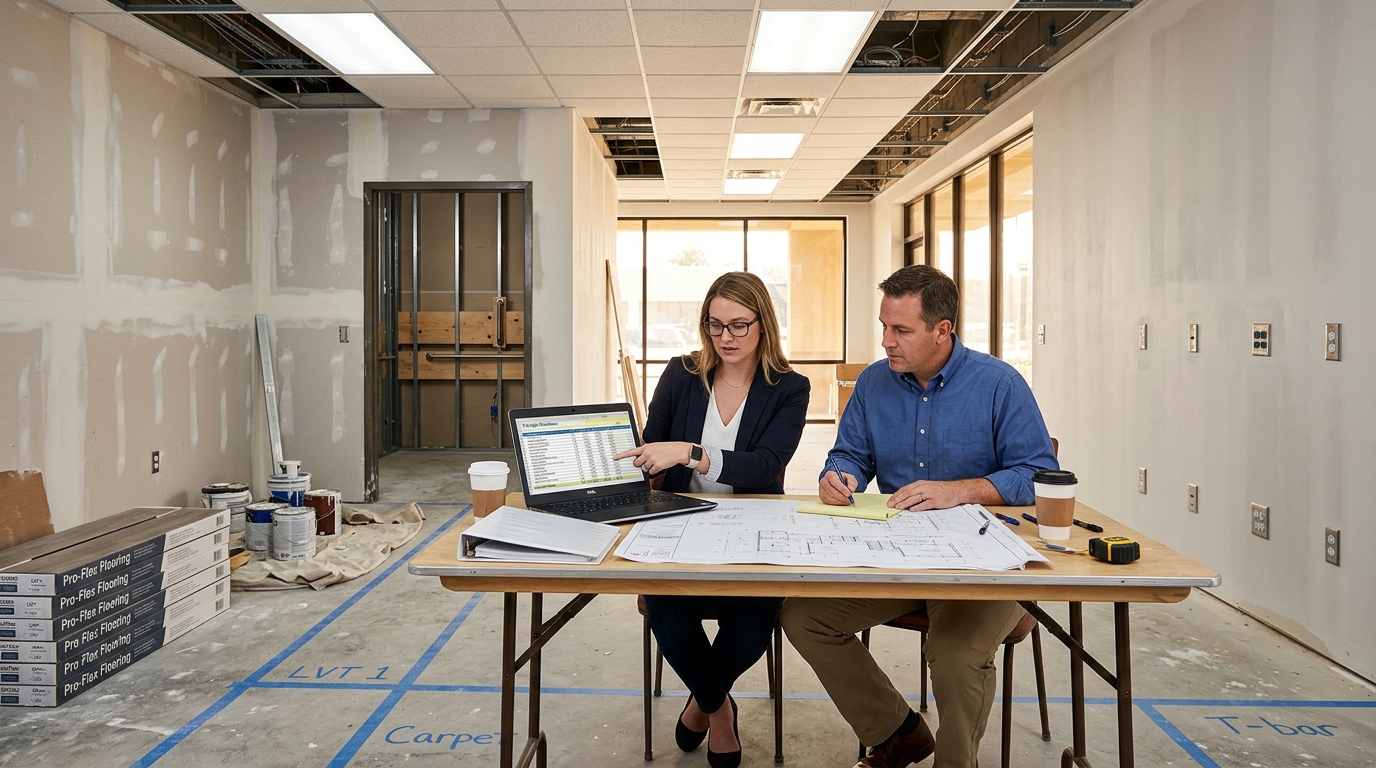
Electrical upgrades are one of the most underestimated TI cost drivers, especially in older Texas buildings.
How to Negotiate a Better TI Allowance
The TI allowance your landlord offers is not fixed. It is a negotiation point, and most tenants leave money on the table because they accept the first number without pushing back. Here are the strategies that consistently produce better results in Texas commercial leases.
Get Your Own Construction Estimate First
Before negotiating, get a detailed estimate from a general contractor or tenant improvement specialist for your planned scope. This gives you a documented number to present to the landlord. When you can show that your buildout will cost $65/sq ft and the landlord is offering $25/sq ft, the gap becomes a concrete negotiation point rather than an abstract conversation.
Offer a Longer Lease Term
Landlords amortize TI costs over the lease term. A 5-year lease makes a $50/sq ft TI allowance cost the landlord $10/sq ft per year. A 7-year lease drops that to $7.14/sq ft per year. If you are willing to commit to a longer term, you can often negotiate a significantly higher TI allowance. The math is straightforward, and it is one of the most effective negotiation levers available to tenants.
Negotiate the TI Separately from Rent
Some landlords try to bundle TI costs into higher base rent rather than providing a separate allowance. This is almost always worse for the tenant. A separate TI allowance is a one-time contribution that you control. Higher rent is a recurring cost you pay for the entire lease term. Always push for the allowance to be a defined dollar amount per square foot, paid against documented construction invoices.
Request Landlord-Performed Base Building Work
Instead of asking for more TI dollars, ask the landlord to perform specific base building improvements before you take possession. Roof repairs, parking lot resurfacing, exterior painting, and HVAC replacements are building-level improvements the landlord should handle anyway. Getting these done before your lease starts reduces your TI scope and cost without requiring a higher allowance number.
Include a TI Audit Clause
If the landlord is managing the TI construction (turnkey buildout), negotiate the right to audit construction invoices. This protects you from inflated costs and ensures the allowance is being spent on actual improvements to your space, not the landlord’s overhead or general building maintenance.
What We See Across Prestige 360 Projects
At Prestige 360 Design, we have managed tenant improvement projects across Texas for retail stores, restaurants, and specialty commercial spaces. Here is what we consistently observe on the ground.
Observation 1: Tenants who invest in professional space planning before construction starts save 15-25% on total TI costs. A well-designed layout eliminates change orders, reduces material waste, and prevents the “we need to move that wall” conversations that add weeks and thousands of dollars to every project.
Observation 2: The gap between the landlord’s TI allowance and the actual buildout cost is almost always larger than tenants expect. In our Texas retail projects, the average gap is $20 to $40 per square foot. Tenants who do not budget for this gap get caught funding construction out of operating capital, which puts pressure on the business before it even opens.
Observation 3: Restaurants and food-service TI projects consistently exceed initial estimates by 20-35%. The culprit is almost always mechanical systems: grease traps, hood ventilation, and the electrical infrastructure required to power commercial kitchen equipment. We now recommend restaurant tenants add a 30% contingency to their TI budget from day one.
Observation 4: San Antonio remains the most cost-effective major metro in Texas for tenant improvements. Labor rates are 10-20% lower than Austin and Dallas, permitting is predictable, and the contractor pool is experienced with commercial retail and restaurant projects. For tenants with flexibility on location, this translates to meaningful savings. Our retail design services help clients in every Texas metro maximize their TI budget regardless of local market conditions.
Key Takeaways
- Tenant improvement cost per square foot in Texas ranges from $15 to $200 in 2026, with most commercial spaces falling between $30 and $80/sq ft.
- Scope is the primary cost driver: a cosmetic refresh ($15-$30/sq ft) is a fundamentally different project than a full buildout ($60-$120/sq ft) or restaurant conversion ($100-$200/sq ft).
- San Antonio offers the lowest TI costs among major Texas metros. Austin is the most expensive due to labor demand and stricter energy codes.
- Building age, HVAC capacity, electrical infrastructure, and ADA compliance are the four factors that most frequently push TI costs above initial estimates.
- Typical landlord TI allowances in Texas range from $20 to $50/sq ft for retail, leaving a $20 to $40/sq ft gap the tenant must fund.
- Professional space planning before construction starts reduces total TI costs by 15-25% by eliminating change orders and material waste.
- Always get an independent construction estimate before negotiating your TI allowance. The landlord’s first offer is not the final number.
Frequently Asked Questions
How much does tenant improvement cost per square foot in Texas in 2026?
Tenant improvement cost per square foot in Texas ranges from $15 to $200 in 2026, depending on the scope of work. A cosmetic refresh with paint, flooring, and lighting updates costs $15 to $30 per square foot. A moderate remodel involving partition walls, updated electrical, and ceiling work runs $30 to $60 per square foot. A full buildout from shell condition costs $60 to $120 per square foot. Specialty spaces like restaurants with commercial kitchen requirements reach $100 to $200 per square foot. Most standard retail and office TI projects in Texas fall in the $30 to $80 per square foot range.
What is a typical TI allowance from a landlord in Texas?
Texas landlords typically offer TI allowances between $20 and $50 per square foot for retail and office spaces, with the exact amount depending on the lease term, tenant creditworthiness, market conditions, and the landlord’s motivation to fill the space. Class A office space in urban cores may offer $40 to $60 per square foot for credit tenants on long-term leases. Strip center retail in suburban areas may offer as little as $10 to $20 per square foot. The allowance is negotiable, and tenants who present detailed construction estimates and commit to longer lease terms consistently secure higher allowances.
What is the difference between a tenant improvement and a buildout?
A tenant improvement (TI) refers specifically to modifications made to a leased commercial space to suit the tenant’s operations, funded in part or in full by the landlord’s TI allowance. A buildout is the broader term for all construction required to make a space operational, regardless of funding source. In practice, the terms overlap significantly. The key distinction is financial: tenant improvements are tied to the lease agreement and the landlord’s contribution, while a buildout describes the physical construction work itself. Both terms apply to the same construction activities, including framing, MEP systems, finishes, and code compliance work.
How long does a tenant improvement project take in Texas?
Tenant improvement timelines in Texas range from 2 weeks for a cosmetic refresh to 28 weeks for a complex restaurant buildout. A moderate remodel of an existing office or retail space typically takes 6 to 10 weeks from permit issuance to certificate of occupancy. A full buildout from shell condition requires 12 to 20 weeks of construction. Permitting adds 2 to 8 weeks before construction begins, depending on the city. Houston has the fastest permitting process among major Texas metros at 2 to 4 weeks. Austin has the slowest at 4 to 8 weeks. Adding a design phase before permitting adds another 3 to 6 weeks to the total project timeline.
Get a Free TI Cost Estimate
Planning a tenant improvement project in Texas? Prestige 360 Design provides free TI cost estimates for retail stores, restaurants, and commercial spaces across San Antonio, Austin, Houston, and Dallas. We review your lease terms, assess the existing space condition, and deliver a detailed cost breakdown so you know exactly what your project will require before construction starts. Request your free TI cost estimate today.
About the Author
Hugo Ramirez is the founder of Prestige 360 Design and a former Nike Retail Project Manager. With direct experience managing retail buildouts, tenant improvements, and commercial space planning across Texas, Hugo leads a team that helps business owners turn lease negotiations and construction budgets into operational spaces that perform. Connect with Hugo at Prestige 360 Design.