Insights
Average Cost to Build Out Office Space in Texas (2026): What to Expect
June 1, 2026
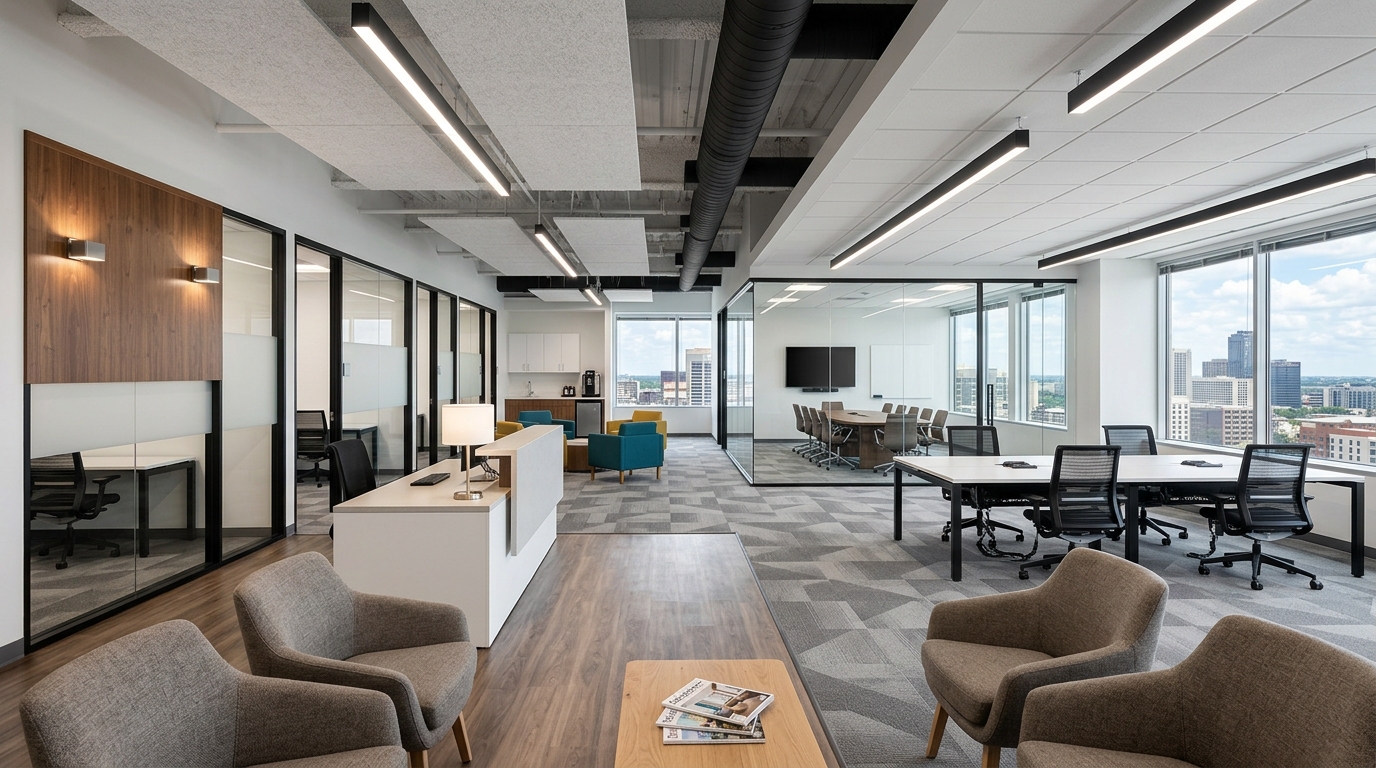
Average Cost to Build Out Office Space in Texas (2026): What to Expect
Quick Answer: The average cost to build out office space in Texas in 2026 is roughly $50 to $150 per square foot, with most standard buildouts landing near $65 to $110 per square foot. A basic open-plan buildout sits at the low end, while a high-end space with many private offices, glass conference rooms, and executive finishes reaches the top. The landlord often covers part of this through a tenant improvement allowance, so your real out-of-pocket cost is the buildout total minus that allowance.
The Average Per Square Foot
Building out office space means turning a landlord’s shell or a previous tenant’s layout into a finished, move-in-ready office. The average cost per square foot depends on how finished the starting space is and how high the finish level goes, but most Texas office buildouts cluster in a predictable band.
| Buildout Level | Cost Per Sq Ft | Typical Features |
|---|---|---|
| Basic / open plan | $50-$75 | Open workstations, few offices, standard finishes |
| Standard | $75-$110 | Mix of offices and open area, conference rooms |
| High-end / executive | $110-$150+ | Many private offices, glass, premium finishes |
For a 5,000 square foot office, that means roughly $250,000 to $375,000 for a basic buildout, $375,000 to $550,000 for a standard one, and $550,000 to over $750,000 for a high-end space. These are planning ranges; the actual number depends on the specific shell, the layout, and the finishes chosen.
Starting condition matters as much as finish level. A second-generation office that you can partly reuse costs far less to build out than a cold, dark shell with no interior walls, ceilings, HVAC distribution, or lighting in place.
Buildout by Office Grade
The finish level, often described as the office grade, is the main lever an owner controls. The difference between grades is not just aesthetics; it is the ratio of private offices to open space, the amount of glass, the quality of flooring and millwork, and the lighting and ceiling treatment.
A higher ratio of private offices raises cost because each office is walls, a door, a light, and an HVAC consideration. Open-plan layouts are cheaper per square foot. Glass-walled offices and conference rooms cost more than drywall. Premium flooring, custom millwork, and feature ceilings each add up. Deciding the grade before design keeps the budget honest.
| Choice | Cost Effect |
|---|---|
| More private offices vs. open plan | Higher |
| Glass walls vs. drywall | Higher |
| Premium flooring and millwork | Higher |
| Reusing existing HVAC and ceilings | Lower |
| Simple, repeatable layout | Lower |
The way these choices come together is the heart of a good commercial office interior design process, which balances the image the company wants against the budget it has.
Who Pays: The TI Allowance
Office buildouts are rarely paid entirely by the tenant. In most commercial leases the landlord contributes a tenant improvement allowance, a per-square-foot amount toward the buildout, in exchange for the lease commitment. Your true out-of-pocket cost is the buildout total minus this allowance.
| Item | Example (5,000 sq ft) |
|---|---|
| Buildout cost at $90 / sq ft | $450,000 |
| TI allowance at $40 / sq ft | -$200,000 |
| Tenant out-of-pocket | $250,000 |
Allowances vary widely with the market, the building, the lease length, and the tenant’s strength. A longer lease and a stronger tenant command a larger allowance. Because the allowance can cover a large share of the cost, negotiating it well is one of the most valuable parts of the deal. Our guide on what to check before signing a commercial lease covers how the allowance and the work-letter are structured.
How to Estimate Your Buildout
A quick, reliable estimate follows a few steps. Start with the buildout level, basic, standard, or high-end, and apply the per-square-foot range to your square footage. Adjust for the starting condition: a cold shell adds cost, a second-generation office subtracts it. Then subtract the expected TI allowance to find your out-of-pocket number, and add the costs that sit outside construction.
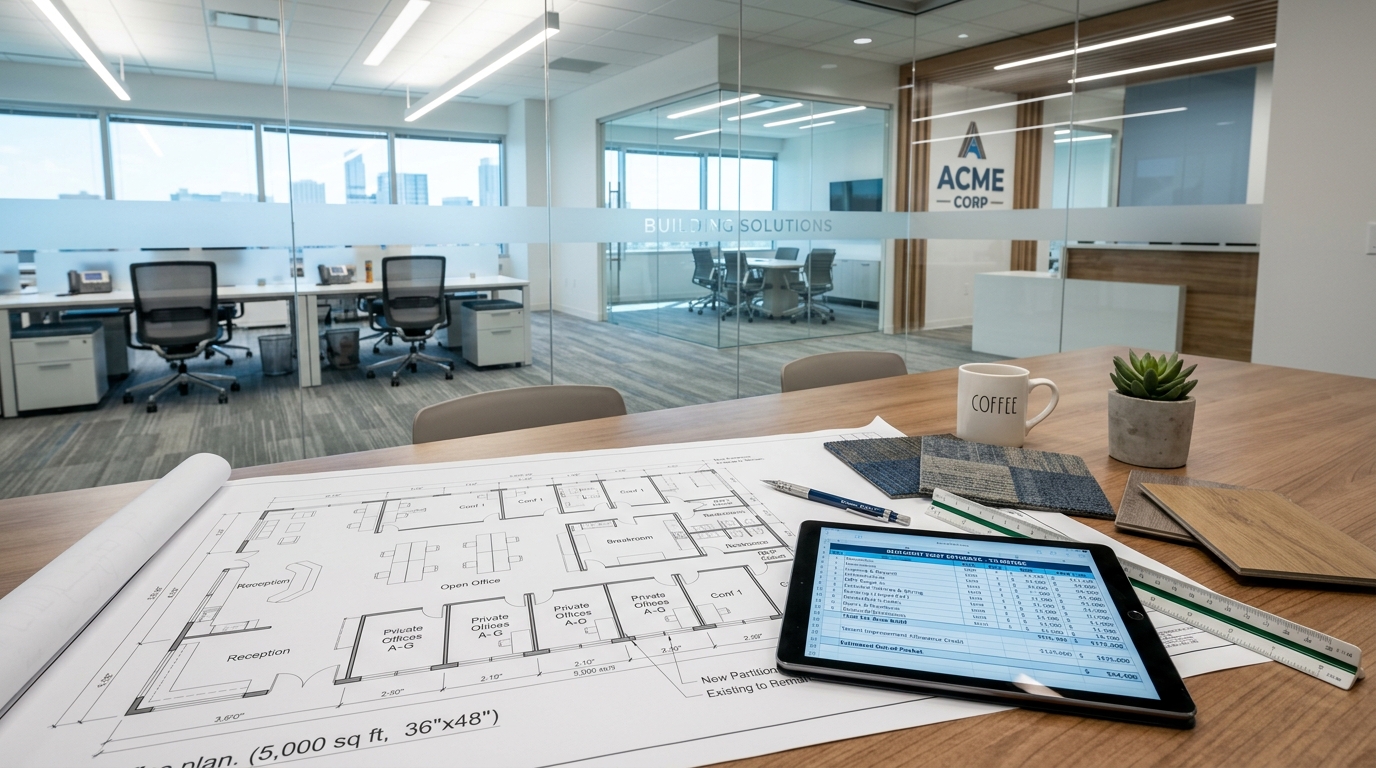
This sequence turns a vague worry about cost into a concrete planning number. The key is to use the right starting condition and not to forget the allowance, which dramatically changes what the tenant actually pays.
Costs Beyond Construction
The construction buildout is not the whole cost of occupying an office. Several items sit outside the construction bid and the TI allowance, and forgetting them is the most common budgeting error.
| Cost | Notes |
|---|---|
| Furniture and workstations | Often a major separate line |
| Data cabling, network, AV | Usually excluded from the construction bid |
| Design and engineering fees | May or may not be in the allowance |
| Moving and downtime | Logistics, lost productivity |
| Signage and branding | Exterior and interior |
Furniture alone can add a meaningful amount per square foot, and the TI allowance typically cannot be spent on it. Budgeting these from the start gives a true picture of what it costs to open the office, not just to build the walls.
What We See in Texas Office Buildouts
When we budget office buildouts across Texas, the number that surprises owners is rarely the construction itself; it is everything around it. Owners anchor on a per-square-foot figure and forget furniture, cabling, and design fees, then feel over budget when those appear. We put the full picture on the table early, construction plus the costs beyond it, so the total is honest from the start.
The second pattern is misjudging the starting condition. A cold shell with no HVAC distribution, ceilings, or lighting costs far more to build out than a second-generation office, yet owners often compare spaces on rent alone. We weigh the buildout cost of each candidate space, because a higher allowance or a more finished starting point can outweigh a lower rent.
The third is the office-grade decision made too late. Owners sometimes design to an executive grade, then discover the budget supports a standard one. We set the grade and the private-office ratio before design, so the drawings match the budget instead of forcing painful cuts later.
The fourth is leaving the TI allowance on the table. The allowance is negotiable and tied to lease length and tenant strength, and a stronger negotiation can shift hundreds of thousands of dollars. We make sure the allowance is understood and pursued before the lease is signed, because it is the cheapest money in the whole project.
Negotiating the Allowance
Because the TI allowance can cover a large share of the buildout, it is worth real attention at the lease stage. Longer lease terms, stronger financials, and a softer market all push the allowance higher. Some landlords will increase the allowance in exchange for a slightly higher rent, effectively financing the buildout into the lease, which can help a tenant preserve cash.
Run the buildout estimate before you finish negotiating the lease, not after. Knowing your real construction cost lets you negotiate the allowance from a position of fact, and lets you compare two spaces on out-of-pocket cost rather than rent alone.
The tenants who fare best treat the buildout cost and the lease as one negotiation. A space with a generous allowance and a finished starting condition can cost far less to occupy than a cheaper-rent space that needs a full buildout with little landlord contribution.
Key Takeaways
- The average Texas office buildout costs about $50 to $150 per square foot in 2026, with most standard projects near $65 to $110.
- Office grade, the ratio of private offices, amount of glass, and finish quality, is the main cost lever the tenant controls.
- The landlord’s tenant improvement allowance often covers a large share, so out-of-pocket cost is the buildout total minus the allowance.
- A cold shell costs far more to build out than a second-generation office; compare spaces on buildout cost, not rent alone.
- Furniture, data cabling, AV, design fees, and moving sit outside the construction bid and belong in the total budget.
- The TI allowance is negotiable and tied to lease length and tenant strength; run the buildout estimate before finishing the lease.
Frequently Asked Questions
What is the average cost to build out office space in Texas?
In 2026, the average cost to build out office space in Texas is roughly $50 to $150 per square foot, with most standard buildouts near $65 to $110. A basic open-plan buildout sits at the low end and a high-end executive space with many private offices and premium finishes reaches the top. The landlord’s tenant improvement allowance often covers part of this, reducing the tenant’s out-of-pocket cost.
What is a tenant improvement allowance?
A tenant improvement allowance is a per-square-foot amount the landlord contributes toward building out the office, in exchange for the lease commitment. Your true out-of-pocket cost is the buildout total minus this allowance. Allowances vary with the market, building, lease length, and tenant strength, and longer leases and stronger tenants typically command larger allowances. The allowance is negotiable and can shift a large share of the cost.
Why does building out a cold shell cost more?
A cold or warm shell has no interior walls, ceilings, HVAC distribution, or lighting in place, so the buildout must add all of it. A second-generation office that already has some of these elements lets you reuse them, lowering cost. That is why comparing office spaces on rent alone is misleading; a finished starting condition or a larger tenant improvement allowance can make a higher-rent space cheaper to occupy overall.
What costs are not included in an office buildout estimate?
Construction buildout estimates commonly exclude furniture and workstations, data cabling, network and audiovisual systems, sometimes design and engineering fees, moving and downtime, and signage. The tenant improvement allowance usually cannot be spent on furniture. Budget these items separately on top of the construction cost to understand the true cost of opening the office, not just building the walls.
Get an Honest Office Buildout Estimate
A real office buildout number accounts for the starting condition, the finish grade, the tenant improvement allowance, and the costs beyond construction. Prestige 360 Design plans, designs, and budgets office buildouts across Texas, helping tenants estimate accurately and negotiate the allowance before signing. Contact us for a grounded estimate of your office buildout.