Insights
Restaurant Renovation Cost Per Square Foot in Texas: 2026 Breakdown
June 1, 2026
Restaurant Renovation Cost Per Square Foot in Texas: 2026 Breakdown
Quick Answer: Restaurant renovation in Texas typically costs between $150 and $400 per square foot in 2026, far more than office or retail, because the kitchen carries expensive systems: a commercial exhaust hood, fire suppression, grease interceptor, heavy plumbing, gas, and high electrical loads. The biggest factor by far is whether you are renovating a second-generation restaurant space that already has these systems or converting a space that needs them installed from scratch. That single difference can change the budget by more than half.
Restaurant Renovation Cost Ranges
Restaurants are the most expensive common commercial space to renovate per square foot, and the spread is wide because the kitchen dominates the cost. A light dining-room refresh of an operating restaurant is one project; gutting a space and rebuilding a full commercial kitchen is another entirely.
| Renovation Scope | Cost Per Sq Ft | What It Includes |
|---|---|---|
| Dining-room refresh | $60-$120 | Finishes, lighting, seating, paint |
| Moderate renovation (reuse kitchen) | $120-$220 | Updated kitchen, new front of house |
| Full renovation / new kitchen | $220-$400+ | New hood, grease, plumbing, equipment |
For a 3,000 square foot restaurant, that is roughly $180,000 to $360,000 for a refresh, $360,000 to $660,000 for a moderate renovation, and $660,000 to over $1.2 million for a full build with a new kitchen. These are planning ranges, and the kitchen scope is what determines which tier you land in. Equipment is often budgeted separately on top.
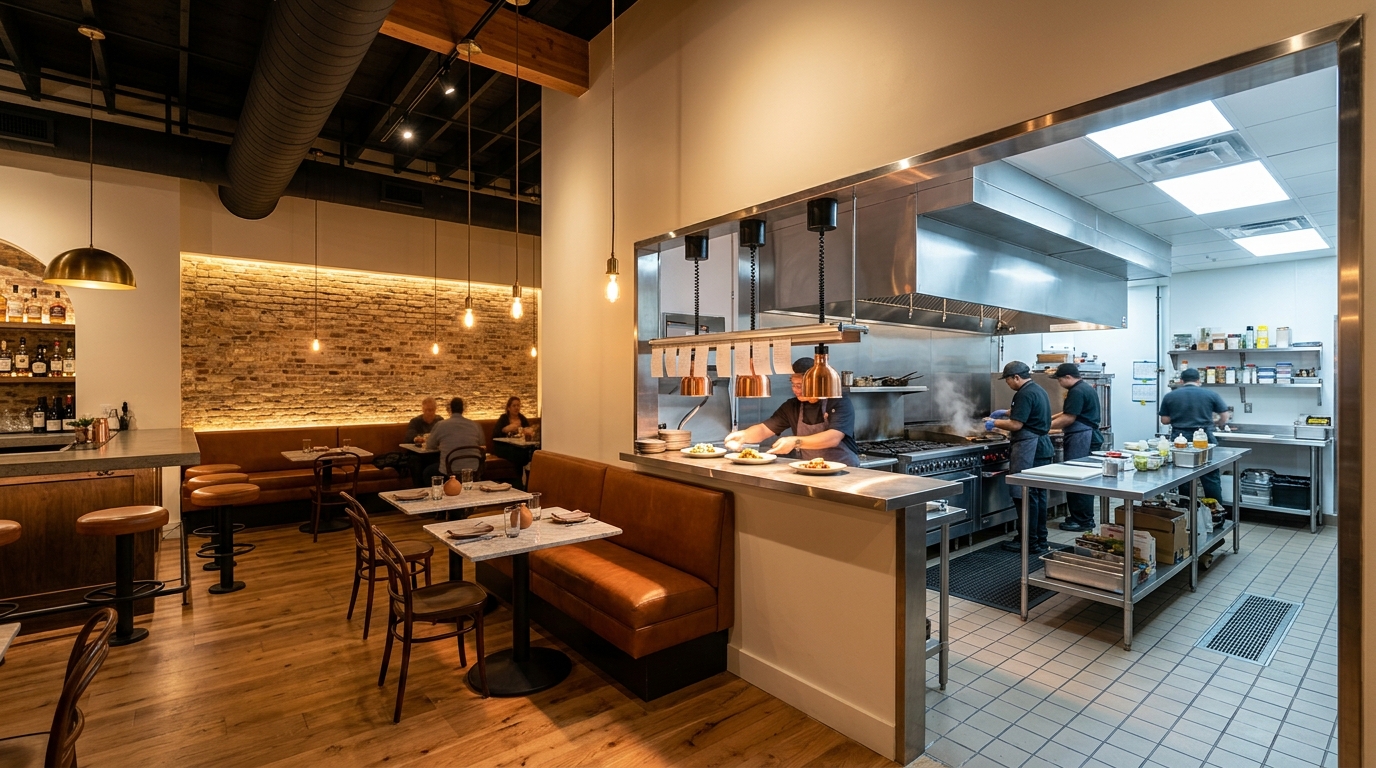
The dining room is what guests see, but the kitchen is what the budget pays for. In a full restaurant renovation, back-of-house systems frequently cost more than the entire dining room, even though guests never set foot in them.
The Kitchen Drives the Budget
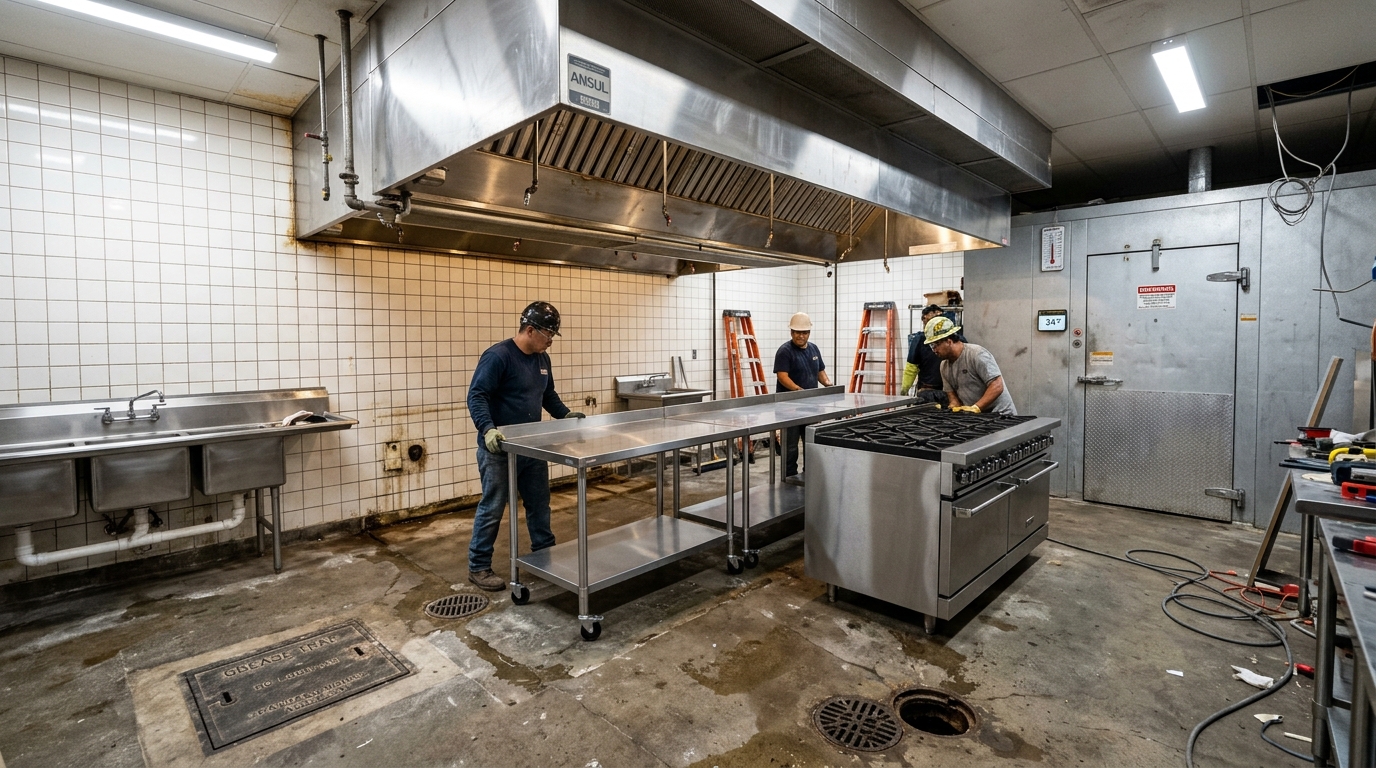
The commercial kitchen is the most expensive concentration of systems in any restaurant. Each of its core components carries real cost, and together they explain why restaurants price so far above other uses.
| System | Why It Is Expensive |
|---|---|
| Exhaust hood and make-up air | Large ductwork, rooftop units, balancing |
| Fire suppression | Code-required system tied to the hood |
| Grease interceptor | Often underground; sizing set by code |
| Plumbing and floor drains | Many fixtures, sloped floors, hot water |
| Gas and electrical | High loads for cooking equipment |
| Walk-in cooler / freezer | Refrigeration, insulation, drainage |
None of these are optional in a code-compliant commercial kitchen, and several, the hood, fire suppression, and grease interceptor, are specifically sized and inspected. This is why the presence or absence of an existing, usable kitchen is the dividing line between an affordable renovation and an expensive one.
Second-Generation Restaurant Space
A second-generation restaurant space is one that was already a restaurant and still has its kitchen infrastructure intact: the hood, grease interceptor, plumbing rough-ins, gas, and often a walk-in. Renovating one of these lets you reuse the most expensive systems and focus your budget on the dining room, branding, and equipment. This is the single most powerful way to control a restaurant renovation cost.
Converting a non-restaurant space, a former retail store or office, is the opposite. You install the hood, run the grease line and interceptor, add the gas and electrical capacity, and build the plumbing from scratch. The same concept can cost twice as much in a raw shell as in a second-generation space, which is why site selection matters more than almost any design choice. Our breakdown of restaurant buildout cost in Texas covers the from-scratch scenario in depth.
Front of House vs. Back of House Spend
A restaurant budget divides between the back of house, where the food is made, and the front of house, where guests experience the brand. Both matter, but they compete for the same dollars, and the right balance depends on the concept.
| Area | Share of Budget (full renovation) |
|---|---|
| Kitchen and back of house systems | 40-55% |
| Dining room and front of house finishes | 25-35% |
| Bar (if applicable) | 5-15% |
| Permits, design, contingency | 10-15% |
A fast-casual concept with a simple menu spends less on the kitchen and can put more into the dining room and brand. A full-service or high-volume concept spends heavily in back, leaving the front to do more with less. Deciding this split before design keeps the project from overbuilding one side at the expense of the other.
Texas Code, Grease, and Health
Restaurants face the most layered code review of any common commercial use. Beyond the building permit, a restaurant renovation typically involves a health department review, a grease and plumbing review, a mechanical review for the hood and ventilation, and fire review for suppression and exits. In Texas, the Texas Food Establishment Rules govern much of the kitchen and food-handling design, and local jurisdictions add grease interceptor sizing and stormwater requirements.
The grease interceptor is a frequent budget and schedule surprise. Sizing is set by code based on the kitchen, and if an existing interceptor is too small or missing, installing one, often underground, is costly and can hold up the health approval. Verify it early.
These overlapping reviews also lengthen the schedule, which carries its own cost in rent and lost revenue before opening. Negotiating enough build time in the lease before rent starts is essential for a restaurant; our guide on what to check before signing a commercial lease covers the free-rent and build-period terms that protect a restaurant operator during a long renovation.
What We See in Texas Restaurant Renovations
When we budget restaurant renovations across Texas, the difference between a workable number and an impossible one almost always comes down to the kitchen the space already has. We have watched the same concept pencil out beautifully in a second-generation restaurant and fall apart in a raw retail box, purely because of the hood, grease, and plumbing that had to be built new. We push operators to weigh second-generation condition above almost everything else during site selection.
The second pattern is the grease interceptor. Owners budget for the kitchen equipment and forget the interceptor, which is code-sized and sometimes has to be installed underground. We verify the existing interceptor and its capacity at the budgeting stage, because discovering it during permitting delays the health approval and the opening.
The third is overbuilding the dining room for the concept. A fast-casual operator sometimes wants a full-service-level dining room the menu cannot support. We align the front-of-house and back-of-house spend with the actual concept and check average, so the budget goes where it earns a return.
The fourth is the schedule and its carrying cost. Restaurants face the most code reviews and inspections, so they take the longest, and every extra week is rent before a single guest is served. We sequence the reviews and order long-lead kitchen equipment early so the health and fire approvals are the last thing waited on, not the kitchen line.
Budgeting a Restaurant Renovation
A sound restaurant renovation budget starts with the kitchen question: second-generation or from scratch. That answer places the project in a per-square-foot tier. From there, decide the front-of-house and back-of-house split to match the concept, add equipment as a separate line, verify the grease interceptor and other code-sized systems, and carry a contingency of 10 to 15 percent plus the carrying cost of the build period.
Equipment is usually a separate budget from construction. A renovation priced at construction cost alone can be missing a six-figure equipment package. Always budget the kitchen equipment, smallwares, furniture, and point-of-sale on top of the build.
The restaurants that open on budget are the ones that confirmed the kitchen infrastructure before falling in love with the space. Matching the concept to a space that already has most of the expensive systems is worth more than any savings a designer can find later.
Key Takeaways
- Texas restaurant renovation runs about $150 to $400 per square foot in 2026, the most expensive common commercial use.
- The commercial kitchen drives the budget: hood, fire suppression, grease interceptor, plumbing, gas, and refrigeration.
- Renovating a second-generation restaurant that already has these systems can cost less than half of converting a raw shell.
- Kitchen and back-of-house systems are typically 40 to 55 percent of a full renovation budget.
- Restaurants face layered code review, health, grease, mechanical, and fire, which lengthens the schedule and carrying cost.
- Kitchen equipment is usually a separate budget on top of construction; never price the build alone.
Frequently Asked Questions
How much does restaurant renovation cost per square foot in Texas?
In 2026, Texas restaurant renovation typically costs between $150 and $400 per square foot. A dining-room refresh runs about $60 to $120, a moderate renovation that reuses an existing kitchen $120 to $220, and a full renovation with a new commercial kitchen $220 to $400 or more per square foot. Kitchen equipment is usually budgeted separately on top of these construction figures.
Why are restaurant renovations so much more expensive than office?
The commercial kitchen carries expensive systems that an office does not: a code-sized exhaust hood and make-up air, fire suppression, a grease interceptor, heavy plumbing with floor drains, high gas and electrical loads, and refrigeration. Several of these are specifically sized and inspected. Together they often cost more than the entire dining room, which is why restaurants price far above office or retail per square foot.
How much does a second-generation restaurant space save?
A second-generation restaurant space already has the hood, grease interceptor, plumbing rough-ins, gas, and often a walk-in cooler, so you reuse the most expensive systems instead of building them new. The same concept can cost roughly half as much in a second-generation space as in a raw retail or office shell. This makes the existing kitchen infrastructure one of the most important factors in site selection.
What code reviews does a restaurant renovation require in Texas?
A restaurant renovation typically requires a building permit plus a health department review under the Texas Food Establishment Rules, a grease and plumbing review with code-sized interceptor requirements, a mechanical review for the hood and ventilation, and a fire review for suppression and exits. Local jurisdictions add grease interceptor sizing and stormwater rules. These overlapping reviews lengthen the schedule, so verify code-sized systems like the grease interceptor early.
Budget Your Restaurant Renovation Around the Kitchen
The kitchen, not the dining room, decides whether a restaurant renovation is affordable. Prestige 360 Design plans and budgets restaurant renovations across Texas, verifying kitchen infrastructure, balancing front-of-house and back-of-house spend, and pricing the full project including code-sized systems. Contact us to build a restaurant budget grounded in the space you actually have.