Insights
Chiropractic Office Design: Layout, Flow, and Texas Buildout Guide (2026)
June 1, 2026

Chiropractic Office Design: Floor Plans, Adjusting Rooms, and Texas Buildout Costs (2026)
Quick Answer: A chiropractic adjusting room with a single table needs about 90 to 120 square feet so the doctor can work on all sides of the table and a patient can transfer comfortably, while an open adjusting bay plans roughly 100 to 140 square feet per table including circulation. The layout decision that shapes everything is open bay versus closed rooms: open bays move more patients per hour and cost less to build, while closed rooms offer privacy and support exam, therapy, and new-patient consults. Most Texas practices use a hybrid of both.
Adjusting Rooms and Open Bay Sizing
The adjusting table is the center of a chiropractic practice, and the room around it has to let the doctor work efficiently. Unlike a typical medical exam room, a chiropractor moves around the entire table and often needs access from the head, foot, and both sides. That all-around access is what drives the room dimension, not the table itself.
A single closed adjusting room generally runs 90 to 120 square feet. An open adjusting bay, where two to four tables share one larger room separated by partitions or curtains, plans about 100 to 140 square feet per table once you account for the doctor’s movement and clear circulation between stations.
| Space Type | Approx. Size | Notes |
|---|---|---|
| Single closed adjusting room | 90-120 sq ft | Privacy, exam, consult capable |
| Open bay (per table) | 100-140 sq ft | Higher throughput, shared room |
| New-patient exam / consult room | 110-140 sq ft | Seating, exam table, discussion |
| Therapy / rehab station | 80-150 sq ft | Varies by equipment |
The right mix depends on practice style. A high-volume, wellness-focused practice leans toward open bays for speed. A practice that emphasizes injury rehabilitation and longer consults needs more closed rooms. Most successful offices combine both, which is why the room program comes before the floor plan.
Patient Flow and Room Program
Chiropractic patient flow is often a loop rather than a line. A returning patient checks in, may do a therapy or warm-up step, gets adjusted, and leaves, sometimes scheduling at the desk on the way out. A new patient follows a longer path: consult, exam, possibly X-ray, then a report-of-findings discussion before the first adjustment. The layout has to serve both without crossing them awkwardly.
Design the returning-patient loop to be as short and frictionless as possible, because that is the volume that pays the rent. The new-patient path can be longer and more deliberate, since it is where trust and the care plan are established.
A typical room program for a mid-size practice includes reception and waiting, two to four adjusting stations (open, closed, or hybrid), one to two exam/consult rooms, a therapy area, a doctor’s office, restrooms, and storage. Plan the front desk with a clear sightline to the entrance and the waiting area, since the desk both greets and schedules. The discipline behind a good medical office layout applies directly, with the open-bay adjusting concept being the main chiropractic-specific twist.
Open Bay vs. Closed Rooms
This is the defining decision. Open bays place multiple tables in one room, letting the doctor move quickly between patients and treating more people per hour. They cost less to build because there are fewer walls, doors, and mechanical runs. The trade-off is privacy and the kinds of conversations that can happen at the table.
Closed rooms cost more and slow throughput, but they support private consults, sensitive exams, and patients who are uncomfortable being adjusted in view of others. They also give the practice flexibility to bill for services that require a private setting.
| Factor | Open Bay | Closed Rooms |
|---|---|---|
| Patient throughput | Higher | Lower |
| Buildout cost | Lower (fewer walls) | Higher |
| Privacy | Limited | Full |
| Best for | Wellness, high volume | Rehab, consults, exams |
The hybrid is the most common answer in Texas: an open bay of two or three tables for routine adjustments, plus one or two closed rooms for new patients, exams, and anyone who needs privacy. This balances revenue per hour against the range of services the practice wants to offer.
Therapy, Rehab, and X-Ray
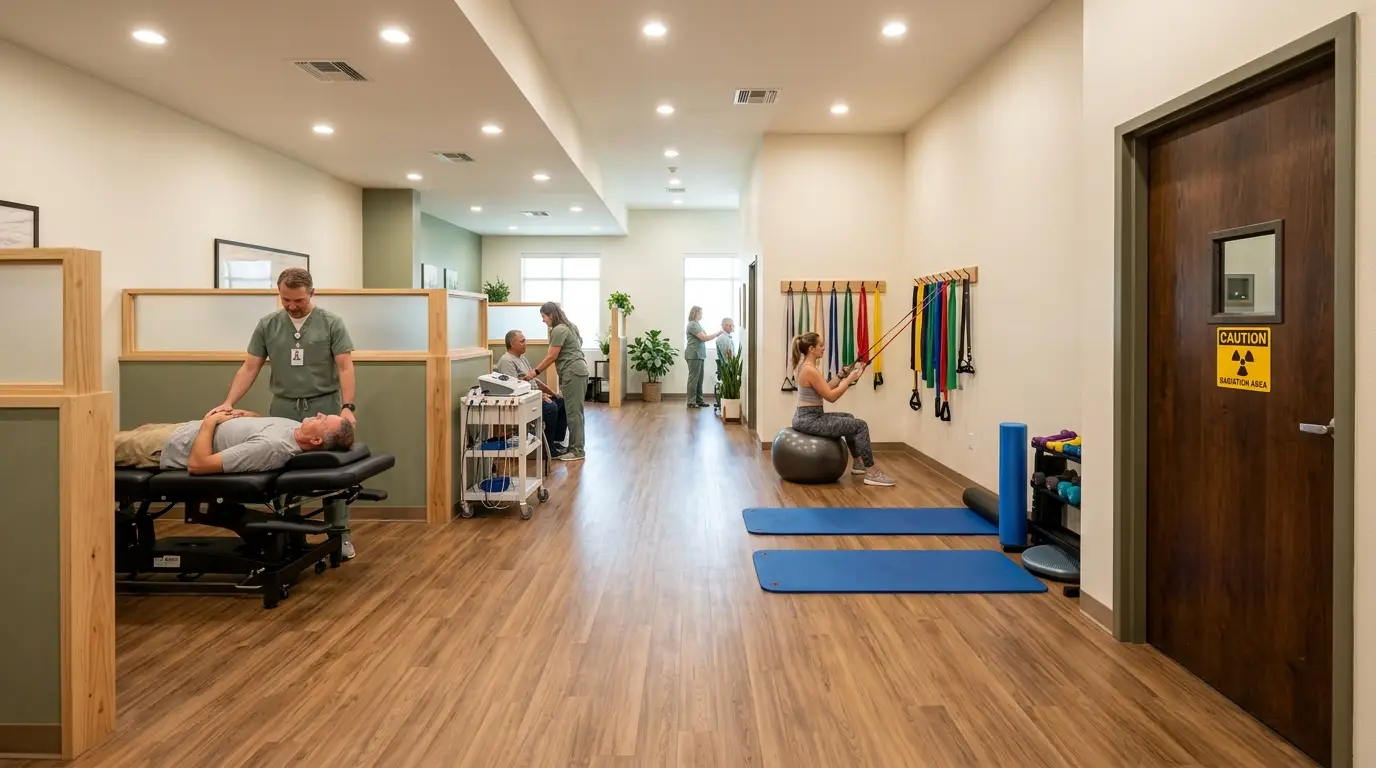
Many chiropractic practices add therapy and rehabilitation, which need their own planned space. Traction tables, electrical stimulation, ultrasound, and exercise or stretching areas each have footprint and power needs. A therapy zone keeps these out of the adjusting flow and lets a patient warm up before being adjusted, smoothing the schedule.
If the practice does in-house imaging, an X-ray room is a specialized build. It requires lead-shielded walls sized by a physicist’s shielding report, a dedicated control area, and Texas Department of State Health Services registration for the radiation-producing equipment. This is one of the most regulated and costly rooms in the office, so decide early whether imaging will be in-house or referred out.
ADA, Privacy, and Comfort
Chiropractic patients often arrive in pain or with limited mobility, which makes accessibility and comfort more than a code checkbox. ADA requires accessible routes, an accessible restroom, adequate door and corridor widths, and clear floor space at reception and in treatment areas. Build in turning space and transfer clearance around at least some adjusting tables so the office can serve patients using mobility aids.
Comfort is a clinical signal. Soft, warm materials, indirect lighting, and low noise reduce the tension a patient carries into an adjustment. A space that feels calm supports the care itself, not just the brand.
Acoustic privacy matters even in open-bay practices. Patients discuss symptoms and history, so the consult and exam rooms need sound-rated walls, and the front desk should be positioned so check-in conversations are not overheard in the waiting room. These privacy details overlap with broader healthcare planning, and the same principles in our medical office layout guide carry over to chiropractic.
What We See in Texas Chiropractic Projects
When we plan chiropractic offices across Texas, the first conversation is always open bay versus closed rooms, because it sets the budget and the throughput. Practices that copy a friend’s layout without matching it to their own care model often end up with too many closed rooms they cannot fill or an open bay that cannot host the consults they want to bill. We start with the practice’s actual patient mix and work the room program from there.
The second recurring issue is the new-patient path. Offices that nail the returning-patient loop sometimes neglect the consult-to-report-of-findings journey that converts a new patient into a care plan. We protect a private, well-considered consult room because that is where the long-term value of each patient is decided.
The third is imaging. We frequently steer newer practices away from building an in-house X-ray room on day one, because the shielding, registration, and equipment cost is significant and many practices refer imaging out until volume justifies it. When imaging is warranted, we coordinate the shielding report early so the wall construction is right the first time.
The fourth is comfort and accessibility. Because so many patients arrive in discomfort, we consistently invest in wide, clear circulation, warm materials, and at least one fully accessible adjusting station. It improves the experience and widens the patient base the office can serve.
Texas Chiropractic Office Buildout Cost Ranges
Costs depend heavily on the open-versus-closed mix, whether the space is a clean second-generation medical suite or a raw retail shell, and whether the practice builds an X-ray room. The figures below are Texas planning ranges, not quotes. Open-bay-heavy layouts in existing medical space sit at the low end; closed-room layouts with imaging in raw space sit at the high end.
| Scope | Typical Range | Main Drivers |
|---|---|---|
| Cosmetic refresh (existing suite) | $30-$70 / sq ft | Finishes, lighting, reception |
| Standard buildout (retail to chiro) | $80-$160 / sq ft | Rooms, plumbing, HVAC, finishes |
| Full buildout (closed rooms + therapy) | $140-$250+ / sq ft | Many rooms, mechanical, casework |
| In-house X-ray room (add) | $15,000-$45,000+ | Lead shielding, control area, registration |
For the underlying shell and tenant-improvement side of these numbers, our breakdown of tenant improvement cost per square foot in Texas provides the base ranges that feed a chiropractic estimate. The single biggest cost lever remains the open-versus-closed room count, which is why we lock the room program before pricing.
Key Takeaways
- Plan 90 to 120 square feet for a closed adjusting room and 100 to 140 square feet per table in an open bay, because the doctor needs all-around table access.
- The open-bay-versus-closed-room decision sets both budget and throughput; most Texas practices use a hybrid of open bays plus a couple of closed rooms.
- Design a short, frictionless loop for returning patients and a longer, more deliberate path for new-patient consult, exam, and report of findings.
- An in-house X-ray room requires lead shielding sized by a physicist’s report and Texas DSHS registration; many practices refer imaging out until volume justifies the build.
- Accessibility and comfort are clinical, not cosmetic, because patients often arrive in pain or with limited mobility.
- Lock the room program to the practice’s actual patient mix before pricing, since room count is the biggest cost lever.
Frequently Asked Questions
How big should a chiropractic adjusting room be?
A single closed adjusting room needs about 90 to 120 square feet so the doctor can move around the entire table and the patient can transfer comfortably. In an open adjusting bay where several tables share one room, plan roughly 100 to 140 square feet per table to include the doctor’s movement and clear circulation between stations.
Is an open bay or closed rooms better for a chiropractic office?
It depends on the practice. Open bays move more patients per hour and cost less to build because there are fewer walls, which suits wellness and high-volume practices. Closed rooms offer privacy and support exams, consults, and rehab, but cost more and slow throughput. Most Texas practices use a hybrid: an open bay for routine adjustments plus one or two closed rooms for new patients and private services.
How much does it cost to build out a chiropractic office in Texas?
A cosmetic refresh of an existing medical suite runs about $30 to $70 per square foot, a standard retail-to-chiropractic buildout about $80 to $160 per square foot, and a full closed-room buildout with therapy $140 to $250 or more per square foot. An in-house X-ray room adds roughly $15,000 to $45,000 or more for lead shielding, a control area, and registration. The room mix is the biggest variable.
Do I need a special room for chiropractic X-ray equipment?
Yes. An in-house X-ray room requires lead-shielded walls sized by a physicist’s shielding report, a dedicated control area protected from the beam, and registration of the radiation-producing equipment with the Texas Department of State Health Services. Because of the cost and regulation, many newer practices refer imaging out until patient volume justifies building the room.
Plan a Chiropractic Office That Fits Your Care Model
The right chiropractic layout starts with your patient mix and care style, not a template. Prestige 360 Design plans chiropractic and rehabilitation offices across Texas, from adjusting-bay and consult-room programming to therapy zones, imaging coordination, and permit-ready drawings. Contact us to design an office that balances throughput, privacy, and patient comfort.