Insights
Auto Repair Shop Layout Design: What the Best Floor Plans Get Right
June 1, 2026
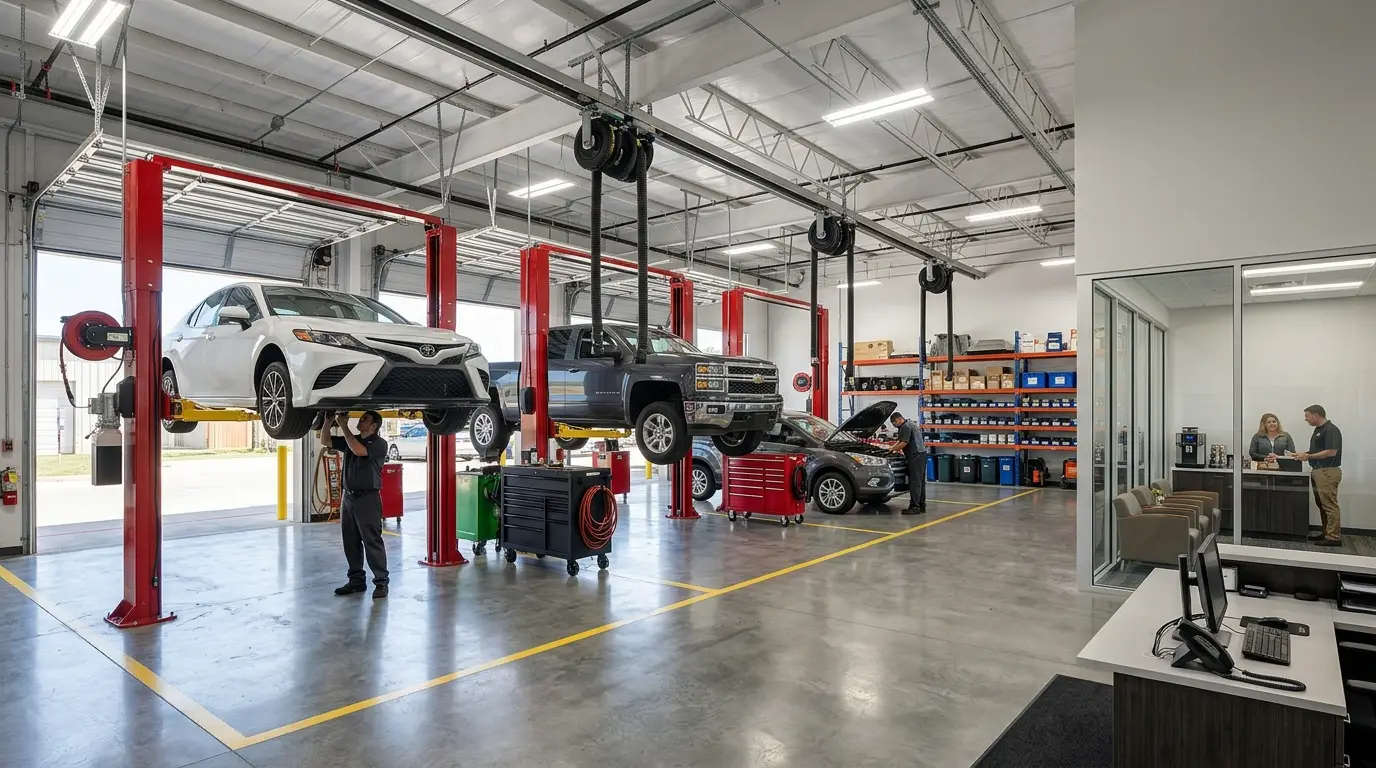
Auto Repair Shop Layout: Bay Planning, Workflow, and Texas Buildout Costs (2026)
Quick answer: The best auto repair shop layout design positions drive-through bays along the building's longest wall, places parts storage within 30 feet of every technician station, separates the customer waiting area from the shop floor with a visual but not acoustic barrier, and sizes each bay at minimum 12 x 24 feet with 14-foot ceiling clearance for lifts. A well-designed floor plan reduces technician travel time by 20-35% and supports a higher repair-order count per shift.
Quick Answer: A standard auto repair service bay needs roughly 12 to 15 feet of width and 24 to 30 feet of depth, which works out to about 300 to 450 square feet per bay once you add aisle and equipment clearance. The layout should move a vehicle in a clean line from intake and diagnosis to the repair bays and back out, with parts, tools, and waste fluids positioned so technicians never cross the customer path. Ventilation, floor loading for lifts, and Texas fire and environmental code drive more of the cost than the bays themselves.
Bay Sizing and Count
The service bay is the revenue unit of an auto repair shop. The number of bays you can fit, and how comfortably a technician can work in each one, determines throughput. A bay that is cramped slows every job, and slow jobs cost money in a business billed by labor hour. Start with the bay envelope and work outward.
A general service bay typically needs 12 to 15 feet of clear width so a vehicle can sit centered with doors fully open and a lift on both sides. Depth runs 24 to 30 feet so a full-size truck fits with room at the front for a workbench and at the rear for the technician to move. Heavy-duty or alignment bays need more.
| Bay Type | Clear Width | Clear Depth | Approx. Footprint |
|---|---|---|---|
| General service (cars/light trucks) | 12-14 ft | 24-26 ft | 300-360 sq ft |
| Heavy-duty / full-size truck | 14-16 ft | 28-32 ft | 400-510 sq ft |
| Alignment / tire | 15-18 ft | 30-34 ft | 450-610 sq ft |
| Quick-service / inspection | 11-13 ft | 22-24 ft | 240-310 sq ft |
Once you know the bay mix, add circulation. The maneuvering aisle in front of the bays needs to let a vehicle turn into any bay without a three-point shuffle. For drive-in/back-out bays, plan a 24 to 30 foot aisle. Drive-through bays cost more floor but cut maneuvering and speed flow.
A useful rule: total building area runs about 1.6 to 2.0 times the raw bay footprint once you include aisles, parts, office, restroom, and customer space. A four-bay shop with 360 square foot bays is not a 1,440 square foot building. It is closer to 2,500 to 3,000 square feet of leased or built space.
Workflow Zones and Vehicle Flow
The most profitable shops are organized around a single clean path for the vehicle. A car arrives, gets written up, gets diagnosed, gets repaired, gets quality-checked, and leaves. Every time that path crosses itself or backtracks, you lose minutes and create congestion. Map five zones before you place a single wall.
Intake and write-up is where the service advisor meets the customer and the vehicle. Diagnosis may share space with intake or sit at the first bay. The repair bays are the core. A parts and tool spine should run along the back or side so technicians pull what they need without leaving the work area. Finally, a finished-vehicle staging zone keeps completed cars out of the active bays until pickup.
| Zone | Purpose | Placement Priority |
|---|---|---|
| Intake / write-up | Customer drop-off, inspection, work order | Front, visible from entrance |
| Diagnosis | Scan, road test prep, estimate | Near intake, first bay |
| Repair bays | Core labor | Center, served by parts spine |
| Parts / tools | Supply, storage, special tools | Adjacent to bays, off customer path |
| Finished staging | Hold completed vehicles | Near exit / pickup |
Keep the customer path and the vehicle path separate. A customer should reach the waiting area and restroom without walking across an active bay. This is both a liability point and a professionalism signal. The same separation logic applies to many service businesses; the workflow discipline behind a strong commercial space planning process is what keeps these paths clean as the shop scales.
Lifts, Equipment, and Floor Loads
Lifts are the single most layout-defining piece of equipment in the shop, and they have requirements that reach into the slab. A two-post lift concentrates the entire vehicle weight onto two anchored columns, which means the concrete must meet a minimum thickness and strength, typically a 4 to 6 inch slab at a specified PSI with proper anchoring. Four-post and drive-on lifts spread the load differently. Confirm the manufacturer slab spec before you pour or before you sign a lease on an existing slab you cannot verify.
A common and expensive surprise: a tenant signs a lease on a former warehouse, then discovers the existing slab is too thin or too weak to anchor two-post lifts safely. The fix is sawcutting and pouring new footings, which can run thousands of dollars per bay. Verify the slab before, not after.
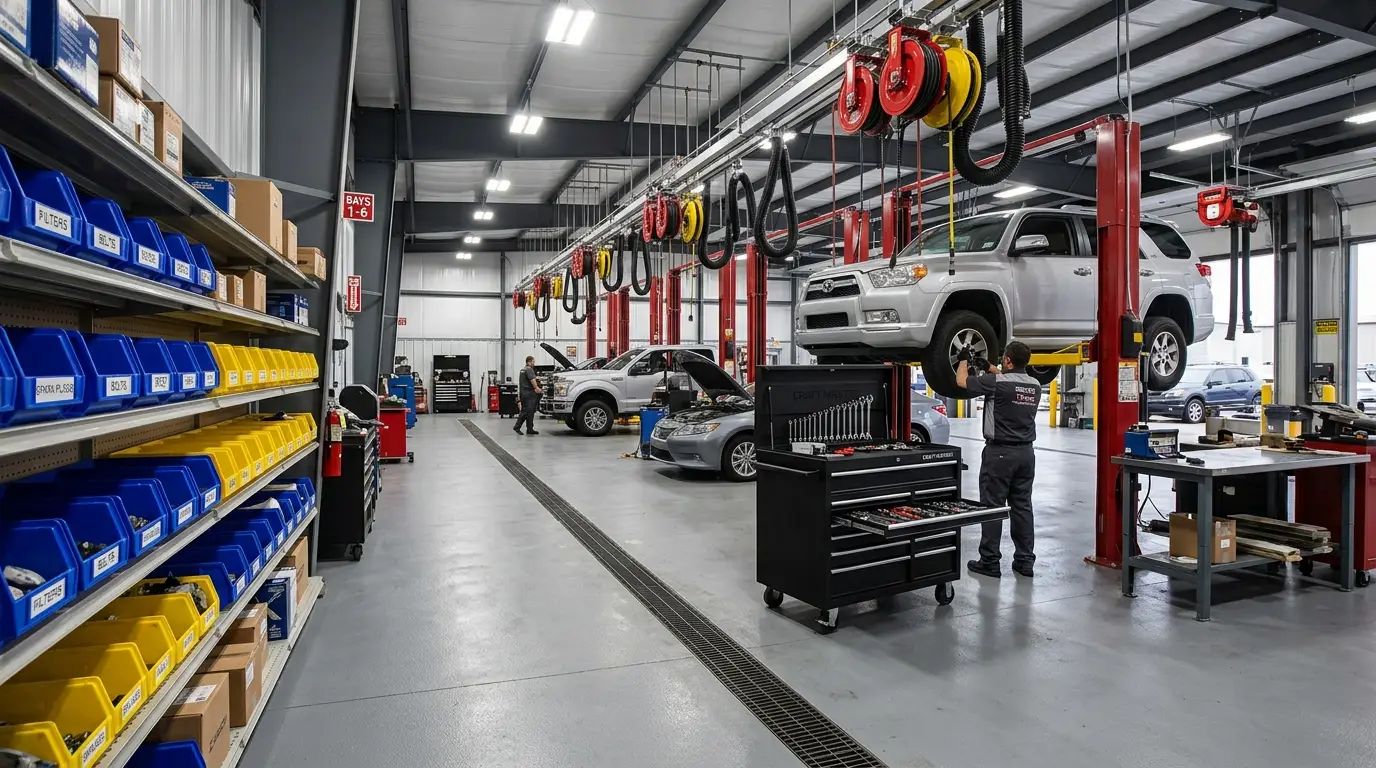
Beyond lifts, plan for compressed air distribution, an air compressor location that is ventilated and ideally isolated for noise, fluid dispensing and waste collection, and dedicated electrical for diagnostic equipment and lifts. Overhead reels for air and electrical keep cords off the floor and speed every job.
Ventilation, Air, and Fluids
Auto repair generates exhaust fumes, welding gas, solvent vapor, and waste fluids. Texas mechanical and fire code require exhaust extraction and ventilation appropriate to the work. A vehicle exhaust extraction system that connects directly to the tailpipe is the cleanest solution and is often expected for any bay where engines run indoors. General ventilation handles ambient fumes.
Waste fluids, used oil, coolant, and solvents are regulated. Texas Commission on Environmental Quality rules and local stormwater ordinances govern how fluids are stored and disposed, and floor drains in repair areas often require an oil/water separator before connecting to the sanitary sewer. Building this in from the start is far cheaper than retrofitting.
| System | Why It Matters |
|---|---|
| Vehicle exhaust extraction | Removes tailpipe fumes at the source; often code-required |
| General ventilation / make-up air | Clears ambient solvent and welding fumes |
| Oil/water separator | Required before floor drains tie to sewer |
| Used fluid storage | Regulated containment for oil, coolant, solvent |
Customer Area, Office, and Parts
The front of house sells trust. A clean, comfortable waiting area with seating, a clear service counter, and a restroom tells the customer the shop is professional before any work begins. Glass between the waiting area and the service floor lets customers see their vehicle being worked on, which builds confidence, while keeping them safely separated from the bays.
The service office needs space for the advisor, a point-of-sale and management system, and document storage. Parts storage should be secure and organized, ideally with a counter where deliveries are received off the main floor. For shops that stock tires or batteries, plan dedicated heavy storage with safe access.
These front-of-house decisions are the same brand and trust calculations that drive any customer-facing fit-out. The way a commercial office interior uses materials and sightlines to signal competence applies directly to the auto shop waiting room and counter.
Texas Code, Zoning, and Permits
Auto repair is a regulated use. Before you commit to a location, confirm the zoning allows vehicle repair, because many commercial and retail zones do not, or allow it only with a conditional use permit. Auto repair classifies as a hazardous or moderate-hazard occupancy under the building code depending on the work, which affects fire separation, exits, and ventilation requirements.
The lease and the zoning are where auto shop deals most often fall apart. A perfect building in the wrong zone is a dead end. Always confirm permitted use and parking minimums with the local jurisdiction before signing, and read the lease for who pays for code-driven improvements. Our guide on what to check before signing a commercial lease covers the clauses that matter most for trade-use tenants.
Plan for permits covering building, mechanical, electrical, plumbing, and often a separate environmental or stormwater review. Parking requirements are higher for auto repair than for office because of customer drop-off, finished-vehicle staging, and employee parking. Undersized parking is a frequent reason a site fails site-plan review.
What We See in Texas Auto Shop Projects
When we plan auto repair shops across Texas, the same handful of issues decide whether a project lands on budget. The first is the slab. We have seen tenants fall in love with a high-bay warehouse only to learn the existing slab will not safely anchor two-post lifts. Verifying slab thickness and strength early, with a core sample if records are missing, saves thousands and weeks of delay.
The second is ventilation and drainage. Owners often budget for the bays and the lifts but underestimate exhaust extraction, make-up air, and the oil/water separator. On one project the separator and trench drain work alone added meaningful cost that had not been in the original number, simply because it was discovered late. Build these into the first estimate.
The third is the front of house. Shops that treat the waiting area as an afterthought leave money on the table. A modest investment in a clean counter, good seating, and a glass view to the floor measurably improves how customers perceive pricing and trust. We consistently recommend protecting that front-of-house budget rather than cutting it first.
The fourth is parking and circulation. More than once a site that looked perfect failed because it could not meet parking minimums or stack finished vehicles without blocking the bays. We map vehicle storage and customer parking at the site-selection stage, not after the lease is signed.
Texas Auto Repair Shop Buildout Cost Ranges
Costs vary with the condition of the existing building, the number and type of lifts, and how much mechanical, electrical, and environmental work the space needs. The ranges below reflect typical Texas buildouts and are planning figures, not quotes. A clean second-generation auto space costs far less than converting raw warehouse or retail.
| Scope | Typical Range | Main Drivers |
|---|---|---|
| Cosmetic refresh (existing auto space) | $25-$60 / sq ft | Paint, lighting, counter, signage |
| Standard conversion (retail/warehouse to shop) | $70-$140 / sq ft | Slab work, lifts, ventilation, drains |
| Full buildout (heavy mechanical + environmental) | $140-$250+ / sq ft | New slab, extraction, separator, high power |
| Per-bay equipment (lift + air + tooling) | $8,000-$25,000 / bay | Lift type, reels, diagnostic gear |
For the building shell and tenant-improvement side of these numbers, our breakdown of tenant improvement cost per square foot in Texas gives the underlying ranges that feed an auto shop estimate. The biggest swing factor remains the slab and the environmental systems, which is why we verify those before producing any final number.
Key Takeaways
- Plan 300 to 450 square feet per general service bay, and expect total building area of roughly 1.6 to 2.0 times the raw bay footprint once aisles, parts, office, and customer space are added.
- Organize the shop around one clean vehicle path: intake, diagnosis, repair, staging, exit, with parts and tools on a spine that keeps technicians off the customer path.
- Verify slab thickness and strength before committing to lifts; a too-thin slab is a common and expensive surprise.
- Budget exhaust extraction, make-up air, and an oil/water separator from the start, because Texas mechanical and environmental code require them.
- Confirm zoning, permitted use, and parking minimums before signing any lease; the wrong zone kills the deal.
- Protect the front-of-house budget; a clean waiting area and service counter measurably improve customer trust and pricing perception.
Commercial Space Planning from Prestige 360
Planning a new auto repair facility or tenant improvement in Texas? Prestige 360 Design handles commercial space planning, permitting, and construction under one contract:
- Commercial Buildout Planning Texas - scope definition, permit management, and project planning for Texas commercial tenants.
- Tenant Improvement Services - design and construction management for leased commercial spaces from shell to CO.
- Retail Space Planning and Design - floor plan optimization and traffic flow design for commercial tenants.
- Commercial Finish Out Texas - full finish-out services for automotive, industrial, and commercial spaces across Texas.
Frequently Asked Questions
How big should an auto repair bay be?
A general service bay for cars and light trucks needs about 12 to 14 feet of clear width and 24 to 26 feet of depth, roughly 300 to 360 square feet. Heavy-duty and alignment bays need more, up to 16 to 18 feet wide and 30 to 34 feet deep. Add maneuvering aisle in front of the bays of about 24 to 30 feet for drive-in, back-out operation.
How many square feet do I need for a four-bay auto shop?
Plan for roughly 2,500 to 3,000 square feet for a four-bay shop. The raw bay footprint of four 360 square foot bays is about 1,440 square feet, but total building area runs about 1.6 to 2.0 times that once you add maneuvering aisles, parts and tool storage, office, restroom, and a customer waiting area.
Does my floor slab need to be special for car lifts?
Yes. Two-post lifts concentrate the full vehicle weight onto two anchored columns, so the concrete must meet the lift manufacturer’s minimum slab thickness and strength, typically a 4 to 6 inch slab at a specified PSI. Many existing warehouse or retail slabs are too thin or weak to anchor lifts safely, which means sawcutting and pouring new footings. Verify the slab before signing a lease or pouring.
What permits and code issues apply to an auto repair shop in Texas?
Auto repair is a regulated use that requires the right zoning, often building, mechanical, electrical, and plumbing permits, plus an environmental or stormwater review. Vehicle exhaust extraction and an oil/water separator on floor drains are commonly required, and used fluids are regulated for storage and disposal. Parking minimums are higher than for office use. Confirm permitted use and parking with the local jurisdiction before committing to a site.
Plan Your Auto Repair Shop the Right Way
A profitable auto shop starts with a layout that respects bay geometry, vehicle flow, and Texas code before a single wall goes up. Prestige 360 Design plans auto repair and service facilities across Texas, from bay layout and equipment coordination to permit-ready drawings and buildout budgeting. Contact us to plan a shop that runs efficiently from day one.