Insights
Coffee Shop Interior Design: Layout, Workflow, and Texas Buildout Costs (2026)
June 1, 2026
Coffee Shop Interior Design: Layout, Workflow, and Texas Buildout Costs (2026)
Quick Answer: A well-designed coffee shop separates the customer path from the barista work zone so that ordering, payment, and pickup never collide. The bar should be planned around a compact work triangle (espresso machine, grinder, and milk station within two steps), seating should be allocated at roughly 15 to 20 square feet per customer, and plumbing for a three-compartment sink, handwash sink, and floor drains must be located before any walls go up. Getting the bar workflow and plumbing right on paper is the difference between a cafe that serves 40 drinks an hour and one that stalls at 20.
The Five Zones of a Coffee Shop Layout
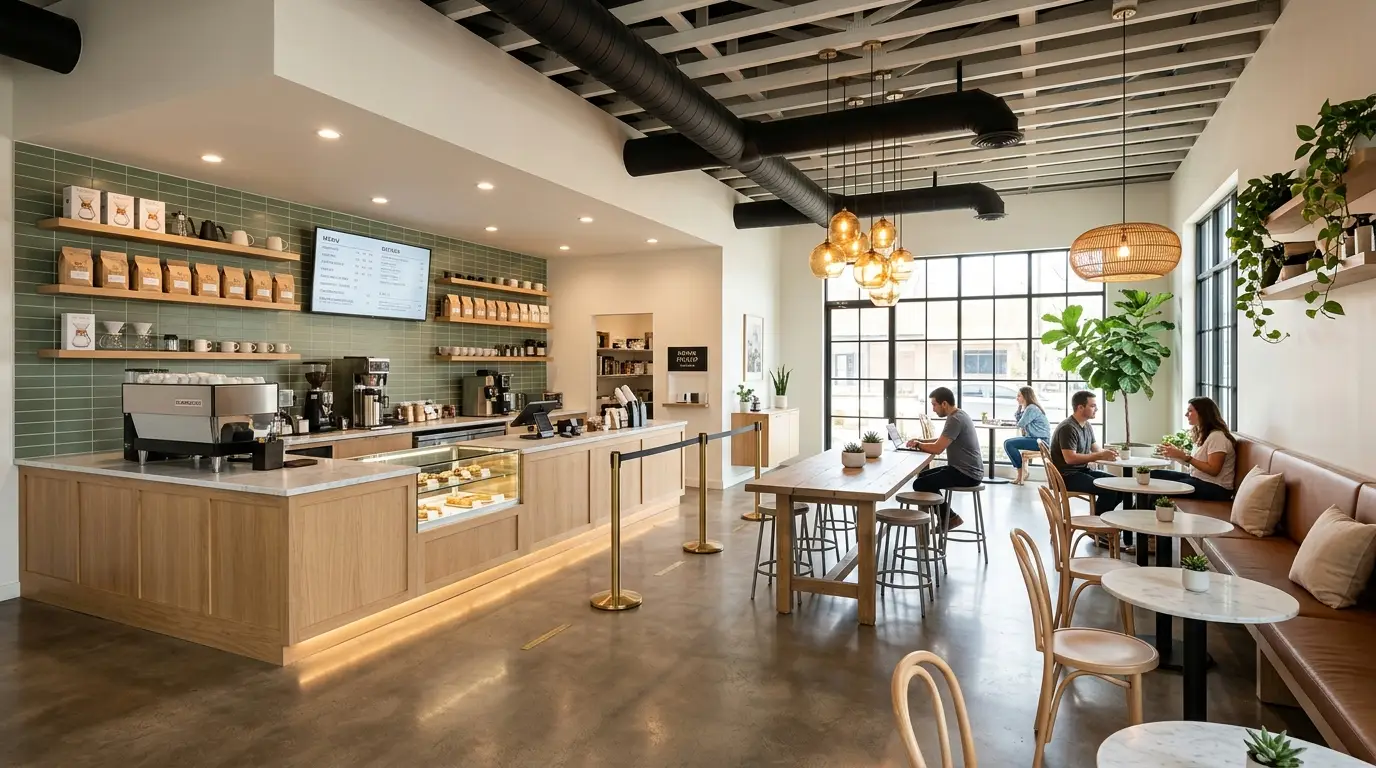
Every functional coffee shop divides into five zones, and the quality of the design is decided by how cleanly these zones connect without overlapping. The five are: the entry and queue zone, the order and payment counter, the production bar, the pickup and condiment zone, and the seating area. When two of these zones share the same floor space, throughput drops and the customer experience suffers.
The entry and queue zone needs enough depth that a line of four to six customers can form without backing out the door or blocking the seating. In a narrow tenant space, this is the single most common planning failure. A queue path of at least 36 inches wide and 10 to 12 feet of length gives a small cafe room to hold a morning rush line. The order counter sits at the end of that queue, and the payment point should be positioned so the customer steps to one side after ordering rather than standing directly in front of the pickup point.
The production bar is the engine of the business. It should be visible to customers (the theater of coffee is part of the product) but protected from foot traffic. The pickup zone is offset from the order counter so that a customer waiting for a drink is not standing where the next customer needs to pay. The seating zone is the last consideration in flow but the largest in square footage, and it determines how long customers stay and how much they spend.
Designing the Bar: Barista Workflow and Ergonomics
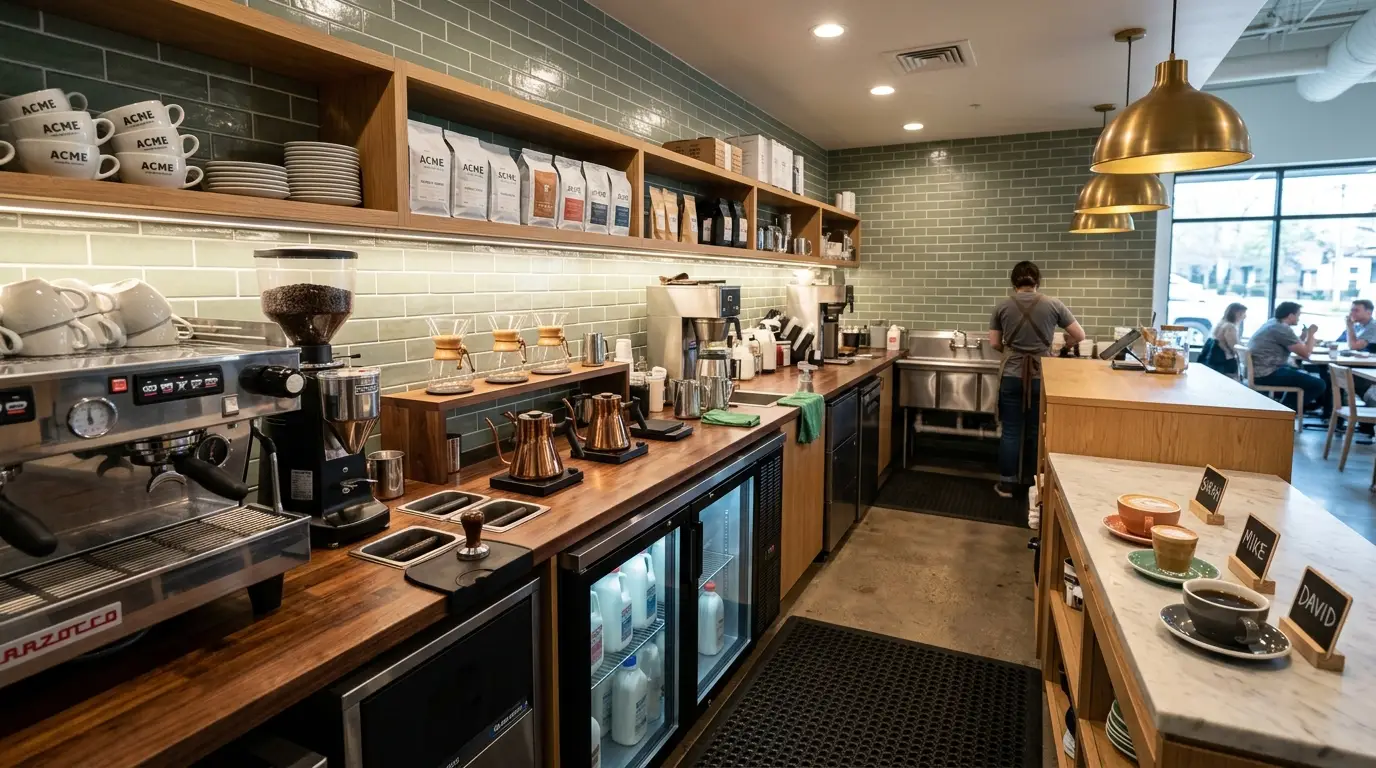
The bar is where coffee shop design earns or loses money. A barista pulling shots during a rush moves through a fixed sequence: take the cup, grind and dose, pull the espresso, steam the milk, pour, and hand off. If any of those stations requires the barista to turn more than 90 degrees or take more than two steps, the sequence slows and the line builds.
The core work triangle is the espresso machine, the grinder, and the milk steaming and refrigeration. These three should sit within an arm sweep of each other. The grinder goes immediately beside the machine on the dominant-hand side. Undercounter refrigeration for milk sits directly below or beside the steam wand so the barista never walks to a reach-in fridge mid-drink. A dedicated knock box, a tamping station, and a clear landing zone for finished drinks complete the bar.
Throughput Reality: A single well-designed two-group espresso bar with one barista can produce 35 to 50 drinks per hour. The same machine in a poorly laid out bar where the grinder is across an aisle and the milk fridge is six feet away will cap at 20 to 25 drinks per hour. The bottleneck is almost never the equipment. It is the walking distance between stations. On a busy Texas morning that difference is hundreds of dollars in lost sales per day.
Counter height and depth matter for both speed and ergonomics. A production bar is typically 36 inches high with a 30-inch deep work surface, while the customer-facing counter often steps up to a 42-inch transaction ledge that hides the work surface and gives customers a place to set bags and phones. Allow at least 42 inches of clear aisle behind the bar so two staff can pass during a rush without collisions.
Customer Flow, Queue, and the Order-to-Pickup Split
The order-to-pickup split is the layout decision that most affects perceived speed. In a linear flow, the customer enters, moves along the queue, orders and pays at the register, then slides down the counter to a pickup point several feet away. This keeps the line moving because a customer waiting for a drink is no longer occupying the register position.
In small spaces where order and pickup share one counter, the cafe feels congested the moment more than three customers are present. If your tenant space is under 1,200 square feet, prioritize a side-by-side or L-shaped counter that creates physical separation between the pay point and the hand-off point even if the total counter length is modest.
Mobile order pickup has changed cafe flow significantly. A dedicated mobile pickup shelf, positioned near the exit and away from the main register, prevents app customers from crossing the in-store queue. Cafes that added mobile ordering without a dedicated pickup point routinely report congestion at the counter. Plan the mobile shelf into the layout from the start, including a data and power drop for a pickup screen.
Seating Mix and Seats Per Square Foot
Seating drives dwell time, and dwell time drives the secondary spend that often separates a profitable cafe from a break-even one. The right seating mix depends on whether the cafe is a grab-and-go model, a destination work-and-stay model, or a hybrid. A planning baseline of 15 to 20 square feet per seat covers the seat, the table share, and the circulation space around it.
| Seating Type | Sq Ft Per Seat | Best For | Notes |
|---|---|---|---|
| Window bar / counter | 10-12 | Solo customers, laptops | High turnover, low footprint, needs power outlets |
| Two-top tables | 15-18 | Pairs, short visits | Flexible, can be pushed together |
| Communal table | 12-15 | Remote workers, students | High seat density, strong community feel |
| Lounge / soft seating | 25-35 | Long dwell, destination visits | Lowest density, highest comfort and brand value |
| Banquette along wall | 14-16 | Mixed groups | Efficient use of perimeter, comfortable |
A grab-and-go cafe near an office corridor may dedicate only 30 percent of its floor to seating and lean on window bars and a couple of two-tops. A destination neighborhood cafe in a walkable San Antonio or Austin district may push seating to 55 or 60 percent of the floor with a mix of communal tables and lounge seating because customers come to stay. Power outlets are no longer optional for the work-and-stay model. Plan floor boxes and wall outlets at every seat that faces a wall or sits at a communal table.
Plumbing, Health Code, and Equipment in Texas
The plumbing plan is where a coffee shop buildout becomes a commercial food project rather than a retail fit-out. Texas retail food establishments are regulated under the Texas Food Establishment Rules (TFER), enforced locally by city or county health departments such as San Antonio Metro Health or Austin Public Health. A cafe serving prepared drinks needs, at minimum, a three-compartment warewashing sink, a dedicated handwashing sink in the production area, a mop or service sink, and often a separate prep sink if food is assembled on site.
Each of these fixtures needs supply lines and drainage, and the espresso machine itself needs a dedicated water line with filtration and a drain connection. Floor drains in the bar area are strongly recommended because espresso work is wet work. The location of the main waste stack in your tenant space dictates how expensive the plumbing becomes. A bar positioned far from the stack requires the slab to be cut and trenched to run new drain lines, which is one of the largest single costs in a cafe buildout.
Plumbing Cost Driver: Locating the bar within 10 to 15 feet of the existing waste stack can keep plumbing rough-in in the $8,000 to $15,000 range for a small cafe. Pushing the bar to the far end of a slab-on-grade space, requiring 40 feet of trenching and a new floor sink, can drive that same scope to $20,000 to $35,000. This is why the bar location should be decided around the plumbing, not the other way around. Moving the bar on paper costs nothing. Moving it after the slab is poured costs five figures.
Grease is usually a smaller concern for a drinks-focused cafe than for a full restaurant, but any cafe that adds a kitchen with cooking equipment may trigger a grease interceptor requirement from the local authority. Confirm the grease and ventilation requirements with the health department before finalizing the kitchen scope, because a Type I hood and interceptor can add tens of thousands of dollars and weeks to the permit timeline.
ADA, Lighting, and Acoustics
A coffee shop is a place of public accommodation under the Americans with Disabilities Act, and in Texas the project is also subject to the Texas Accessibility Standards enforced by the Texas Department of Licensing and Regulation. A portion of seating must be accessible, with knee clearance under tables of at least 27 inches high, 30 inches wide, and 19 inches deep. The order counter needs an accessible lowered section no higher than 36 inches, and the path of travel through the seating and to the restroom must maintain a 36-inch clear width.
Lighting sets the mood and the brand. Most successful cafes layer three types: ambient lighting for overall comfort, task lighting over the bar so baristas can read pours and tickets, and accent lighting on the menu board and any retail merchandising. Warm color temperatures in the 2700K to 3000K range read as inviting, while the bar work surface benefits from slightly cooler, brighter task light for accuracy.
Acoustics are the quietly decisive factor in whether customers stay. Hard surfaces (concrete floors, glass, exposed ceilings) look great and photograph well but create a loud, echoey room that drives customers out. Acoustic ceiling clouds, felt panels, upholstered banquettes, and area rugs in lounge zones bring the reverberation down to a level where conversation and laptop work are comfortable. Budget for acoustic treatment from the start rather than chasing it after opening when customers complain the room is too loud.
What We See in Texas Coffee Shop Projects
We design cafe and coffee shop buildouts across San Antonio, Austin, and the Hill Country, and a few patterns repeat on almost every project.
The most expensive mistake is signing a lease on a space where the bar has to go far from the plumbing. One operator we worked with leased a long, narrow space and wanted the bar at the front for street visibility. The waste stack was at the rear. Running drains 45 feet under a slab and adding a floor sink added roughly $22,000 to the budget that a pre-lease assessment would have flagged. A two-hour walkthrough before signing the lease, costing a fraction of that, would have either changed the bar position or changed the space.
The second pattern is undersized queue space. Owners focus on seating and the bar and forget that 20 people will line up at 7:30 in the morning. A cafe with a beautiful interior but a queue that backs into the seating loses both the seated customers (who get crowded) and the line customers (who feel rushed). We plan the morning rush line first and let it set the front-of-house geometry.
The third is treating acoustics as an afterthought. Polished concrete and exposed ceilings are the default aesthetic, and they are loud. We build the acoustic budget in from day one because retrofitting felt and ceiling clouds after opening is more expensive and more disruptive than installing them during construction.
Texas Coffee Shop Buildout Cost Ranges
| Scope | Cost Range | Notes |
|---|---|---|
| Light fit-out (former food space, plumbing in place) | $80,000-$150,000 | Reuses existing utilities, focus on finishes and bar |
| Standard cafe buildout (1,200-1,800 sq ft) | $150,000-$300,000 | New bar, plumbing rough-in, seating, finishes |
| Full buildout with kitchen and hood | $300,000-$500,000+ | Type I hood, grease interceptor, expanded prep |
| Plumbing rough-in (near stack) | $8,000-$15,000 | Three-comp sink, handwash, espresso line, floor drain |
| Plumbing rough-in (far from stack) | $20,000-$35,000 | Slab cutting, trenching, new floor sink |
| Acoustic treatment | $6,000-$18,000 | Ceiling clouds, felt panels, depends on room size |
These ranges reflect tenant improvement pricing in the San Antonio and Austin metros and exclude espresso equipment, furniture, and point-of-sale technology. Equipment for a serious cafe (machine, grinders, refrigeration, water filtration) commonly adds $40,000 to $90,000. For broader context on tenant improvement budgeting, see our guide on tenant improvement cost per square foot in Texas, and for restaurant-grade scope read our restaurant buildout cost guide.
Key Takeaways
- Separate the five zones cleanly: queue, order, production bar, pickup, and seating. Overlap kills throughput.
- Design the bar as a tight work triangle. The espresso machine, grinder, and milk fridge belong within two steps of each other.
- Split the order point from the pickup point so a waiting customer never blocks the next customer paying.
- Plan a dedicated mobile order pickup shelf near the exit to keep app traffic out of the in-store queue.
- Allocate 15 to 20 square feet per seat and match the seating mix to your grab-and-go or work-and-stay model.
- Locate the bar near the existing waste stack. Far-from-stack plumbing can add $20,000 or more.
- Build acoustic treatment into the budget from day one. Polished concrete and exposed ceilings are loud.
- Confirm health department and grease requirements before finalizing any kitchen scope.
Frequently Asked Questions
How much does it cost to build out a coffee shop in Texas?
A standard coffee shop buildout in the San Antonio or Austin metro typically runs $150,000 to $300,000 for a 1,200 to 1,800 square foot space, covering the bar, plumbing rough-in, seating, and finishes. A light fit-out of a former food space with utilities already in place can start around $80,000, while a full buildout that adds a kitchen with a Type I hood and grease interceptor can exceed $500,000. Espresso equipment and furniture are usually budgeted separately and add $40,000 to $90,000.
How many square feet do you need per seat in a coffee shop?
Plan for 15 to 20 square feet per seat as a baseline, which accounts for the seat, a share of the table, and the circulation space around it. Window bars and communal tables are more efficient at 10 to 15 square feet per seat, while lounge and soft seating run 25 to 35 square feet per seat. The right mix depends on whether the cafe is a fast grab-and-go model or a destination work-and-stay model.
What plumbing does a Texas coffee shop need?
Under the Texas Food Establishment Rules, a cafe needs at minimum a three-compartment warewashing sink, a dedicated handwashing sink in the production area, and a mop or service sink, plus a dedicated filtered water line and drain for the espresso machine. A prep sink is required if food is assembled on site. Floor drains in the bar are strongly recommended. The bar should be located near the existing waste stack to control plumbing costs.
How do you design a coffee shop bar for speed?
Design the bar around a compact work triangle so the espresso machine, grinder, and milk refrigeration sit within an arm sweep of each other. Keep the grinder directly beside the machine on the barista’s dominant-hand side and place undercounter milk refrigeration next to the steam wand. Provide at least 42 inches of clear aisle behind the bar so two staff can pass during a rush. A tight bar lets one barista produce 35 to 50 drinks per hour instead of stalling at 20 to 25.
Planning a Coffee Shop in San Antonio or Austin?
Prestige 360 Design plans and designs cafe and coffee shop buildouts across San Antonio, Austin, and the Texas Hill Country. We handle the bar workflow, the customer flow, the plumbing strategy, and the health department coordination so you open on time and serve at full speed from day one.
Schedule a consultation with our team to review your space before you sign a lease or hire a contractor.