Insights
Optometry Office Design and Layout in Texas (2026): Exam Lanes, Optical, Flow
June 5, 2026
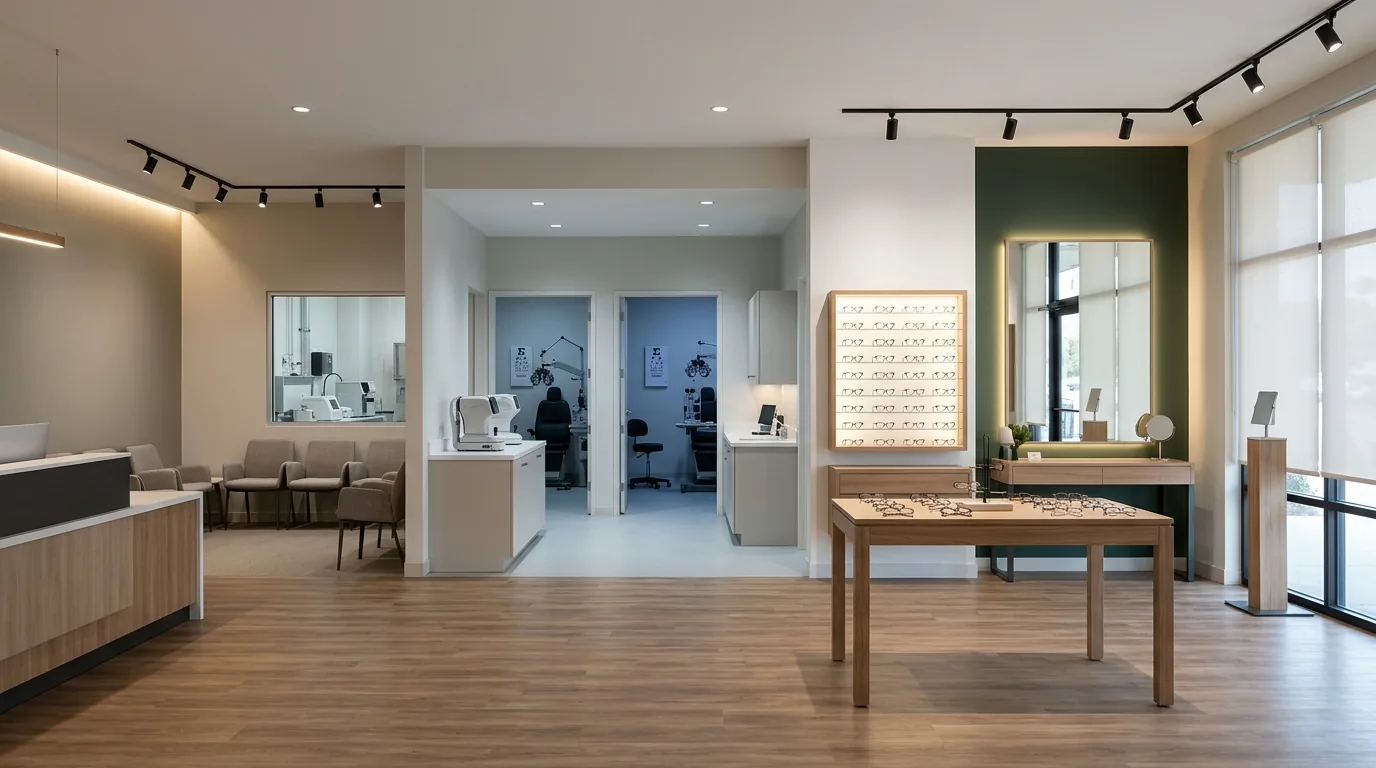
Quick Answer: An optometry office is two businesses sharing one floor plan: a clinic of exam lanes and pretesting on one side, and an optical retail dispensary selling frames and lenses on the other. The design challenge is to connect them with a smooth patient flow, check-in, pretest, exam lane, then optical, while keeping the clinical and retail experiences distinct. Exam lanes need controlled dimmable lighting and specific equipment power and data, while the optical area needs flattering retail lighting and display. Design the patient path first, then size the lanes to the doctor count and the optical to the frame inventory.
Clinic and Retail in One Space
What makes optometry distinct from a medical office is its dual nature. Half the practice is clinical, exam lanes, pretesting, and contact lens fitting, and half is retail, an optical dispensary where patients choose and buy eyewear. These two halves have different lighting, different finishes, and different emotional registers, and a good design lets them coexist without one feeling like an afterthought.
This is why an optometry office should not be designed as a generic medical suite with a frame rack added near the door. The optical dispensary is a real retail environment that drives a large share of revenue, and it deserves genuine commercial space planning attention to its display, lighting, and flow, while the clinical lanes are designed to medical standards. Balancing the two is the heart of optometry design.
The optical dispensary is not a waiting-room accessory, it is a profit center. Designing it as a real retail space, with proper frame display, mirrors, and flattering light, is as important as designing the exam lanes.
The Patient Flow
A well-designed optometry office moves a patient along a clear path that ends, naturally, in the optical dispensary. The typical flow is check-in and insurance, then pretesting, then an exam lane with the doctor, then, after the prescription, into optical for frame selection and dispensing. Designing this sequence so it flows forward, rather than sending patients back through the waiting room, both improves the experience and increases optical capture.
| Step | Space and Purpose |
|---|---|
| Check-in | Reception, insurance verification, waiting |
| Pretesting | Diagnostic equipment, often a dedicated alcove or room |
| Exam lane | Refraction and examination with the doctor |
| Contact lens area | Fitting, training, and dispensing |
| Optical dispensary | Frame selection, styling, lens options, sale |
| Edging lab (if in-house) | Lens cutting and finishing |
Routing the patient from the exam directly toward optical, rather than back to the lobby, is one of the highest-value moves in the layout. It treats the prescription as the start of the optical conversation, not the end of the visit, which is why the path between the exam lanes and the dispensary deserves deliberate design.
Designing the Exam Lanes
The exam lane is the clinical core, and its design is driven by the examination itself. A lane needs room for the exam chair, the instrument stand with the phoropter on an articulating arm, the doctor’s stool, and a clear sightline to the acuity chart at the proper testing distance, which in smaller lanes is achieved with a mirror. Crucially, exam lanes need controlled, dimmable lighting, because refraction and certain tests require low light, unlike the bright optical area a few steps away.
The number of lanes is set by the number of doctors and the practice’s growth plan. A common approach is to build at least two lanes per doctor so the doctor can move between a finishing patient and a ready one, keeping throughput high. Planning lane count for the practice’s future, not just today, avoids a costly re-fit when a second doctor joins. The clinical portion otherwise follows sound medical office layout principles for exam-room sizing, circulation, and accessibility.
The Optical Dispensary
The optical dispensary is where design and revenue meet. Frames are displayed on walls and tables, patients try them at mirrors, and a styling and dispensing area handles measurements, lens choices, and the sale. Good frame display uses even, flattering lighting and an organized, browsable arrangement, while the styling tables need task lighting and mirrors that show frames honestly.
Lighting tells the two halves apart. The optical area wants warm, even, flattering light that makes frames and faces look good, while the exam lanes want controlled, dimmable light for testing. Designing these lighting zones distinctly is essential to both selling and examining well.
The dispensary also needs a comfortable seated dispensing area for measurements and lens education, secure storage for inventory, and, if the practice finishes lenses in-house, an edging lab with the right power, water, and dust handling. Treating the optical area with real retail design discipline, not as leftover space, is what turns an eye exam into eyewear sales.
Technical and Equipment Needs
Optometry is equipment-dense, and the equipment dictates the infrastructure. Pretest instruments, the lanes, and an in-house lab all need specific power and data at specific locations, and some diagnostic devices have particular space or mounting needs. Getting the electrical and data design right for the equipment is one of the most important technical tasks, because relocating a circuit or a data drop after the cabinetry is built is costly.
| Need | Design Consideration |
|---|---|
| Exam-lane lighting control | Dimmable, often individually switched per lane |
| Equipment power and data | Located precisely for instruments and lanes |
| Acuity testing distance | Lane length or mirror system to achieve it |
| Edging lab (optional) | Power, water, dust handling, ventilation |
| Accessibility | ADA reception, restroom, and accessible lane |
Because so much of the cost and function is locked into the equipment plan, the practice’s instrument list should drive the construction documents. Designing the electrical, data, and casework around the actual equipment, rather than a generic template, is what makes the finished office work on opening day.
What an Optometry Buildout Costs
An optometry buildout falls in the mid-to-upper range of commercial interiors because it combines medical-grade exam lanes with a designed retail dispensary, plus equipment-driven electrical and data. The cost per square foot depends on the lane count, whether an in-house edging lab is included, the finish level of the optical area, and the starting condition of the space.
As with any tenant project, a second-generation medical or optical space with usable plumbing, power, and partitions costs less to adapt than a raw shell, and the landlord allowance offsets a meaningful share. Our breakdown of commercial buildout cost in 2026 shows how lane count and finishes flow into a number, and tenant improvement cost per square foot in Texas covers how the allowance reduces what the practice actually pays.
What We See in Texas Optometry Buildouts
When we design optometry offices across Texas, the practices that thrive are the ones that treated optical as a real store. We design the dispensary with proper frame display, styling mirrors, and flattering light, and we route the patient from the exam toward optical rather than back to the lobby, because that path is where a large share of revenue is won or lost.
The second pattern is lane planning for today instead of tomorrow. A practice that builds exactly the lanes it needs now often faces an expensive re-fit when a second doctor joins. We plan lane count and rough-in for the growth plan, so adding a doctor is a light change, not a renovation.
The third is equipment-driven infrastructure. Optometry lives and dies by where the power, data, and lighting controls land for each instrument and lane. We build the electrical and data design around the actual equipment list, because moving a circuit after the millwork is in is slow and costly.
The fourth is the lighting split. Exam lanes need controlled dimmable light while the optical area needs warm flattering light, and a layout that lights both the same way undermines both. We design the lighting as distinct zones so the clinic examines well and the dispensary sells well.
Key Takeaways
- An optometry office is a clinic and a retail store in one; design both halves with full intent, not the optical as an afterthought.
- Route the patient flow from check-in to pretest to exam lane to optical, ending in the dispensary to maximize eyewear capture.
- Exam lanes need controlled dimmable lighting, proper acuity testing distance, and equipment-specific power and data.
- Plan at least two lanes per doctor and rough in for growth so adding a doctor is not a full renovation.
- Design the optical dispensary as a true retail space with flattering light, frame display, styling mirrors, and secure inventory.
- Let the equipment list drive the electrical, data, and casework, and use the starting condition and landlord allowance to control cost.
Frequently Asked Questions
How many exam lanes should an optometry office have?
A common planning rule is at least two exam lanes per doctor, which lets the doctor move between a finishing patient and a ready one to keep throughput high. The right number depends on patient volume, the number of doctors, and the growth plan. Because adding lanes later can mean an expensive re-fit, it is wise to plan the lane count and rough in power, data, and lighting for the practice’s future rather than only its present, so bringing on a second doctor is a light change instead of a renovation.
Why do exam lanes need special lighting?
Refraction and several diagnostic tests are performed in low light, so exam lanes require controlled, dimmable lighting, often individually switched per lane. This is the opposite of the optical dispensary, which needs warm, even, flattering light to display frames and show faces honestly. Designing these as distinct lighting zones is essential: a layout that lights the clinic and the retail area the same way compromises both accurate examination and effective eyewear sales. Lighting design is one of the defining technical tasks in an optometry office.
How is an optometry office different from a medical office?
An optometry office combines a clinic and a retail store. Alongside exam lanes, pretesting, and contact lens fitting, it includes an optical dispensary that sells frames and lenses and drives a large share of revenue. That retail half needs genuine display, styling mirrors, and flattering lighting, while the clinical half follows medical exam-room standards with dimmable lighting and equipment-specific infrastructure. Designing the patient flow to move from the exam into optical, and treating the dispensary as a real store rather than leftover space, is what sets optometry design apart.
What drives the cost of an optometry buildout?
The main cost drivers are the number of exam lanes, whether an in-house edging lab is included, the finish level of the optical dispensary, and the equipment-driven electrical and data design. An optometry office sits in the mid-to-upper range of commercial interiors because it blends medical-grade lanes with a designed retail area. The starting condition matters most: a second-generation medical or optical space with usable plumbing, power, and partitions costs far less to adapt than a raw shell, and the landlord tenant improvement allowance offsets a meaningful share of the total.
Design an Optometry Office That Examines and Sells
The best optometry offices treat the clinic and the optical store as equals. Prestige 360 Design plans and designs optometry practices across Texas, sizing exam lanes for growth, engineering equipment-driven infrastructure, and designing the optical dispensary as a true retail space. Contact us to lay out a practice that flows from exam to eyewear.